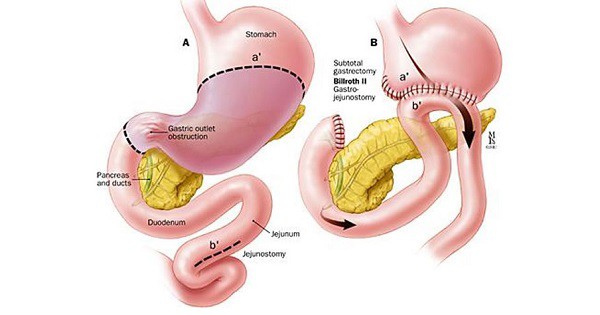
Gastric Outlet Obstruction
Which is the most common cause of gastric outlet obstruction in India?
| A |
Tuberculosis |
|
| B |
Cancer of stomach |
|
| C |
Duodenal lymphoma |
|
| D |
Peptic ulcer disease |
Which is the most common cause of gastric outlet obstruction in India?
| A |
Tuberculosis |
|
| B |
Cancer of stomach |
|
| C |
Duodenal lymphoma |
|
| D |
Peptic ulcer disease |
The most common cause of gastric outlet obstruction in developing and developed countries are distal gastric cancer.
25% of patients with pancreatic cancer can also present with gastric outlet obstruction.
Ref: Bailey and Love Short Practice of Surgery, 25th Edition, Pages 1065-66; Essentials of Emergency Medicine By Richard Aghababian, 2nd Edition, Page 55; General Surgery: Principles and International Practice By Kirby I. Bland, Volume 2, 2nd Edition, Page 526.
Which of the following is the site of gastric outlet obstruction in a patient with peptic ulcer disease?
| A |
Antrum |
|
| B |
Pylorus |
|
| C |
Pyloric canal |
|
| D |
Duodenum |
Which of the following is the site of gastric outlet obstruction in a patient with peptic ulcer disease?
| A |
Antrum |
|
| B |
Pylorus |
|
| C |
Pyloric canal |
|
| D |
Duodenum |
Gastric outlet obstruction is a complication of peptic ulcer disease. The most common site of gastric outlet obstruction in a peptic ulcer patient is the first part of duodenum, which is the most common site for a peptic ulcer.
Other complications include includes perforation and hemorrhage.
Peptic ulcers are defects in the gastrointestinal mucosa that extend through the muscularis mucosa.
It refers to ulcers in the stomach, duodenum or both. Majority of peptic ulcer occur due to H pylori or NSAIDs.
Gastric ulcer most commonly occur along the lesser curvature at the junction of the fundic and antral mucosa.
Most common location of duodenal ulcer is the duodenal bulb.
Ref: Surgery: Basic Science and Clinical Evidence By Jeffrey A. Norto, Pages 853-4; Nonprescription Product Therapeutics By W. Steven Pray, Page 100
Congenital hypertrophic pyloric stenosis is characterized by progressive gastric outlet obstruction. Incidence of congenital hypertrophic pyloric stenosis is highest in:
| A |
First female baby |
|
| B |
First male baby |
|
| C |
Second male baby |
|
| D |
Second female baby |
Congenital hypertrophic pyloric stenosis is characterized by progressive gastric outlet obstruction. Incidence of congenital hypertrophic pyloric stenosis is highest in:
| A |
First female baby |
|
| B |
First male baby |
|
| C |
Second male baby |
|
| D |
Second female baby |
Hypertrophic pyloric stenosis (HPS) is postnatal muscular hypertrophy of the pylorus.
HPS occurs in approximately 1–8 per 1000 births and originally was believed to occur in first-born males between 3 and 6 weeks of age.

In gastric outlet obstruction in a peptic ulcer patient, the site of obstruction is most likely to be-
| A |
Antrum |
|
| B |
Duodenum |
|
| C |
Pylorus |
|
| D |
All |
In gastric outlet obstruction in a peptic ulcer patient, the site of obstruction is most likely to be-
| A |
Antrum |
|
| B |
Duodenum |
|
| C |
Pylorus |
|
| D |
All |
Ans. is ‘b’ i.e., Duodenum
- Bailey writes – “The term ‘pyloric stenosis’ is a misnomer. The stenosis is seldom at the pylorus. Commonly, when the condition is due to underlying peptic ulcer disease, the stenosis is found in the first part of the duodenum, the most common site for a peptic ulcer.”
- Also know
- There are 2 common causes of gastric outlet obstruction
– pyloric stenosis secondary to peptic ulcer
– gastric cancer
– Earlier peptic ulcer was the most common cause, but now the most common cause of gastric outlet obstruction is —> gastric cancer.
Which is Not true regarding gastric outlet obstruction
| A |
Hypokalemia |
|
| B |
Hypochloremia |
|
| C |
Alkaline urine |
|
| D |
Metabolic alkalosis |
Which is Not true regarding gastric outlet obstruction
| A |
Hypokalemia |
|
| B |
Hypochloremia |
|
| C |
Alkaline urine |
|
| D |
Metabolic alkalosis |
Ans is ‘c’ ie Alkaline urine
The most common cause of gastric outlet obstruction in India is
| A |
Tuberculosis |
|
| B |
Cancer of stomach |
|
| C |
Duodenal lymphoma |
|
| D |
Peptic ulcer disease |
The most common cause of gastric outlet obstruction in India is
| A |
Tuberculosis |
|
| B |
Cancer of stomach |
|
| C |
Duodenal lymphoma |
|
| D |
Peptic ulcer disease |
Ans. is ‘b’ i.e. Cancer of stomach
Ca stomach is now the most common cause of gastric outlet obstruction in world as well as in India.
The two most common causes of gastric outlet obstruction are gastric cancer and pyloric stenosis secondary to peptic ulceration. With the presence of potent anti-ulcer drugs, gastric cancer is now the most common cause, and any gastric outlet obstruction should be considered malignant until proven otherwise.
Commonest operation done for peptic ulcer with gastric outlet obstruction is –
| A |
Truncal vagotomy with pyloroplasty |
|
| B |
Highly selective vagotomy with pyloroplasty |
|
| C |
Truncal vagotomy with gastrojejunostomy |
|
| D |
Gastrojejunostomy |
Commonest operation done for peptic ulcer with gastric outlet obstruction is –
| A |
Truncal vagotomy with pyloroplasty |
|
| B |
Highly selective vagotomy with pyloroplasty |
|
| C |
Truncal vagotomy with gastrojejunostomy |
|
| D |
Gastrojejunostomy |
Ans. is ‘c’ i.e., Truncal Vagotomy with gastrojejunostomy
Gastric outlet obstruction due to peptic ulcer can develop either acutely or chronically.
Acute obstruction
Is due to edema and inflammation..
Acute gastric outlet obstruction is treated by nasogastric suction, rehydration, and intravenous
administration of antisecretory agents. Acute obstruction due to pyloric inflammation resolves with
supportive measures within 72 hours.
Chronic obstruction
Repeated episodes of ulceration can lead to pyloric scarring and a fixed stenosis with chronic gastric
outlet obstruction.
Surgery for duodenal ulcer:
– Truncal vagotomty with antrectomy (surgery of choice)
– Truncal vagotomy with gastrojejunostomy
– Surgery for gastric ulcer
– Distal gastrectomy
For a patient of Gastric outlet obstruction, the OPD fluid management is –
| A |
Normal saline |
|
| B |
Hypertonic saline |
|
| C |
Na bicarbonate to counteract aciduria |
|
| D |
Hypotonic saline without potassium |
For a patient of Gastric outlet obstruction, the OPD fluid management is –
| A |
Normal saline |
|
| B |
Hypertonic saline |
|
| C |
Na bicarbonate to counteract aciduria |
|
| D |
Hypotonic saline without potassium |
Ans : ‘a’ i.e. Normal saline
About fluid management of patients with gastric outlet obstruction Schwartz & Sabiston writes
Acute treatment of hypokalemic alkalosis includes administration of large amounts of sodium chloride-containing solutions (i.e. Normal saline) and once diuresis is established, potassium is added until the serum potassium level is increased. This will also correct the serum bicarbonate level.
In gastric outlet obstruction in a peptic ulcer patient the site of obstruction is most likely to be :
| A |
Antrum |
|
| B |
Duodenum |
|
| C |
Pylorus |
|
| D |
Pyloric canal |
In gastric outlet obstruction in a peptic ulcer patient the site of obstruction is most likely to be :
| A |
Antrum |
|
| B |
Duodenum |
|
| C |
Pylorus |
|
| D |
Pyloric canal |
Answer is B (Duodenum)
Gastric outlet obstruction in a patient with peptic ulcer disease is suggestive of pyloric stenosis. The term pyloric stenosis is normally a misnomer. The stenosis is seldom at the pylorus.
Commonly the stenosis is found in the first part of the duodenum, the most common site for a peptic ulcer.
Commonest operation done for gastric outlet obstruction with peptic ulcer is:
March 2007
| A |
Truncal vagotomy with gastrojejunostomy |
|
| B |
Truncal vagotomy with gastrojejunostomy |
|
| C |
Highly selective vagotomy with pyloroplasty |
|
| D |
Gastrojejunostomy |
Commonest operation done for gastric outlet obstruction with peptic ulcer is:
March 2007
| A |
Truncal vagotomy with gastrojejunostomy |
|
| B |
Truncal vagotomy with gastrojejunostomy |
|
| C |
Highly selective vagotomy with pyloroplasty |
|
| D |
Gastrojejunostomy |
Ans. A: Truncal vagotomy with gastrojejunostomy
Gastric outlet obstruction is manifested by obstruction at the level of the pylorus, which is the outlet of the stomach. Patients may develop vomiting, which may be projectile but non-bilious in nature, nausea or abdominal pain. An unusual finding that may lead to the diagnosis is the succussion splash, a splash-like sound heard over the stomach in the left upper quadrant of the abdomen on shaking the patient, with or without the stethoscope.
The diagnosis is typically made by X-ray, which will show an absent air bubble in the stomach, or by CT scan.
Causes of gastric outlet obstruction include peptic ulcer disease; tumours of the stomach, including adenocarcinoma (and its linitis plastica variant), lymphoma, and gastrointestinal stromal tumours; infections, such as tuberculosis; and infiltrative diseases, such as amyloidosis.
Metabolic alkalosis may develop as a result of loss of acid.
Traditionally severe cases of Gastric outlet obstruction are treated usually by a gastroenterostomy rather than a pyloroplasty. Truncal vagotomy leads to reduction of the maximal acid output by 50% as vagus nerves are sectioned which critically controls the secretion of gastric acid.