GLOSSOPHARYNGEAL NERVE
During Tonsillitis, pain in the ear is due to involvement of?
| A |
Vagus Nerve |
|
| B |
Chorda tympani Nerve |
|
| C |
Glossopharyngeal Nerve |
|
| D |
Hypoglossal Nerve |
During Tonsillitis, pain in the ear is due to involvement of?
| A |
Vagus Nerve |
|
| B |
Chorda tympani Nerve |
|
| C |
Glossopharyngeal Nerve |
|
| D |
Hypoglossal Nerve |
NERVE SUPPLY OF TONSILS
- Lesser palatine branches of sphenopalatine ganglion & Glossopharyngeal N (major supply)
- Glossopharyngeal nerve also gives sensory supply to middle ear.
- Pain from the tonsils can be referred to middle ear along Glossopharyngeal nerve.
Nerve supply of circumvallate papillae is:
| A |
Hypoglossal nerve |
|
| B |
Glossopharyngeal nerve |
|
| C |
Lingual nerve |
|
| D |
Chorda tympani |
Nerve supply of circumvallate papillae is:
| A |
Hypoglossal nerve |
|
| B |
Glossopharyngeal nerve |
|
| C |
Lingual nerve |
|
| D |
Chorda tympani |
Circumvallate papilla is one of the large papillae near the base on the dorsal aspect of the tongue arranged in a criteria used at term. The vast majority of fetuses with V-shape. The taste buds are located in the epithelium of the trench surrounding the papilla. Motor nerve supply of tongue: All the intrinsic and extrinsic muscles of the tongue are supplied by the hypoglossal nerve except the palatoglossus muscle which is supplied by the cranial part of the accessory nerve through the pharyngeal plexus.
Glossopharyngeal nerve is both general sensory and special sensory to the posterior 1/3rd of the tongue. Posterior most part of the tongue is supplied by the internal laryngeal nerve which is a branch of vagus nerve.
Referred pain from tonsil to middle ear is due to:
| A |
Glossopharyngeal nerve |
|
| B |
Greater auricular nerve |
|
| C |
Auriculotemporal nerve |
|
| D |
Chorda tympani nerve |
Referred pain from tonsil to middle ear is due to:
| A |
Glossopharyngeal nerve |
|
| B |
Greater auricular nerve |
|
| C |
Auriculotemporal nerve |
|
| D |
Chorda tympani nerve |

Which of the following statement regarding the sensory nerve supply of pharyngeal mucous membrane is TRUE?
| A |
Nasopharynx is supplied by the maxillary nerve |
|
| B |
Glossopharyngeal nerve innervates the oral pharynx |
|
| C |
Laryngeal pharynx is supplied by the internal laryngeal branch of vagus nerve |
|
| D |
All of the above |
Which of the following statement regarding the sensory nerve supply of pharyngeal mucous membrane is TRUE?
| A |
Nasopharynx is supplied by the maxillary nerve |
|
| B |
Glossopharyngeal nerve innervates the oral pharynx |
|
| C |
Laryngeal pharynx is supplied by the internal laryngeal branch of vagus nerve |
|
| D |
All of the above |
Which of the following nerve carries taste sensations from the posterior 1/3rd of tongue?
| A |
Glossopharyngeal |
|
| B |
Lingual |
|
| C |
Chorda tympani |
|
| D |
Vagus |
Which of the following nerve carries taste sensations from the posterior 1/3rd of tongue?
| A |
Glossopharyngeal |
|
| B |
Lingual |
|
| C |
Chorda tympani |
|
| D |
Vagus |
The sensory nerve fibers from the taste buds on the anterior two-thirds of the tongue travel in the chorda tympani branch of the facial nerve, and those from the posterior third of the tongue reach the brainstem via the glossopharyngeal nerve. The fibers from areas other than the tongue (eg, pharynx) reach the brain stem via the vagus nerve.On each side, these nerves unite in the gustatory portion of the nucleus of the solitary tract (NTS) in the medulla oblongata. From there, axons of second-order neurons ascend in the ipsilateral medial lemniscus and project directly to the ventral posteromedial nucleus of the thalamus.From the thalamus, the axons of the third-order neurons pass to neurons in the anterior insula and the frontal operculum in the ipsilateral cerebral cortex.
Sensory supply to tongue is by all, EXCEPT?
| A |
Lingual nerve |
|
| B |
Vagus nerve |
|
| C |
Glossopharyngeal nerve |
|
| D |
None of the above |
Sensory supply to tongue is by all, EXCEPT?
| A |
Lingual nerve |
|
| B |
Vagus nerve |
|
| C |
Glossopharyngeal nerve |
|
| D |
None of the above |
The sensory innervation of the tongue reflects its embryological development. The nerve of general sensation to the presulcal part is the lingual nerve, which also carries taste sensation derived from the chorda tympani branch of the facial nerve. The nerve supplying both general and taste sensation to the postsulcal part is the glossopharyngeal nerve. An additional area in the region of the valleculae is supplied by the internal laryngeal branch of the vagus nerve.
Which of the following cranial nerve travels through the jugular foramen in the base of the skull?
| A |
3rd branch of trigeminal nerve |
|
| B |
Abducens nerve |
|
| C |
Facial nerve |
|
| D |
Glossopharyngeal nerve |
Which of the following cranial nerve travels through the jugular foramen in the base of the skull?
| A |
3rd branch of trigeminal nerve |
|
| B |
Abducens nerve |
|
| C |
Facial nerve |
|
| D |
Glossopharyngeal nerve |
The Glossopharyngeal nerve supplies the posterior part of the tongue because it develops from the
| A |
Hyoid arch |
|
| B |
Tuberculum impar |
|
| C |
Mandibular arch |
|
| D |
Hypobranchial eminence |
The Glossopharyngeal nerve supplies the posterior part of the tongue because it develops from the
| A |
Hyoid arch |
|
| B |
Tuberculum impar |
|
| C |
Mandibular arch |
|
| D |
Hypobranchial eminence |
D i.e. Hypobranchial eminence
– Tongue muscles originate from myoblast of occipital somitesQ. Thus tongue musculature is innervated by hypoglossal nerve.
– Glossopharyngeal (9th) nerve supplies posterior (1/3) part of tongue because it develops from hypobrachial eminence (copula).
Parathyroid glands develop from 4th (superior) & 3rd (inferior para thyroid glands) pharyngeal endodermal pouch.
Correct statement(s) about tongue is/are:
| A |
Facial nerve supplies fungi from papillae |
|
| B |
Glossopharyngeal nerve supplies circumvallate papillae |
|
| C |
Genioglossus is the safety muscle |
|
| D |
All |
Correct statement(s) about tongue is/are:
| A |
Facial nerve supplies fungi from papillae |
|
| B |
Glossopharyngeal nerve supplies circumvallate papillae |
|
| C |
Genioglossus is the safety muscle |
|
| D |
All |
Ans. A i.e. Facial nerve supplies fungi from papillae; B i.e. Glossopharyngeal nerve supplies circumvallate papillae ; C i.e. Genioglossus is the safety muscle
– anterior 2/3 of tongue is supplied by chorda tympani branch of facial nerveQ (carrying taste sensation) & lingual nerveQ (carrying general sensation); posterior 1/3 of tongue is supplied by glossopharyngeal nerveQ (carrying taste & general sensation both); and posterior most tongue in the region of valleculae is supplied by internal laryngeal branch of vagus nerveQ
– Except palatoglossus (extrinsic muscle) all muscles of tongue (i.e. all intrinsic muscles eg bilateral superior & inferior longitudinal, transverse & vertical and 3 pairs of extrinsic muscles i.e. genioglossus, hypoglossus & styloglossus/ chondroglossus) are supplied by lzypoglossal nerveQ
Hypoglossal nerve has only motor (but no sensory) supply to tongueQ, so injury to it can not lead to loss of taste or general sensationQ. Injury to hypoglossal nerve present with pure motor tongue features such as ipsilateral muscular
All of the following nerves supply auricle and extrernal meatus except:
| A |
Trigeminal nerve |
|
| B |
Glossopharyngeal nerve |
|
| C |
Facial nerve |
|
| D |
Vagus nerve |
All of the following nerves supply auricle and extrernal meatus except:
| A |
Trigeminal nerve |
|
| B |
Glossopharyngeal nerve |
|
| C |
Facial nerve |
|
| D |
Vagus nerve |
Which of the following nerves has no sensory supply to the auricle?
| A |
Lesser occipital nerve |
|
| B |
Greater auricular nerve |
|
| C |
Auricular branch of vagus nerve |
|
| D |
Tympanic branch of glossopharyngeal nerve |
Which of the following nerves has no sensory supply to the auricle?
| A |
Lesser occipital nerve |
|
| B |
Greater auricular nerve |
|
| C |
Auricular branch of vagus nerve |
|
| D |
Tympanic branch of glossopharyngeal nerve |
Sensory nerve supply of middle ear cavity is provided by:
| A |
Facial |
|
| B |
Glossopharyngeal |
|
| C |
Vagus |
|
| D |
Trigeminal |
Sensory nerve supply of middle ear cavity is provided by:
| A |
Facial |
|
| B |
Glossopharyngeal |
|
| C |
Vagus |
|
| D |
Trigeminal |
- The nerve supply of middle ear is derived from tympanic plexus which lies over the promontory.
- The inferior ganglion of the glossopharyngeal nerve gives off the tympanic nerve which enters the middle ear through the tympanic canaliculus and takes part in formation of the tympanic plexus on the medial wall of middle ear.
- This distributes it fibres to the middle ear, and also to the auditory tube, aditus ad atrum mastoideum (aditus to mastoid antrum).
- Glossopharyngeal nerve —> Tympanic nerve/tympanic plexus —> Auditory tube
Muscle supplied by glossopharyngeal nerve:
| A |
Platysma |
|
| B |
Stylopharyngeus |
|
| C |
Styloglossus |
|
| D |
Genioglossus |
Muscle supplied by glossopharyngeal nerve:
| A |
Platysma |
|
| B |
Stylopharyngeus |
|
| C |
Styloglossus |
|
| D |
Genioglossus |
Stylopharyngeus is the only muscle in the pharynx innervated by the glossopharyngeal nerve (CN IX) and is done by its motor branch, which supplies special visceral efferent (SVE) fibers to it.
Sensory nerve supply of the palatine tonsils is by
| A |
Greater Palatine nerve |
|
| B |
Trigeminal nerve |
|
| C |
Glossopharyngeal nerve |
|
| D |
Facial nerve |
Sensory nerve supply of the palatine tonsils is by
| A |
Greater Palatine nerve |
|
| B |
Trigeminal nerve |
|
| C |
Glossopharyngeal nerve |
|
| D |
Facial nerve |
Glossopharyngeal and lesser palatine nerves supply palatine tonsil
Palatine tonsil
- The Palatine tonsils are two prominent masses situated one on either side between the glossopalatine and pharyngopalatine arches.
- Each tonsil consists fundamentally of an aggregation of lymphoid tissue underlying the mucous membrane between the palatine arches.
- In the child the tonsils are relatively (and frequently absolutely) larger than in the adult
- The follicles of the tonsil are lined by a continuation of the mucous membrane of the pharynx, covered with stratified squamous epithelium
Arteries supplying the tonsil are the:
- Dorsalis linguae from the lingual
- The ascending palatine and tonsillar from the external maxillary
- The ascending pharyngeal from the external carotid
- The descending palatine branch of the internal maxillary
- A twig from the small meningeal.
- The veins end in the tonsillar plexus, on the lateral side of the tonsil
- The nerves are derived from the sphenopalatine ganglion, and from the glossopharyngeal.
Contents of jugular foramen are?

| A |
Glossopharyngeal nerve |
|
| B |
vagus nerve |
|
| C |
Accessory nerve |
|
| D |
All the above |
Contents of jugular foramen are?
| A |
Glossopharyngeal nerve |
|
| B |
vagus nerve |
|
| C |
Accessory nerve |
|
| D |
All the above |
The glossopharyngeal nerve, the vagus nerve and the accessory nerve, so cranial nerves IX, X and XI pass through the jugular foramen. That’s four structures to remember. You’ve got cranial nerves IX, X and XI and you’ve got the internal jugularvein.
Which of the following cranial nerve travels through this structure(marked with blue) in the base of the skull?

| A |
3rd branch of trigeminal nerve |
|
| B |
Abducens nerve |
|
| C |
Facial nerve |
|
| D |
Glossopharyngeal nerve |
Which of the following cranial nerve travels through this structure(marked with blue) in the base of the skull?
| A |
3rd branch of trigeminal nerve |
|
| B |
Abducens nerve |
|
| C |
Facial nerve |
|
| D |
Glossopharyngeal nerve |
Ans;D).Glossopharyngeal nerve
Markesd stucture is Jugular Foramen
Glossopharyngeal nerve travel through the middle compartment of the jugular foramen. Jugular foramen is formed by the petrous portion of the temporal and occipital bones.
Jugular Foramen:
1. Anterior part: Inferior Petrosal Sinus
2. Middle part:
- a. CN IX (Glossopharyngeal nerve)
- b. CN X (Vagus nerve)
- c. CN XI (Accesory nerve)
- d. Meningeal branch of Ascending Pharyngeal Artery
3. Posterior part:
- a. Internal Jugular vein (IJV) – Sigmoid sinus junction
- b. Emissary vein (Sigmoid sinus to occipital vein)
- c. Occipital artery
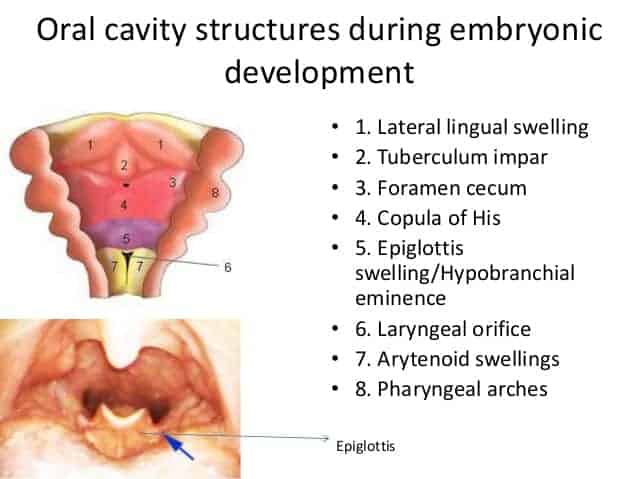
Identify the structure represented as number “5” in the picture below?

| A |
Hyoid arch. |
|
| B |
Tuberculum impar. |
|
| C |
Mandibular arch. |
|
| D |
Hypobranchial eminence. |
Identify the structure represented as number “5” in the picture below?
| A |
Hyoid arch. |
|
| B |
Tuberculum impar. |
|
| C |
Mandibular arch. |
|
| D |
Hypobranchial eminence. |
Ans:D.)Hypobranchial Eminence.
The structure marked as number “5” (Red arrow) in the picture above represents the Hypobranchial Eminence.
- The hypopharyngeal eminence or hypobranchial eminence is a midline swelling of the third and fourth pharyngeal arches, in the development of the tongue.
- It appears in the fifth and sixth weeks of embryogenesis.
- The hypopharyngeal eminence forms mostly from the endoderm of the third pharyngeal arch and only partially from the fourth pharyngeal arch.
- It quickly grows to cover the copula formed earlier from the second pharyngeal arch, and will form the posterior one third of the tongue.