Hanging- Types, Causes of Death, Postmortem Findings and Medicolegal Importance
Hanging is established by :
| A |
Fracture of hyoid cartilage |
|
| B |
Fracture of thyroid cartilage |
|
| C |
Staining of saliva |
|
| D |
All |
Hanging is established by :
| A |
Fracture of hyoid cartilage |
|
| B |
Fracture of thyroid cartilage |
|
| C |
Staining of saliva |
|
| D |
All |
C i.e. Staining of saliva
Hanging causes large amount of injury to:
| A |
Vertebral artery |
|
| B |
Carotid A |
|
| C |
Trachea |
|
| D |
Oesophagus |
Hanging causes large amount of injury to:
| A |
Vertebral artery |
|
| B |
Carotid A |
|
| C |
Trachea |
|
| D |
Oesophagus |
B i.e. Carotid artery
Reddy’s Essentials of forensic medicine & toxicology 23/e P-287 – Injury to trachea is unusual & intima of carotid artery show transverse splits with extravasation of blood.
Parikh 6/e P-3.40 – Jugular veins are occluded by 2 kg tension, carotids by 3.5 kg, trachea by 15 kg, vertebral arteries by 16.6 kg. So amount & chances of injury is also in same order
Hanging with the feet touching the ground is seen in:
| A |
Partial hanging |
|
| B |
Complete hanging |
|
| C |
Homicidal hanging |
|
| D |
Suicidal hanging |
Hanging with the feet touching the ground is seen in:
| A |
Partial hanging |
|
| B |
Complete hanging |
|
| C |
Homicidal hanging |
|
| D |
Suicidal hanging |
A i.e. Partial hanging

Hanging is defined as :
| A |
Suspension of body a ligature, body weight acting as constricting force |
|
| B |
Suspension of body by ligature after death |
|
| C |
Obliteration of air passages by external compression |
|
| D |
Mechanical interference to respiration |
Hanging is defined as :
| A |
Suspension of body a ligature, body weight acting as constricting force |
|
| B |
Suspension of body by ligature after death |
|
| C |
Obliteration of air passages by external compression |
|
| D |
Mechanical interference to respiration |
A i.e. Suspension of body, body weight acting as constricting force
When a person has suspended himself by applying ligature around neck so that the point of suspension (knot) is situated in the region of the occiput. Such a hanging is called as:
| A |
Typical |
|
| B |
Atypical |
|
| C |
Partial |
|
| D |
Incomplete |
When a person has suspended himself by applying ligature around neck so that the point of suspension (knot) is situated in the region of the occiput. Such a hanging is called as:
| A |
Typical |
|
| B |
Atypical |
|
| C |
Partial |
|
| D |
Incomplete |
A i.e. Typical Hanging
The “Knot” in judicial hanging is placed at
| A |
The back of the neck |
|
| B |
The side of the neck |
|
| C |
Below the chin |
|
| D |
Choice of hangman |
The “Knot” in judicial hanging is placed at
| A |
The back of the neck |
|
| B |
The side of the neck |
|
| C |
Below the chin |
|
| D |
Choice of hangman |
B i.e. Side of the neck
Transverse tear in intima of carotid arteries may be seen in:
March 2003
| A |
Partial hanging |
|
| B |
Judicial hanging |
|
| C |
Bansdola |
|
| D |
Garroting |
Transverse tear in intima of carotid arteries may be seen in:
March 2003
| A |
Partial hanging |
|
| B |
Judicial hanging |
|
| C |
Bansdola |
|
| D |
Garroting |
Ans. B i.e. Judicial hangin
In simple hanging, the knot comes to rest at the:
September 2009
| A |
Occiput |
|
| B |
Chin |
|
| C |
Angle of mandible |
|
| D |
Below the cheek |
In simple hanging, the knot comes to rest at the:
September 2009
| A |
Occiput |
|
| B |
Chin |
|
| C |
Angle of mandible |
|
| D |
Below the cheek |
Ans. C: Angle of mandible
In most hanging deaths, the ligature and ligature mark lie above the thyroid prominence, with a point of suspension usually behind one ear.
Frontal knots are unusual.
The appearance of the ligature mark varies with the type of ligature used and with the physical characteristics of the individual neck. Soft broad ligatures may not leave any recognizable marks. In most cases, the ligature does not completely encii le the neck.
‘La facies sympathique’ is a condition seen in cases of:
NEET 13; COMEDK 13
| A |
Hanging |
|
| B |
Strangulation |
|
| C |
Throttling |
|
| D |
Railway accidents |
‘La facies sympathique’ is a condition seen in cases of:
NEET 13; COMEDK 13
| A |
Hanging |
|
| B |
Strangulation |
|
| C |
Throttling |
|
| D |
Railway accidents |
Ans. Hanging
Following is most suggestive of antemortem hanging:
DNB 09
| A |
Salivary dribbling |
|
| B |
Congestion of lungs |
|
| C |
Ligature marks |
|
| D |
Petechial hemorrhages |
Following is most suggestive of antemortem hanging:
DNB 09
| A |
Salivary dribbling |
|
| B |
Congestion of lungs |
|
| C |
Ligature marks |
|
| D |
Petechial hemorrhages |
Ans. Salivary dribbling
Hanging causes injury to:
JIPMER 14
| A |
Carotid artery |
|
| B |
Esophagus |
|
| C |
Trachea |
|
| D |
Vertebral artery |
Hanging causes injury to:
JIPMER 14
| A |
Carotid artery |
|
| B |
Esophagus |
|
| C |
Trachea |
|
| D |
Vertebral artery |
Ans. Carotid artery
Lynching is a type of:
AFMC 11; FMGE 13
| A |
Homicidal hanging |
|
| B |
Suicidal hanging |
|
| C |
Judicial hanging |
|
| D |
Accidental hanging |
Lynching is a type of:
AFMC 11; FMGE 13
| A |
Homicidal hanging |
|
| B |
Suicidal hanging |
|
| C |
Judicial hanging |
|
| D |
Accidental hanging |
Ans. Homicidal hanging
Outward displacement of fractured hyoid bone is seen in:
UP 10
| A |
Manual strangulation |
|
| B |
Ligature strangulation |
|
| C |
Hanging |
|
| D |
Bansdola |
Outward displacement of fractured hyoid bone is seen in:
UP 10
| A |
Manual strangulation |
|
| B |
Ligature strangulation |
|
| C |
Hanging |
|
| D |
Bansdola |
Ans. Hanging
In a case of hanging, ligature mark is an example of:
NEET 13
| A |
Contusion |
|
| B |
Pressure abrasion |
|
| C |
Laceration |
|
| D |
Burn |
In a case of hanging, ligature mark is an example of:
NEET 13
| A |
Contusion |
|
| B |
Pressure abrasion |
|
| C |
Laceration |
|
| D |
Burn |
Ans. Pressure abrasion
What is the situation of the knot of ligature in cases of typical hanging‑
| A |
In front of chin |
|
| B |
Angle of mandible |
|
| C |
Occiput |
|
| D |
Mastoid |
What is the situation of the knot of ligature in cases of typical hanging‑
| A |
In front of chin |
|
| B |
Angle of mandible |
|
| C |
Occiput |
|
| D |
Mastoid |
Ans. is ‘c’ i.e., Occiput
Typical hanging : The ligature runs from the midline above the thyroid cartilage, symmetrically upward on both side of neck to the occipital region, the point of suspension (knot of ligature) being on occiput (at nape of neck).
Atypical hanging : Any variation from typical knot site (i.e. other than occiput/nape of neck) is called atypical hanging. Most common site of knot is near one side of mastoid process or angle of mandible.
Ligature material in case of hanging is kept preserved as ‑
| A |
Ligature knot is opened completely |
|
| B |
Ligature is cut at the knot? |
|
| C |
Ligature is cut away from the knot |
|
| D |
Ligature knot is loosened |
Ligature material in case of hanging is kept preserved as ‑
| A |
Ligature knot is opened completely |
|
| B |
Ligature is cut at the knot? |
|
| C |
Ligature is cut away from the knot |
|
| D |
Ligature knot is loosened |
Ans. is ‘c’ i.e., Ligature is cut away from the knot
For removal and preservation of the ligature from the dead body in case of hanging it is cut away from the knot and the cut ends are tied with string or wire.
Judicial Hanging causes
| A |
C2-3 fracture dislocation |
|
| B |
C4-5 fracture dislocation |
|
| C |
C6-7 Fracture dislocation |
|
| D |
None of the above |
Judicial Hanging causes
| A |
C2-3 fracture dislocation |
|
| B |
C4-5 fracture dislocation |
|
| C |
C6-7 Fracture dislocation |
|
| D |
None of the above |
Ans. is ‘a’ i.e., C2-3 fracture dislocation
Judicial hanging
In india, legal death sentence is carried out by hanging the criminal. Placement of knot beneath the chin (submental position) is thought to be most effective, ensuring a quicker death. However some prefer side of neck (left sub aural i.e. below angle of jaw) knot.
The preson is allowed to drop for 5-7 meters according to the weight, age and build of the person. Sudden stop causes fracture dislocation usually at level of C2-C3 or C3-C4 vertebra, and injury to spinal cord and brainstem (pons and medulla).
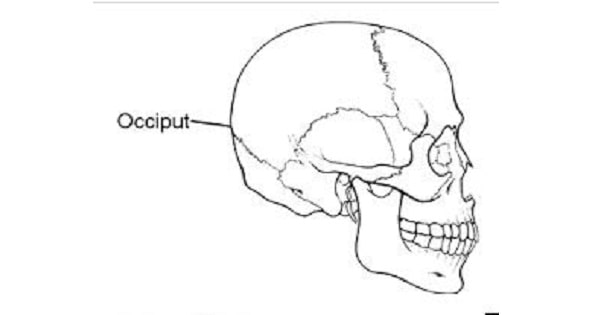
When a person has suspended himself by applying ligature around neck so that the point of suspension (knot) is situated in the region shown in the picture below.Such a hanging is called as ? 
| A |
Typical. |
|
| B |
Atypical. |
|
| C |
Partial. |
|
| D |
Incomplete. |
When a person has suspended himself by applying ligature around neck so that the point of suspension (knot) is situated in the region shown in the picture below.Such a hanging is called as ?
| A |
Typical. |
|
| B |
Atypical. |
|
| C |
Partial. |
|
| D |
Incomplete. |
Hanging is best defined as the constriction of neck by a ligature tightened by the weight of the body. When the point of suspension is over the center of occiput, there is a maximum possibility of occlusion of the arteries and this is known as typical hanging as shown in the picture above., while all other points of suspension are called atypical hanging.