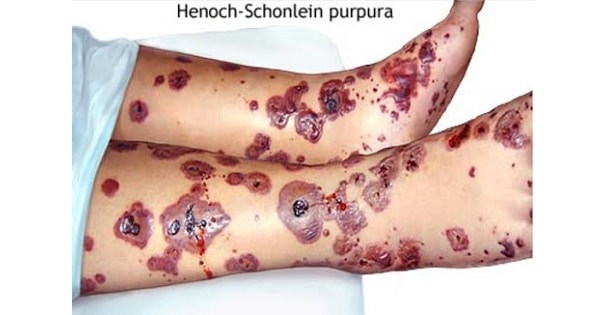
Henoch Schonlein Purpura
| A | IgG | |
| B |
Ig A |
|
| C | IgM | |
| D |
IgE |
| A | IgG | |
| B |
Ig A |
|
| C | IgM | |
| D |
IgE |
Ig A REF: Harrison’s 17th ed chapter 319, CURRENT Medical Diagnosis & Treatment Chapter 20. Musculoskeletal & Immunologic Disorders
Henoch-Schonlein purpura, the most common systemic vasculitis in children, occurs in adults as well. Typical features are palpable purpura, abdominal pain, arthritis, and hematuria. Pathologic features include leukocytoclastic vasculitis with IgA deposition. The cause is not known.
Cresentic Glomerulonephritis may be seen in all of the following, except:
| A |
Post Streptococcal Glomerulonephritis (PSGN) |
|
| B |
Henoch Schonlein Purpura (HSP) |
|
| C |
Anti Basement Membrane Disease |
|
| D |
Alport Syndrome |
Cresentic Glomerulonephritis may be seen in all of the following, except:
| A |
Post Streptococcal Glomerulonephritis (PSGN) |
|
| B |
Henoch Schonlein Purpura (HSP) |
|
| C |
Anti Basement Membrane Disease |
|
| D |
Alport Syndrome |
Alports syndrome is not associated with rapidly progressive Glomerulonephritis or Cresentic Glomerulonephritis.
Ref: Robbin’s Illustrated Pathology, 7th Edition, Page 977; Harrison’s Principles of Internal Medicine, 17th Edition, Page 1785
A 24 year old male presents with abdominal pain, rashes, palpable purpura and, arthritis. The most probable diagnosis is:
| A |
Henoch Schonlein Purpura (HSP) |
|
| B |
Sweet syndrome |
|
| C |
Meningococcemia |
|
| D |
Hemochromatosis |
A 24 year old male presents with abdominal pain, rashes, palpable purpura and, arthritis. The most probable diagnosis is:
| A |
Henoch Schonlein Purpura (HSP) |
|
| B |
Sweet syndrome |
|
| C |
Meningococcemia |
|
| D |
Hemochromatosis |
The above mentioned clinical features are the classic presentation of HSP. So Henoch Schonlein Purpura is the single best answer of choice.
Ref: Harrison’s Principles of Internal Medicine, 16th Edition, Page 2010
All of the following conditions are associated with palpable purpura, EXCEPT:
| A |
Giant cell arteritis |
|
| B |
Henoch Schonlein Purpura |
|
| C |
Wegner granulomatosis |
|
| D |
Polyarteritis nodosa |
All of the following conditions are associated with palpable purpura, EXCEPT:
| A |
Giant cell arteritis |
|
| B |
Henoch Schonlein Purpura |
|
| C |
Wegner granulomatosis |
|
| D |
Polyarteritis nodosa |
Differential diagnosis of palpable purpura includes Henoch-Schonlein purpura (HSP), cryoglobulinemia or cryofibrinogenemia, polyarteritis nodosa (PAN), Wegener’s granulomatosis, infections, and collagen vascular disorders.
Giant cell arteritis being a large vessel vasculitis does not cause any purpura.
Henoch Schonlein purpura presents with deposition of:
| A |
IgG |
|
| B |
IgA |
|
| C |
IgM |
|
| D |
IgE |
Henoch Schonlein purpura presents with deposition of:
| A |
IgG |
|
| B |
IgA |
|
| C |
IgM |
|
| D |
IgE |
Henoch-Schonlein purpura, the most common systemic vasculitis in children. Typical features are palpable purpura, abdominal pain, arthritis, and hematuria.
Direct immunofluorescence of the skin lesions demonstrates immunoglobulin deposition in and about affected blood vessels.
All immunoglobulin classes may be present, but IgA is always present. Many times, it is the only immunoglobulin detected.
Ref: Cutaneous Medicine: Cutaneous Manifestations of Systemic Disease By John A. Flynn (MD.), Thomas T. Provost, John A Flynn, 2001, Page 180 ; Harrison’s 17th ed chapter 319
Which of the following is not a characteristic finding in Henoch Schonlein Purpura?
| A |
Palpable purpura |
|
| B |
Nephritis |
|
| C |
Thrombocytopenia |
|
| D |
Abdominal pain |
Which of the following is not a characteristic finding in Henoch Schonlein Purpura?
| A |
Palpable purpura |
|
| B |
Nephritis |
|
| C |
Thrombocytopenia |
|
| D |
Abdominal pain |
Henoch Schonlein Purpura is a small vessel vasculitis characterized by palpable purpura, arthralgia, gastrointestinal signs and symptoms and glomerulonephritis. Patients have a normal platelet count, other laboratory findings includes mild leukocytosis, occasional eosinophilia, normal serum complement and elevated IgA.
Reference:
Harrison’s Principles of Internal Medicine 18th edition, chapter 326.
All are seen in Henoch schonlein purpura except ‑
| A |
Thrombocytopenia |
|
| B |
Glomerulonephritis |
|
| C |
Arthralgia |
|
| D |
Abdominal pain |
All are seen in Henoch schonlein purpura except ‑
| A |
Thrombocytopenia |
|
| B |
Glomerulonephritis |
|
| C |
Arthralgia |
|
| D |
Abdominal pain |
Ans. is ‘a’ i.e., Thrombocytopenia
Clinical manifestations of H.S.Purpura
Constitutional symptoms
- Fever, fatigue, malaise, Anorexia, weight loss. Skin
- The hallmark of this disease is rash begining as pinkish maculopapules that initially blanch on pressure and progress to petechiae or purpura which are characterized by clinically as palpable purpura.
o Purpura usually occurs on dependent areas of the body such as buttocks.
Joints
o Arthralgia or arthritis of large joints that involves primarily the joint of lower exterimities, i.e. knee & ankle.
- Migratory pattern of joint involvement occurs. Gastrointestinal tract
o Abdominal pain and GI bleeding.
o Diarrhoea (with or without visible blood) or hematemesis. o Intussusception may occur.
Kidney
o Almost always appear after the development of skin manifestations.
o The characteristic of kidney involvement is microscopic heamaturia due to glomerulonephritis.
o Non-nephrotic range proteinuria.
o There is deposition of IgA in the mesangium. Others
o Rarely CNS and pulmonary involvement may occur. Important lab findings
- T ESR
o T IgA1
o Inspite of immune-complex deposition, complement levels are usually normal.
- A Hematuria, protenuria, RBC casts. o Mild to moderate leukocytosis.
o Mild to moderate thrombocytosis (not thrombocytopenia)
Hypersensitivity angitis is seen in –
| A |
SLE |
|
| B |
Polyarteritis nodosa |
|
| C |
Henoch schonlein purpura |
|
| D |
Buergers disease |
Hypersensitivity angitis is seen in –
| A |
SLE |
|
| B |
Polyarteritis nodosa |
|
| C |
Henoch schonlein purpura |
|
| D |
Buergers disease |
Ans. is ‘c’ i.e., Henoch schonlein purpura
o HSP is not hypersensitivity angitis. But the best answer amongst the given options is HSP because it is the most important differential of hypersensitivity angitis.
Hypersensitivity angitis
- Hypersensitivity vasculitis or hypersensitivity angitis or leukocytoclastic angitis is a small vessel vasculitis due to hypersensitivity reaction.
- It is usually to a known drug, e.g. cefoperazone, autoantigens or infectious agents.
- Immune complexes lodge in the vessel wall, attracting polymorphoneuclear leukocytes who in turn release tissue-degrading substances leading to an inflammatory process.
- Hypersensitivity angitis usually present with skin manifestation, e.g. palpable purpura, but sometimes nerves, kidneys, joints and heart may also be involved.
Diagnostic criteria
o At least 3 out of the 5 criteria are required
- Age > 16
- Use of possible triggering drug in relation to symptoms.
- Palpable purpura
- Maculopapular rash
- Skin biopsy showing neutrophil infiltrate around vessel.
o Henoch-schonlein purpura is the most important differential.
Increased IgA deposits are seen in –
| A |
Henoch Schonlein Purpura |
|
| B |
Minimal Change Glomerulonephritis |
|
| C |
Chronic Pyelonephritis |
|
| D |
Haemolytic Uremic Syndrome |
Increased IgA deposits are seen in –
| A |
Henoch Schonlein Purpura |
|
| B |
Minimal Change Glomerulonephritis |
|
| C |
Chronic Pyelonephritis |
|
| D |
Haemolytic Uremic Syndrome |
Ans. is ‘a’ i.e., Henoch schonlein purpura
Henoch schonlein purpura
o This syndrome consists of
(i) Pruritic skin lesions characteristically involving the extensor surfaces of arms and legs as well as buttocks.
(ii) Abdominal manifestations —> Pain, vomiting, bleeding
(iii) Nonmigratory arthralgia
(iv) Renal abnormalities
o The disease most commonly affects children between 3 to 8 years.
o Renal manifestations
Gross or microscopic hematuria
Proteinuria
Nephrotic syndrome
There is deposion of IgA, sometimes with IgG and C3, in the mesangial region.
IgA is deposited in the glomerular mesangium in a distribution similar to that of IgA nephropathy. This has led to the concept that IgA nephropathy and Henoch-Schonlein purpura are spectra of the same disease.
All are true about ANCA associated crescentic glomerulonephritis, except –
| A |
Seen in Wegner’s granulomatosis |
|
| B |
Seen in microscopic polyangitis |
|
| C |
Seen in Henoch Schonlein purpura |
|
| D |
Is pauci-immue in nature |
All are true about ANCA associated crescentic glomerulonephritis, except –
| A |
Seen in Wegner’s granulomatosis |
|
| B |
Seen in microscopic polyangitis |
|
| C |
Seen in Henoch Schonlein purpura |
|
| D |
Is pauci-immue in nature |
Ans. is ‘c’ i.e., Seen in Henoch Schonlein purpura
In which of the following are linear IgA deposits in mesangium noted –
| A |
Henoch Schonlein purpura |
|
| B |
Malaria |
|
| C |
Good Pasture’s syndrome |
|
| D |
Wegener’s granulomatosis |
In which of the following are linear IgA deposits in mesangium noted –
| A |
Henoch Schonlein purpura |
|
| B |
Malaria |
|
| C |
Good Pasture’s syndrome |
|
| D |
Wegener’s granulomatosis |
Ans. is ‘a’ i.e., Henoch Schonlein Purpura
All are seen in Henoch schonlein purpura except –
| A |
Thrombocytopenia |
|
| B |
Glomerulonephritis |
|
| C |
Arthralgia |
|
| D |
Abdominal pain |
All are seen in Henoch schonlein purpura except –
| A |
Thrombocytopenia |
|
| B |
Glomerulonephritis |
|
| C |
Arthralgia |
|
| D |
Abdominal pain |
Ans. is ‘a’ i.e., Thrombocytopenia
Clinical manifestations of H.S. Purpura
Constitutional symptoms —> Fever, fatigue, malaise, Anorexia, weight loss
Skin
- The hallmark of this disease is rash begining as pinkish maculopapules that initially blanch on pressure and progress to petechiae or purpura which are characterized by clinically as palpable purpura.
o Purpura usually occurs on dependent areas of the body such as buttocks.
Joints
o Arthralgia or arthritis of large joints that involves primarily the joint of lower exterimities, i.e. knee & ankle.
- Migratory pattern of joint involvement occurs.
Gastrointestinal tract
o Abdominal pain and GI bleeding
- Diarrhoea (with or without visible blood) or hematemesis.
o Intussusception may occur. Kidney
o Almost always appear after the development of skin manifestations.
o The characteristic of kidney involvement is microscopic heamaturia due to glomerulonephritis.
o Non-nephrotic range proteinura.
o There is deposition of IgA in the mesangium.
Others —> Rarely CNS and pulmonary involvement may occur.
The most common leukocytoclastic vasculitis affecting children is –
| A |
Takayasu disease |
|
| B |
Mucocut an e o us lymph node syndrome. (Kawasaki disease) |
|
| C |
Henoch Schonlein purpura |
|
| D |
Polyarteritis nodosa |
The most common leukocytoclastic vasculitis affecting children is –
| A |
Takayasu disease |
|
| B |
Mucocut an e o us lymph node syndrome. (Kawasaki disease) |
|
| C |
Henoch Schonlein purpura |
|
| D |
Polyarteritis nodosa |
Ans. is ‘c’ i.e., Henoch Schonlein purpura
Leucocytoclastic vasculitis‑
o It is a cutaneous acute vasculitis characterized clinically by palpable purpura especially of the legs and histologically by the presence of leucocytoclasts (Leucocytoclasts are nuclear debris of neutrophils)
o Causes of leucocytoclastic vasculitis: ‑
1) Drug induced vasculitis 2) Henoch schonlein purpura 3) Systemic lupus erythematosis
4) Rheumatoid arthritis 5) Sjogren ‘s syndrome 6) Essential mixed cryoglobulinemia
7) SABE 8) EBV infection 9) HIV infection
10) Chronic active hepatitis 11) Ulcerative colitis 12) Retro peritoneal fibrosis
13) Primary biliary cirrhosis
A 5 year old child develops non blanching macules, papules and petecheal hemorrhage on lower extremities, mild abdominal pain, and skin biopsy showed IgA deposition along blood vessels and perivascular neutrophilic infiltrate. Most probably diagnosis is
| A |
Wegner’s granulomatosis |
|
| B |
Poly artiritis nodosa |
|
| C |
Henoch Schonlein purpura |
|
| D |
Kawasaki disease |
A 5 year old child develops non blanching macules, papules and petecheal hemorrhage on lower extremities, mild abdominal pain, and skin biopsy showed IgA deposition along blood vessels and perivascular neutrophilic infiltrate. Most probably diagnosis is
| A |
Wegner’s granulomatosis |
|
| B |
Poly artiritis nodosa |
|
| C |
Henoch Schonlein purpura |
|
| D |
Kawasaki disease |
C.i.e. Henoch Schonlein purpura
Increased IgA deposits are seen in:
| A |
Henoch Schonlein Purpura |
|
| B |
Minimal Change Glomemlonephritis |
|
| C |
Chronic Pyelonephritis |
|
| D |
Haemolytic Uremic Syndrome |
Increased IgA deposits are seen in:
| A |
Henoch Schonlein Purpura |
|
| B |
Minimal Change Glomemlonephritis |
|
| C |
Chronic Pyelonephritis |
|
| D |
Haemolytic Uremic Syndrome |
Answer is A (Henoch schonlein purpura) :
Renal manifestations in henoch schonlein purpura are very similar to those in IgA nephropathy.
- IgA is deposited in the glomerular 4esangium in a distribution similar to IgA nephroputbi
Renal manifestations of Henoch Schonlein Purpura include:
- Haematuria (gross or microscopic), proteinuria, and nephrotic syndrome.
- Rapidly progressive G.N. may be seen.
The difficulty in isolating cases of Henoch schonlein purpura from those of Ig A nephropathy has led to the notion that these are spectra of the same disease.
A 24 year old male presents with abdominal pain, rashes, palpable purpura and, arthritis. The most probable diagnosis is.
| A |
Henoch Schonlein Purpura (HSP) |
|
| B |
Sweet syndrome |
|
| C |
Meningococcemia |
|
| D |
HemochromatosisKawasaki Disease |
A 24 year old male presents with abdominal pain, rashes, palpable purpura and, arthritis. The most probable diagnosis is.
| A |
Henoch Schonlein Purpura (HSP) |
|
| B |
Sweet syndrome |
|
| C |
Meningococcemia |
|
| D |
HemochromatosisKawasaki Disease |
Answer is A (Henoch Schonlein Purpura)
Palpable Purpura (most commonly distributed over the buttocks and lower extremities), arthralgias, and abdominal pain are all charachteristic features of Henoch-Schonlein purpura. Although H.S purpura is usually seen in a children and most patients range in age from 4-7 years, Harrisons text clearly mentions that this condition may also be seen in infants and adults. The charachteristic clinical manifestation of palpable purpura, arthralgia and abdominal pain in this young adult suggest the diagnosis of H-S purpura.
Henoch Schonlein Purpura : Anaphylactoid Purpura : Review
What is H. S. Purpura?
- H. S. Purpura is a vasculitis of small vessels°
- The pathogenic mechanism for this vasculitis is iminune complex deposition°
- The most common class of antibodies seen in immune complexes of H.S purpura is IgAQ
How does H. S. Purpura Present?
Vasculitis
|
Vasculitis of Skin |
Vasculitis of Toints |
Vasculitis of Gastrointesinal |
Vasculitis of |
|
(cutaneous) |
(Arthralgias) |
tract |
kidney |
|
Palpable purpura |
• Polyarthralgiase in absence |
Colicky Abdominal paine is |
Mild glomerulonephritis2 |
|
Most commonly distributed over the |
of frank arthritis (Non deforming in nature) |
the most charachteristic manifestation . |
leading to proteinuria, microscopic haematuriaQ and |
|
buttocks and lower |
• Mainly involves large joints |
Other manifestations.. |
RBC cast in urine are the |
|
extremity |
of the lower extremity |
• Passage of blood & mucus |
charachteristic renal |
|
|
• Joint involvement is often migratory |
per rectum • Nausea/vomiting |
manifestation |
|
|
|
• Diarrhea / constipation |
|
Henoch Schonlein purpura is characterized by all except
| A |
Thrombocytopenia |
|
| B |
Glomerulonephritis |
|
| C |
Arthralgia |
|
| D |
Abdominal pain |
Henoch Schonlein purpura is characterized by all except
| A |
Thrombocytopenia |
|
| B |
Glomerulonephritis |
|
| C |
Arthralgia |
|
| D |
Abdominal pain |
Answer is A (Thrombocytopenia) ;
Purpura in Henoch SchOnlein purpura is due to vasculitis and not thrombocytopenia. Platelet count is either normal or elevated.
Remember:
- Usually seen in children (in fact it is the most common small vessel vasculitis in children Q)
- Vasculitis is caused by immune complex deposition
- Most common antibody seen in these immune complexes is ‘IgA ‘Q (IgA levels are elevated)Q
- Platelet count is normal or elevated2
- Serum compliment levels are normal
- Prognosis : Is excellent and disease is self-limiting. Lasts about six weeks and resolves without sequelae.
- Treatment : Involves administration ofglucocorticoids.Q
Henoch schonlein purpura is characterized by all except:
| A |
Thrombocytopenia |
|
| B |
Glomerulonerphritis |
|
| C |
Arthralgia |
|
| D |
Abdominal pain |
Henoch schonlein purpura is characterized by all except:
| A |
Thrombocytopenia |
|
| B |
Glomerulonerphritis |
|
| C |
Arthralgia |
|
| D |
Abdominal pain |
Answer is A (Thrombocytopenia):
Schonlein purpura is due to vasculitis and not thrombocytopenia.
A 20 year old girl presents with abdominal pain, arthralgia and a palpable purpuric rash all over the body. The most likely diagnosis is:
| A |
Henoch Schonlein Purpura (HSP)
|
|
| B |
Kowasaki Disease |
|
| C |
Hemolytic Uremic Syndrome (HUS) |
|
| D |
Idiopathic Thrombocytopenic Purpura (ITP) |
A 20 year old girl presents with abdominal pain, arthralgia and a palpable purpuric rash all over the body. The most likely diagnosis is:
| A |
Henoch Schonlein Purpura (HSP)
|
|
| B |
Kowasaki Disease |
|
| C |
Hemolytic Uremic Syndrome (HUS) |
|
| D |
Idiopathic Thrombocytopenic Purpura (ITP) |
Answer is A (Henoch Schonlein Purpura):
Palpable Purpura (most commonly distributed over the buttocks and lower extremities), arthralgias, and abdominal pain are all charachteristic features of Henoch-Schonlein purpura. Although H.S purpura is usually seen in children and most patients range in age from 4-7 years, Harrisons text clearly mentions that this condition may also be seen in infants and adults. The charachteristic clinical manifestation of palpable purpura, arthralgia and abdominal pain in this young adult suggest the diagnosis of H-S purpura.
Henoch Schonlein Purpura presents with deposition of
| A |
IgG |
|
| B |
IgM |
|
| C |
IgA |
|
| D |
IgE |
Henoch Schonlein Purpura presents with deposition of
| A |
IgG |
|
| B |
IgM |
|
| C |
IgA |
|
| D |
IgE |
Answer is C (IgA)
The most common class of antibodies deposited in immune complexes of Henoch Schonlein Purpura is IgA.