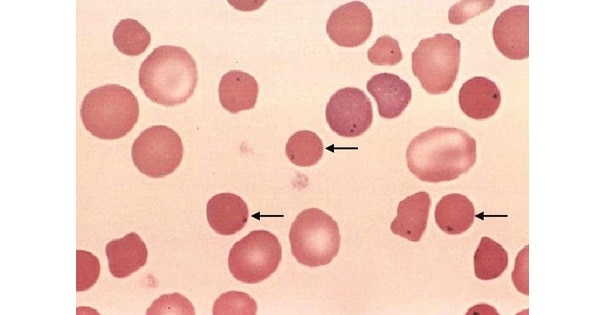
Hereditary spherocytosis
In hereditary spherocytosis mutation not seen is?
| A |
Ankyrin |
|
| B |
Spectrin |
|
| C |
Band-3 |
|
| D |
Na+ 1K+ channel protein |
In hereditary spherocytosis mutation not seen is?
| A |
Ankyrin |
|
| B |
Spectrin |
|
| C |
Band-3 |
|
| D |
Na+ 1K+ channel protein |
Na+ K+ channel protein REF: Wintrobe’s clinical hematology 12th edition vol 1- Table 31.1,http://en.wikipedia.org/wiki/ Hereditary_spherocytosis
Note: Some people think option D was Action
Pathophysiology of hereditary spherocytosis:
Hereditary spherocytosis is an autosomal dominant or recessive trait,[41 most commonly (though not exclusively) found in Northern European and Japanese families, although an estimated 25% of cases are due to spontaneous mutations. A patient has a 50% chance of passing the mutation onto his/her off spring.Hereditary spherocytosis is caused by a variety of molecular defects in the genes that code for Spectrin (alpha and beta), Ankyrin, band-3 protein, protein 4.2 and other erythrocyte membrane proteins:
These proteins are necessary to maintain the normal shape of an erythrocyte, which is a biconcave disk.
|
Type |
Gene |
Locus |
Defective protein |
|
HS1 |
ANK1 |
8p11.2 |
Ankyrin 1 |
|
HS2 |
SPTB |
14q22-q23 |
Spectrin beta chain |
|
HS3 |
SPTA |
1q21 |
Spectrin alpha chain |
|
HS4 |
SLC4A1 |
17q21-q22 |
Anion Exchanger 1 (AE1) or Band 3 |
|
HSS |
EPB42 |
15q15 |
Erythrocyte membrane protein band 4.2 |
Hereditary spherocytosis is caused by mutations in:
| A |
Ankyrin |
|
| B |
Band 3 |
|
| C |
Spectrin |
|
| D |
All of the above |
Hereditary spherocytosis is caused by mutations in:
| A |
Ankyrin |
|
| B |
Band 3 |
|
| C |
Spectrin |
|
| D |
All of the above |
Ref: Robbins 8th edition Chapter 14.
Transient erythroid hypoplasia in hereditary spherocytosis is caused by:
| A |
Epstein Barr virus |
|
| B |
Parvovirus B19 |
|
| C |
CMV |
|
| D |
Hepatitis B |
Transient erythroid hypoplasia in hereditary spherocytosis is caused by:
| A |
Epstein Barr virus |
|
| B |
Parvovirus B19 |
|
| C |
CMV |
|
| D |
Hepatitis B |
Parvovirus B 19 can cause transient red cell aplasia in patients with hemolytic disorders. It can cause aplastic crisis.
Ref: Harrisons principles of internal medicine, 18th edition, Page 874.

The main diagnostic test for hereditary spherocytosis is:
| A |
Osmotic fragility |
|
| B |
Bone marrow study |
|
| C |
Hemoglobin electrophoresis |
|
| D |
Mutation study |
The main diagnostic test for hereditary spherocytosis is:
| A |
Osmotic fragility |
|
| B |
Bone marrow study |
|
| C |
Hemoglobin electrophoresis |
|
| D |
Mutation study |
The presence of osmotic fragility is the main diagnostic test for hereditary spherocytosis.
All are TRUE about Hereditary Spherocytosis, EXCEPT:
| A |
Cholesterol gallstones |
|
| B |
Mild to moderate anemia |
|
| C |
Normocytic anemia |
|
| D |
Increase in MCHC |
All are TRUE about Hereditary Spherocytosis, EXCEPT:
| A |
Cholesterol gallstones |
|
| B |
Mild to moderate anemia |
|
| C |
Normocytic anemia |
|
| D |
Increase in MCHC |
Increased incidence of gallstones are seen in Hereditary spherocytosis, but they are pigment gallstones. This is almost the only condition where an elevated MCHC is seen.
All are true about the clinical features of hereditary spherocytosis, EXCEPT:
| A |
Gallstones |
|
| B |
Severe anemia during childhood |
|
| C |
Splenomegaly |
|
| D |
Jaundice |
All are true about the clinical features of hereditary spherocytosis, EXCEPT:
| A |
Gallstones |
|
| B |
Severe anemia during childhood |
|
| C |
Splenomegaly |
|
| D |
Jaundice |
CLinical features of hereditary spherocytosis:
Involved in Hereditary spherocytosis-
| A |
Spectrin |
|
| B |
Ankyrin |
|
| C |
Pyrin |
|
| D |
a and b |
Involved in Hereditary spherocytosis-
| A |
Spectrin |
|
| B |
Ankyrin |
|
| C |
Pyrin |
|
| D |
a and b |
Ans. ‘a’ i.e., Spectrin; ‘b’ i.e., Ankyrin
Defect in Hereditary spherocytosis
Ankyrin (most common) Band 3 (protein 3 or Anion transport channel)
Spectrin Band 4.2
The peripheral smear of Hereditary spherocytosis will show spherocytes –
| A |
Usually of same size |
|
| B |
Reticulocytosis seen |
|
| C |
Smaller size |
|
| D |
b & c |
The peripheral smear of Hereditary spherocytosis will show spherocytes –
| A |
Usually of same size |
|
| B |
Reticulocytosis seen |
|
| C |
Smaller size |
|
| D |
b & c |
Ans. is ‘b’ i.e., Reticulocytosis seen; ‘c’ i.e., Smaller size
Clinical features of hereditory spherocytosis
The clinical features are those of extravascular hemolysis : ‑
o Anemia —> Mild to moderate
o Jaundice (Mainly indirect bilirubin)
o Splenomegaly
o Gall stones -3 Elevated excretion of bilirubin promotes formation of pigment stone.
o Leg ulcer —> Rare clinical manifestation.
o Aplastic crisis —> Triggered by parvo-virus infection.
Laboratory findings
o Spherocytosis –> Peripheral smear shows microspherocytes which are small RBCs without central pallor (Normally central 1 /3 pallor is present in red cells).
o MCV o Reticulocytosis —*As seen with any type of hemolytic anemia.
o MCHC T o Hemoglobin .1
o Increased unconjugate bilirubin o Serum Heptoglobin —> Normal to decreased.
o Urine urobilinogen T o Increased osmotic fragility.
o Stool stercobilinogen r
Hereditary spherocytosis is characterised by ‑
| A |
Membrane skeleton abnormalities |
|
| B |
Microtubule defect |
|
| C |
Accumulation of intermediate filament |
|
| D |
None of the above |
Hereditary spherocytosis is characterised by ‑
| A |
Membrane skeleton abnormalities |
|
| B |
Microtubule defect |
|
| C |
Accumulation of intermediate filament |
|
| D |
None of the above |
Ans. is ‘a’ i.e., Membrane skeleton abnormalities
Which of the following statements is true of hereditary spherocytosis –
| A |
About 50% of affected infants have moderately severe neonatal jaundice |
|
| B |
Diagnosis can be made in neonatal period easily by examination of a blood film |
|
| C |
Intra vascular hemolysis is a common feature |
|
| D |
The disorder is usually due to autosomal recessive inheritance |
Which of the following statements is true of hereditary spherocytosis –
| A |
About 50% of affected infants have moderately severe neonatal jaundice |
|
| B |
Diagnosis can be made in neonatal period easily by examination of a blood film |
|
| C |
Intra vascular hemolysis is a common feature |
|
| D |
The disorder is usually due to autosomal recessive inheritance |
Ans. is ‘a’ i.e., About 50% of affected infants have moderately severe neonatal jaundice
Features of hereditary spherocytosis include all of the following except :
| A |
↑Osmotic fragility |
|
| B |
↑MCHC |
|
| C |
↑mcv |
|
| D |
Decrease surface area per unit volume . |
Features of hereditary spherocytosis include all of the following except :
| A |
↑Osmotic fragility |
|
| B |
↑MCHC |
|
| C |
↑mcv |
|
| D |
Decrease surface area per unit volume . |
Answer is C (MCV Ted)
Mean corpuscular volume of RBC is decreased in patients with hereditary spherocytosis.
Hereditary spherocytosis is characterised by defect in one of the proteins in the cytoskeleton of Red cell membrane, leading to loss of membrane, and hence decreased ratio of surface area to volume and consequently spherocytosis.
Characteristic Laboratory abnormalities
- The mean corpuscular volume (MCV) : is decreasedQ
- The mean corpuscular Hb. concentration (MCHC) : is increasedQ
- Osmotic fragility is : increasedQ
Remember the following also :
|
• |
Most common membrane defect is that of |
Ankyrin Q |
|
• |
One characteristic clinical presentation is |
Striking splenomegaly Q |
|
• |
Treatment of choice is |
(anemia, splenomegaly, jaundice) Splenectomy Q |
Hereditary spherocytosis is due to deficiency of:
September 2007
| A |
Spectrin |
|
| B |
Pyruvate kinase |
|
| C |
Cytokeratin |
|
| D |
Integrin |
Hereditary spherocytosis is due to deficiency of:
September 2007
| A |
Spectrin |
|
| B |
Pyruvate kinase |
|
| C |
Cytokeratin |
|
| D |
Integrin |
Ans. A: Spectrin
Hereditary spherocytosis (HS) is due to a deficiency of a protein called ankyrin.
Ankyrins are cell membrane proteins (thought to interconnect integral proteins with the spectrin-based membrane skeleton)
The ankyrin of red blood cells (erythrocytic ankyrin) is called ankyrin-R/ankyrin-1/ ANK1.
Hereditary spherocytosis is characterized by:
March 2004
| A |
Anemia |
|
| B |
Splenomegaly |
|
| C |
Jaundice |
|
| D |
All of the above |
Hereditary spherocytosis is characterized by:
March 2004
| A |
Anemia |
|
| B |
Splenomegaly |
|
| C |
Jaundice |
|
| D |
All of the above |
Ans. D i.e. All of the above
True statements regarding hereditary spherocytosis are all of the following except:
March 2012
| A |
Splenomegaly |
|
| B |
Anemia |
|
| C |
Spherocytosis is a pathognomic finding |
|
| D |
It is due to intrinsic defect in RBC membrane skeleton |
True statements regarding hereditary spherocytosis are all of the following except:
March 2012
| A |
Splenomegaly |
|
| B |
Anemia |
|
| C |
Spherocytosis is a pathognomic finding |
|
| D |
It is due to intrinsic defect in RBC membrane skeleton |
Ans: C i.e. Spherocytosis is a pathognomic finding
Hereditary spherocytosis
- The characteristic clinical features are anemia, moderate splenomegaly (500-1000 gm), and jaundice.
- The most specific morphologic finding of hereditary spherocytosis is spherocytosis but spherocytosis is not pathognomic, since other forms of membrane loss, such as in autoimmune haemolytic anemias, also cause the formation of spherocytes
- Hereditary spherocytosis is an inherited disorder caused by intrinsic defects in the RBC membrane skeleton that render RBC spheroid, less deformable, and vulnerable to splenic sequestration and destruction.
Not a feature of hereditary Spherocytosis:
March 2007
| A |
Autosomal dominant |
|
| B |
Increased RBC surface area |
|
| C |
Increased MCHC |
|
| D |
Normal or decreased MCV |
Not a feature of hereditary Spherocytosis:
March 2007
| A |
Autosomal dominant |
|
| B |
Increased RBC surface area |
|
| C |
Increased MCHC |
|
| D |
Normal or decreased MCV |
Ans. B: Increased RBC surface area
It’s the only condition presenting with Increased MCHC
Spherocytosis is caused by a molecular defect in one or more of the proteins of the red blood cell cytoskeleton, including, spectrin, ankyrin so blood cell contracts to its most surface-tension efficient and least flexible configuration, a sphere( spherocytes).
They have a high osmotic fragility and are more prone to physical degradation.
They are most commonly found in immunologically-mediated hemolytic anemias and in hereditary spherocytosis, but the former would have a positive direct Coombs test and the latter would not.
The misshapen but otherwise healthy red blood cells are mistaken by the spleen for old or damaged red blood cells and it thus constantly breaks them down, causing a cycle whereby the body destroys its own blood supply (auto-hemolysis). Chronic symptoms include anemia and splenomegaly. As a result of the broken-down blood cells — bilirubin — accumulates in the gallbladder and can cause pigmented gallstones to develop.
In peripheral blood smears, red blood cells will appear abnormally small.
The CBC will show elevated MCHC.
The bone marrow in its role of manufacturing red blood cells will display hyperplasia, the increased activity of replacing RBCs. As a result, immature red blood cell or reticulocyte counts will appear elevated.
Most common defect in hereditary spherocytos is in ‑
| A |
Spectrin |
|
| B |
Ankyrin |
|
| C |
Band 3 |
|
| D |
Band 4.2 |
Most common defect in hereditary spherocytos is in ‑
| A |
Spectrin |
|
| B |
Ankyrin |
|
| C |
Band 3 |
|
| D |
Band 4.2 |
Ans. is ‘b’ i.e., Ankyrin
Which among the following terms are used to describe the state of an erythrocyte marked by a “black arrow” in the blood smear of a patient suffering from hereditary sphercocytosis.?

| A |
Spherocytes. |
|
| B |
Anisocytes. |
|
| C |
Macrocytosis. |
|
| D |
Codocytes. |
Which among the following terms are used to describe the state of an erythrocyte marked by a “black arrow” in the blood smear of a patient suffering from hereditary sphercocytosis.?
| A |
Spherocytes. |
|
| B |
Anisocytes. |
|
| C |
Macrocytosis. |
|
| D |
Codocytes. |
Spherocytes: are nearly spherical erythrocytes which are nearly spherical erythrocytes which usually have a diameter smaller than normal. They lack the central pale area due to their spherical shape.Most commonly seen in cases of-
- Hemolytic anemia
- Post transfusion
- Hereditary sphercocytosis.
Which of the following is not seen in Hereditary Spherocytosis
| A |
Direct Coomb’s Positive |
|
| B |
Increased Osmotic Fragility |
|
| C |
Splenomegaly |
|
| D |
Gall stones |
Which of the following is not seen in Hereditary Spherocytosis
| A |
Direct Coomb’s Positive |
|
| B |
Increased Osmotic Fragility |
|
| C |
Splenomegaly |
|
| D |
Gall stones |
Ans. is ‘a’ i.e., Direct Coomb’s positive
Hereditary Spherocytosis
- Membrane cytoskeleton that lies closely opposed to the internal surface of the plasma membrane, is responsible for elasticity and maintenance of RBC shape.
Membrane skeleton consists :‑
Spectrin → The chief protein component responsible for biconcave shape.
Ankyrin and band 4-2 → Binds spectrin to band 3
Band 3 → A transmembrane ion transport protein.
Band 4.1 → Binds spectrin to glycophorin A, atransmembrane protein.
- Hereditary spherocytosis is an autosomal dominant disorder characterized by intrinsic defects in red cell membrane. This results in production of red cells that are sphere (spherocytes) rather than biconcave.
- The mutation most commonly involves the gene coding for ankyrin, followed by Band-3 (anionic transport channel), spectrin, and Band 4.2 (also called palladin).
Also know
Most common, defect in hereditary elliptocytosis is in spectrin
Pathogensis of Hereditary spherocytosis
- Loss of membrane cytoskeleton proteins (ankyrin, spectrin, Band 3, 4.2) results in reduced membrane stability. Reduced membrane stability leads to spontaneous loss of membrane fragments during exposure to shear stresses in the circulation. The loss of membrane relative to cytoplasm forces the cells to assume the smallest possible diameter for a given volume cells become microspherocytes.
- Because of their spheroidal shape and reduced membrane plasticity, red cells become less deformable and are trapped in to spleen as they are unable to pass through the interendothelial fenestrations of the venous sinusoids. In the splenic sinusoides, red cells are phagocytosed by RE cells Extravascular hemolysis.
Clinical features of Hereditory spherocytosis
The clinical features are those of extravascular hemolysis :
Anemia → Mild to moderate
Jaundice (Mainly indirect bilirubin)→ Splenomegaly
Gall stones → Elevated excretion of bilirubin promotes formation of pigment stone.
Leg ulcer → Rare clinical manifestation.
Aplastic crisis → Triggered by parvo-virus infection.
Laboratory findings
- Spherocytosis –> Peripheral smear shows microspherocytes which are small RBCs without central pallor (Normally central 1/3 pallor is present in red cells).
- MCV4
- MCHC r
- Increased unconjugate bilirubin
- Urine urobilinogen 1′
- Stool stercobilinogen
- Reticulocytosis -4 As seen with any type of hemolytic anemia.
- Hemoglobin 1
- Serum Heptoglobin –> Nonnal to decreased.
- Increased osmotic fragility on pink test.
- Coomb’s test is used to distinguish hereditary spherocytosis from autoimmune hemolytic anemias.
- Autoimmune hemolytic anemias are coomb’s positive_ whereas hereditary spherocytosis is coomb’s negative.
Usually associated with parvovirus B19 infection in those with hereditary spherocytosis
| A |
Mild to moderate splenomegaly |
|
| B |
Aplastic crisis |
|
| C |
Gallstones |
|
| D |
Hemolytic crisis |
Usually associated with parvovirus B19 infection in those with hereditary spherocytosis
| A |
Mild to moderate splenomegaly |
|
| B |
Aplastic crisis |
|
| C |
Gallstones |
|
| D |
Hemolytic crisis |
Ans. is ‘b’ i.e., Aplastic crisis
- Parvovirus B19 selectively infects erythroid precursors and is the most common aetiological agent that induces
- aplastic crisis in patients with hereditary spherocytosis (and other Hemolytic disorders).
Transient aplastic crisis
- Persons with decreased erythrocytes caused by conditions such as iron deficiency anemia, human immunodeficiency virus sickle cell disease, spherocytosis or thalassemia are at risk of transient aplastic crisis if infected with parvovirus B19.
- The virus causes a cessation of erythrocyte production.
- Parvovirus infection may be the first manifestation in HS.
- It begins with reticulocytosis and thrombocytosis
With regards to hereditary spherocytosis, which of the following is false
| A |
Usually has autosomal dominant inheritance |
|
| B |
Caused by mutations in genes for proteins such as spectrin, ankrin or band 3 |
|
| C |
Red blood cells are destroyed in the spleen |
|
| D |
Aplastic crises are common |
With regards to hereditary spherocytosis, which of the following is false
| A |
Usually has autosomal dominant inheritance |
|
| B |
Caused by mutations in genes for proteins such as spectrin, ankrin or band 3 |
|
| C |
Red blood cells are destroyed in the spleen |
|
| D |
Aplastic crises are common |
Ans. is ‘d’ i.e., Aplastic Crisis are common
Aplastic crisis are a rare/uncommon complication of Hereditary Spherocytosis typically caused by virally induced
bone marrow suppression.
- The most common aetiological agent that induces Aplastic Crisis in patients with Hereditary Spherocytosis is Parvovirus B19
Hereditary spherocvtosis usually has autosomal dominant inheritance caused by mutation in genes for proteins such as spectrin. ankrin or band 3.
- The genes responsible for HS include akyrin, b spectrin, band-3-protein, a-spectrin, and protein 4.2. In approximately two-thirds to three-quarter of HS patients, inheritance is autosomal dominant. In the remaining patients, inheritance is non-dominant due to autosomal recessive inheritance of a de novo mutation.
In patients with hereditary spherocvtosis Red blood cells are destroyed in the spleen
- The spleen plays a critical role in the pathobiology of HS, as destruction of spherocytes in the spleen is the primary cause of hemolysis in HS patients.
Aplastic Crisis is an Uncommon Complication
- Aplastic crisis following virally induced bone marrow suppression are uncommon, but may result in severe anaemia with serious complications including congestive heart failure or even death.
- The most common aetiological agent in these cases is parvovirus B19.
- Parvovirus selectively infects erythropoietic progenitor cells and inhibits their growth
Not true about hereditary spherocytosis
| A |
Defect in ankyrin |
|
| B |
Decreased MCV |
|
| C |
Decreased MCHC |
|
| D |
Reticulocytosis |
Not true about hereditary spherocytosis
| A |
Defect in ankyrin |
|
| B |
Decreased MCV |
|
| C |
Decreased MCHC |
|
| D |
Reticulocytosis |
Ans. is ‘c’ i.e., Decreased MCHC