Histamine & Histaminic receptors
| A |
Arteriolar dilatation |
|
| B | Increased permeability of venules | |
| C | Constriction of large arteries | |
| D | Platelet aggregation |
| A |
Arteriolar dilatation |
|
| B | Increased permeability of venules | |
| C | Constriction of large arteries | |
| D | Platelet aggregation |
Platelet aggregation REF: Robbin’s pathology 7th edition page 63
Preformed histamine is present in mast cell granules and is released by mast cell degranulation in response to variety of stimuli. In humans histamine causes:
- Arteriolar dilatation
- Increased permeability of venules (however constricts large arteries)
- Via binding to H1 receptor on endothelial cells
| A | Is found in Mast cells | |
| B | Increases gastric acid secretion | |
| C | Related to arousal and blood pressure | |
| D | All of the above |
| A | Is found in Mast cells | |
| B | Increases gastric acid secretion | |
| C | Related to arousal and blood pressure | |
| D | All of the above |
All of the above
Which of the following is NOT the role of histamine in acute inflammation?
| A |
It mediates increase in vascular permeability |
|
| B |
It mediates chemotaxis |
|
| C |
Release of pain causing substances |
|
| D |
Causes vasoconstriction |
Which of the following is NOT the role of histamine in acute inflammation?
| A |
It mediates increase in vascular permeability |
|
| B |
It mediates chemotaxis |
|
| C |
Release of pain causing substances |
|
| D |
Causes vasoconstriction |
Vasodilation is the most important vascular effect of histamine in humans.
It involves both H1 and H2 receptors distributed throughout the resistance vessels in most vascular beds.
Histamine’s effect on small vessels results in efflux of plasma protein and fluid into the extracellular spaces and an increase lymph flow, causing edema.
The gaps between endothelial cells also may permit passage of circulating cells recruited to tissues during the mast cell response.
In the epidermis, it causes itch; in the dermis, it evokes pain, sometimes accompanied by itching.
- A localized red spot within a few seconds and reaches a maximum in 1 minute.
- A brighter red flush, or “flare,” extending around 1 cm developing more slowly.
- A wheal that is discernible in 1-2 minutes.
The initial red spot results from the direct vasodilating effect of histamine (H1 receptor–mediated NO production).
The flare is due to histamine-induced stimulation of axon reflexes that cause vasodilation indirectly.
The wheal reflects histamine’s capacity to increase capillary permeability (edema formation).
Which of the following statements about Histamine is true:
| A |
Is found in Mast cells |
|
| B |
Increases gastric acid secretion |
|
| C |
Related to arousal and blood pressure |
|
| D |
All of the above |
Which of the following statements about Histamine is true:
| A |
Is found in Mast cells |
|
| B |
Increases gastric acid secretion |
|
| C |
Related to arousal and blood pressure |
|
| D |
All of the above |
All of the statements given above are true about histamine.
Ref: Textbook of Medical Physiology By Guyton and Hall, 11th Edition, Pages 285, 450, 480, 797; Ganong’s Review of Medical Physiology, 22nd Edition, Page 107; KDT, 6th Edition, Pages 151-53
HCL secretion is stimulated by:
| A |
Secretin |
|
| B |
Somatostatin |
|
| C |
Histamine |
|
| D |
All |
HCL secretion is stimulated by:
| A |
Secretin |
|
| B |
Somatostatin |
|
| C |
Histamine |
|
| D |
All |
C i.e. Histamine
Increased permeability in acute inflammation is due to-
| A |
Histamine |
|
| B |
IL-2 |
|
| C |
TGF-P |
|
| D |
FGF |
Increased permeability in acute inflammation is due to-
| A |
Histamine |
|
| B |
IL-2 |
|
| C |
TGF-P |
|
| D |
FGF |
Ans. is ‘a’ i.e., Histamine
o Formation of endothelial gaps in venules, i.e. immediate transient response is the most common mechanism causing increased vascular permeability in acute inflammation.
o Mediators involved in this mechanism are :-
i) Immediate (more important) : Histamine, bradykinin, leukotrienes, neuropeptide substance P. Somewhat delayed : IL-1, TNF, IFN-y
The most important source of histamine –
| A |
Mast cells |
|
| B |
Eosinophil |
|
| C |
Neutrophil |
|
| D |
Macrophages |
The most important source of histamine –
| A |
Mast cells |
|
| B |
Eosinophil |
|
| C |
Neutrophil |
|
| D |
Macrophages |
Ans. is ‘a’ i.e., Mast cells
Mast cells and basophils
- Mast cells and basophils are important inflammatory cells.
- They precipitate in both acute & chronic inflammation.
- Basophils circulate in the blood, whereas mast cells reside and mature in tissues.
- They are the most important cells in immediate hypersensitivity and are also the most important source of histamine.
- Other secretions are : Serine proteases, Carboxypeptidases, Glycosidoses, Proteoglycans, Sulfatases.
Vasoactive amines, involved in inflammation are –
| A |
Histamine |
|
| B |
Renin |
|
| C |
Angiotensin |
|
| D |
All |
Vasoactive amines, involved in inflammation are –
| A |
Histamine |
|
| B |
Renin |
|
| C |
Angiotensin |
|
| D |
All |
Ans. is ‘a’ i.e., Histamine
Vasoactive amines
- The two amines are especially important because they are present in preformed stores in cells and are therefore among the first mediators to be released during inflammation. These are ‑
1. Histamine
- It is widely distributed in tissues, the richest source being the mast cells.
- It is also found in basophils and platelets.
- It is the principal mediator of immediate transient phase of increased permeability.
- It causes
- Increased vascular permeability
- Vasodilatation
- Smooth muscle contraction.
2. Serotonine (5-hydroxy tryptamine)
- Serotonin is present in platelets and enterochromaffin cells.
- It is also present in mast cells of rodents, but not humans.
Biological effects of serotonin are same as histamine..
Histamine causes all EXCEPT –
| A |
Arteriolar dilatation |
|
| B |
Increased permeability of venules |
|
| C |
Constriction of large arteries |
|
| D |
Platelet aggregation |
Histamine causes all EXCEPT –
| A |
Arteriolar dilatation |
|
| B |
Increased permeability of venules |
|
| C |
Constriction of large arteries |
|
| D |
Platelet aggregation |
Ans. is ‘d’ i.e., Platelet aggregation
Mast cell synthesize and/or secrete –
| A |
Adrenaline |
|
| B |
Ach |
|
| C |
Histamine |
|
| D |
All |
Mast cell synthesize and/or secrete –
| A |
Adrenaline |
|
| B |
Ach |
|
| C |
Histamine |
|
| D |
All |
Ans. is ‘c’ i.e., Histamine
Mast cells
o Mast cells are bone marrow derived cells.
o They are found predominantly near blood vessels and nerves and in subepithelial sites, where local immediate hypersensitivity reaction tend to occur.
o Mast cells have cytoplasmic membrane-bound granules that contain a variety of biologically active mediators. o These granules are referred as metachromatic granules.
o Mast cells are central to the development of immediate hypersensitivity.
H1 blockers are useful as:
March 2013
| A |
Antacids |
|
| B |
Anti-allergic |
|
| C |
Anti-asthmatics |
|
| D |
Anti-migraine |
H1 blockers are useful as:
March 2013
| A |
Antacids |
|
| B |
Anti-allergic |
|
| C |
Anti-asthmatics |
|
| D |
Anti-migraine |
Ans. B i.e. Anti-allergic
H1 antagonist is a histamine antagonist of the H1 receptor that serves to reduce or eliminate effects mediated by histamine, an endogenous chemical mediator released during allergic reactions.
Pulmonary vasodilatation is caused by ‑
| A |
Hypoxia |
|
| B |
Thromboxane A2 |
|
| C |
Histamine |
|
| D |
Angiotensin-II |
Pulmonary vasodilatation is caused by ‑
| A |
Hypoxia |
|
| B |
Thromboxane A2 |
|
| C |
Histamine |
|
| D |
Angiotensin-II |
Ans. is ‘c’ i.e., Histamine
Triple response is due to ‑
| A |
Serotonin |
|
| B |
Histamine |
|
| C |
Dopamine |
|
| D |
Bradykine |
Triple response is due to ‑
| A |
Serotonin |
|
| B |
Histamine |
|
| C |
Dopamine |
|
| D |
Bradykine |
Ans. is ‘b’ i.e., Histamine
Triple response (Lewis triple response)
When a pointed object is stroked very firmly over the skin, a characteristic 3 part response develops. Its feature are :‑
1) Red reaction (red line) is due to transient capillary engorgement (vasodilation) caused by histamine released from damaged tissue. Histamine relaxes precapillary sphincter thus leads to capillary dilatation.
2) Flush or flare is spreading of redness beyond the injury (red line). It is due to arteriolar dilation mediated by axon reflex (may be an indirect effect of histamine).
3) Wheal is local edema and elevation of skin due to increased permeability of capillaries and post capillary venules with consequent extravasation of fluid. Capillary permeability is increased due to histamine and other mediators.
Which of the following is the preformed toxin involved in mechanism of allergic rhinitis ‑
| A |
Histamine |
|
| B |
Leukotriene |
|
| C |
TXA2 |
|
| D |
PGD2 |
Which of the following is the preformed toxin involved in mechanism of allergic rhinitis ‑
| A |
Histamine |
|
| B |
Leukotriene |
|
| C |
TXA2 |
|
| D |
PGD2 |
Ans. is ‘a’ i.e., Histamine
True regarding the disorder as shown in the picture below? 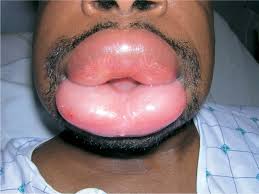
| A |
Histamine may play a role |
|
| B |
Deficiency of C1 esterase inhibitor |
|
| C |
Bradykinin may play a role |
|
| D |
All of the above |
True regarding the disorder as shown in the picture below?
| A |
Histamine may play a role |
|
| B |
Deficiency of C1 esterase inhibitor |
|
| C |
Bradykinin may play a role |
|
| D |
All of the above |
Ans:D.)All of the Above.
The condition shown in the image is Angioedema
Angioedema
- It is the swelling of deep dermis, subcutaneous, or submucosal tissue due to vascular leakage.
- Acute episodes often involve the lip, eyes, and face however, angioedema may affect other parts of body, including respiratory and gastrointestinal (GI) mucosa. Laryngeal swelling can be life-threatening.
- Angioedema is a result of the fast onset of an increase in local vascular permeability in subcutaneous or submucosal tissue.
- Histamine and bradykinin are the most recognized vasoactive mediators known to be critical in the pathologic process of angioedema.
- Hereditary angioedema (HAE), angiotensin-converting enzyme (ACE) inhibitor–induced angioedema, and certain idiopathic angioedemas are examples of bradykinin-mediated angioedema.
- C1-INH is a serine protease that is involved in the regulation of bradykinin. Low levels of this protease (either hereditary or acquired) results in unchecked activation of the kallikrein-kinin system, which leads to the overproduction of bradykinin
In Lewis Triple Response, redness when skin is scratched with a pointed object is seen due to
| A |
Axon reflex causing vasoconstriction |
|
| B |
Histamine release due to local injury to mast cells |
|
| C |
Free nerve endings injury |
|
| D |
Endothelial damage leading to increase in permeability |
Ans. b. Histamine release due to local injury to mast cells
- In Lewis Triple Response, redness when skin is scratched with a pointed object is seen due to histamine release due to local injury to mast cells
Lewis Triple Response
- Lewis triple response is a three-part response to blunt injury.
- It consists of the red reaction, wheal and flare.
Lewis Triple Response
Red reaction
- Red reaction appears at the site of injury within 10 seconds°.
- Due to dilation of pre- capillary sphincters by histamine and polypep aged skiff,.
Wheal
- Wheal is local edema due to increased permeability of the capillaries with conse- quent extravasation of fluid°
- Occurs due to histamine or histamine-like substances released from local mast cells°.
Flare response
- Flare response is a spread‑ ing redness is due to arte‑ riolar dilatation produced by the axon reflee
Increased permeability in acute inflammation is due to‑
| A |
Histamine |
|
| B |
IL-2 |
|
| C |
TGF-(3 |
|
| D |
FGF |
Increased permeability in acute inflammation is due to‑
| A |
Histamine |
|
| B |
IL-2 |
|
| C |
TGF-(3 |
|
| D |
FGF |
Ans. is ‘a’ i.e., Histamine
- Formation of endothelial gaps in venules, i.e. immediate transient response is the most common mechanism causing increased vascular permeability in acute inflammation.
- Mediators involved in this mechanism are :-
- Immediate (more important) : Histamine, bradykinin, leukotrienes, neuropeptide substance P.
- Somewhat delayed: IL-1, TNF, IFN-y