


Lepra Reaction And Erythma Nodosum Leprosum
| A |
Chloroquin |
|
| B |
Rifampicin |
|
| C | Clofazimine | |
| D | Thalidomide |
| A |
Chloroquin |
|
| B |
Rifampicin |
|
| C | Clofazimine | |
| D | Thalidomide |
Explanation:
Rifampicin
REF: Rook’s 7′ ed p. 29.1-29.14
Treatment of lepra reactions according to severity
|
|
Type 1 |
Type 2 |
|
Mild |
NSAIDS |
NSAIDS |
|
Moderate |
Nsaids , Corticosteroids |
NSAIDS , Clofazimine, Thalidomide, Chloroquine |
|
Severe |
NSAIDS . Corticosteroids |
Thalidomide , Corticosteroids , Parenteral antimony |
Q. 2
Drug not used in Type 1 Lepra reac‑ tion is:
| A | Antileprotics | |
| B | Analgesics | |
| C | Corticosteroids | |
| D | Thalidomide |
Q. 2
Drug not used in Type 1 Lepra reac‑ tion is:
| A | Antileprotics | |
| B | Analgesics | |
| C | Corticosteroids | |
| D | Thalidomide |
Explanation:
Thalidomide
Q. 3
Type-II lepra reaction is found in:
| A | BL | |
| B | LL | |
| C | BT | |
| D | None of the above |
Q. 3
Type-II lepra reaction is found in:
| A | BL | |
| B | LL | |
| C | BT | |
| D | None of the above |
Explanation:
LL
Q. 4
Drugs used in lepra reaction is:
| A | Thalidomide | |
| B | Clofazimine | |
| C | Chloroquine | |
| D | All of the above |
Q. 4
Drugs used in lepra reaction is:
| A | Thalidomide | |
| B | Clofazimine | |
| C | Chloroquine | |
| D | All of the above |
Explanation:
All of the above
Q. 5
Drug of choice for type II Lepra Reaction is:
| A | Thalidomide | |
| B | Steroids | |
| C | Clofazamine | |
| D | Rifampicrn |
Q. 5
Drug of choice for type II Lepra Reaction is:
| A | Thalidomide | |
| B | Steroids | |
| C | Clofazamine | |
| D | Rifampicrn |
Explanation:
Corticosteroids are the drug of choice for type 2 lepra reaction or erythema nodosum leprosum. Thalidomide can be used if corticosteroids are ineffective.
Q. 6
Type 2 lepra reaction occurs in:
| A | Pauci bacillary leprosy | |
| B | Multi bacillary leprosy | |
| C | Both of the above | |
| D | None of the above |
Q. 6
Type 2 lepra reaction occurs in:
| A | Pauci bacillary leprosy | |
| B | Multi bacillary leprosy | |
| C | Both of the above | |
| D | None of the above |
Explanation:
- Type 1 Lepra Reaction also known as Reversal Reaction may occur both in Pauci Bacillary (PB) and Multi Bacillary (MB) leprosy.
- Type 2 reaction is also known as Erythema Nodosum Leprosum (ENL) andoccurs only in MB leprosy.
Q. 7
Which of the following anti leprosy drugs is used in treatment of type 2 lepra reaction:
| A | Clofazimine | |
| B | Dapsone | |
| C | Rifampicin | |
| D | None of the above |
Q. 7
Which of the following anti leprosy drugs is used in treatment of type 2 lepra reaction:
| A | Clofazimine | |
| B | Dapsone | |
| C | Rifampicin | |
| D | None of the above |
Explanation:
Q. 8
If a leprosy patient on multi drug therapy develops type II lepra reaction, what is the next course of action?
| A | Stop multi drug therapy | |
| B | Start steroids | |
| C | Start steroids and clofazimine | |
| D | None of the above |
Q. 8
If a leprosy patient on multi drug therapy develops type II lepra reaction, what is the next course of action?
| A | Stop multi drug therapy | |
| B | Start steroids | |
| C | Start steroids and clofazimine | |
| D | None of the above |
Explanation:
If a patient develops lepra reaction during treatment, multi drug therapy should not be stopped.
Type II lepra reaction is treated with steroids and clofazimine.
Q. 9
Characteristic of type II lepra reaction ‑
| A | Erythema & edema | |
| B | ENL | |
| C | Lymphadenopathy | |
| D | All |
Q. 9
Characteristic of type II lepra reaction ‑
| A | Erythema & edema | |
| B | ENL | |
| C | Lymphadenopathy | |
| D | All |
Explanation:
. Ans. is ‘a’ i.e., Erythema & edema; ‘b’ i.e., ENL; ‘c’ i.e., Lymphadenopathy
1) Lepra 1 reaction
- Type 1 lepra reaction is a type IV hypersensitivity.
- There are classical signs of inflammation (Redness, pain & Tenderness) within previously involved macule,
papules or plaque.
- Systemic features do not occur (in contrast to type 2 reaction).
- Neuritis is common and ulnar nerve is involved most commonly.
2) Lepra 2 reaction (Erythema nodosum leproticum : ENL)
- The presenting symptoms include :0 Crops of fresh painful erythematous papules or nodules are most common presenting feature.
ii) Systemic features :- Fever, malaise, arthritis, neuritis, dactylitis, orchitis, uveitis (iridocyclitis), lymphadenitis, glomerulonephritis, periostitis, hepatitis.
Q. 10
Reversal lepra reaction shown no response to :
| A | Cloafazimine | |
| B | Chloroquine | |
| C | Glucocorticoids | |
| D | Thalidomide |
Q. 10
Reversal lepra reaction shown no response to :
| A | Cloafazimine | |
| B | Chloroquine | |
| C | Glucocorticoids | |
| D | Thalidomide |
Explanation:
D. i.e. Thalidomide
Appearance of new skin lesions or signs of inflammation (e.g. redness and swelling etc.) in prevous lesions, neuritis (e.g. nerve pain) and low grade fever in borderline forms of leprosy suggest the diagnosis of Jopling’s type I (delayed type IV hype/sensitivity) reaction. If type I lepra reaction preceeds the initiation of appropiate antimicrobial therapy it is k/a down grading reaction & the case becomes histologically more lepromatous. When it occurs after initiation of therapy, it is termed as reversal reaction & the case becomes more tuberculoid.
– This is presentation of lepra reaction (type I – reversal) & in any case of lepra reaction antileprotic drug is not stopped.
Thalidomide is ineffective and has no role in type I lepra (downgrading and reversal) reactionsQ.
Q. 11
DOC in type I lepra reaction with severe neuritis
| A | Thalidomide | |
| B | Clafazamine | |
| C | Dapsone | |
| D | Systemic Corticosteroid |
Q. 11
DOC in type I lepra reaction with severe neuritis
| A | Thalidomide | |
| B | Clafazamine | |
| C | Dapsone | |
| D | Systemic Corticosteroid |
Explanation:
D i.e. Systemic corticosteroid
Q. 12
Antileprotic drug also used in lepra reaction is:
| A | Rifampcin | |
| B | Dapsone | |
| C | Ciprofloxacin | |
| D | Clofazimine |
Q. 12
Antileprotic drug also used in lepra reaction is:
| A | Rifampcin | |
| B | Dapsone | |
| C | Ciprofloxacin | |
| D | Clofazimine |
Explanation:
D i.e. Clofazamine
Q. 13
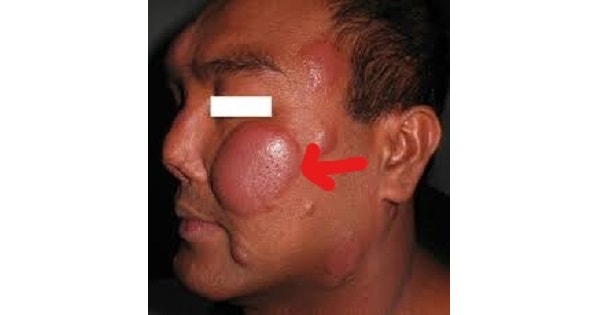
Which among the following is the main cytokine involved in the reaction marked by a red arrow in a leprosy patient? 

| A | InterLeukin-2. | |
| B | Interferon-gamma. | |
| C | Tumor necrosis factor-alpha.
|
|
| D | Macrophage colony stimulating factor. |
Q. 13
Which among the following is the main cytokine involved in the reaction marked by a red arrow in a leprosy patient?
| A | InterLeukin-2. | |
| B | Interferon-gamma. | |
| C | Tumor necrosis factor-alpha.
|
|
| D | Macrophage colony stimulating factor. |
Explanation:
Ans:C.)Tumor necrosis factor-alpha.
The reaction marked by a red arrow in the leprosy patient above represent erythema nodosum leprosum (ENL) reaction.
Q. 14
The lepra reaction as shown in a 38 year old female patient as represented in the picture below are features of which of the following types of leprosy? 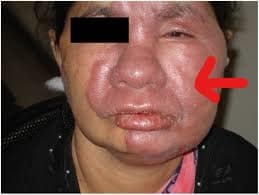

| A | Lepromatous. | |
| B | Borderline. | |
| C | Tuberculoid. | |
| D | Borderline tuberculoids.
|
Q. 14
The lepra reaction as shown in a 38 year old female patient as represented in the picture below are features of which of the following types of leprosy?
| A | Lepromatous. | |
| B | Borderline. | |
| C | Tuberculoid. | |
| D | Borderline tuberculoids.
|
Explanation:
Ans:A.)Lepromatous
The patient is suffering from Type II Lepra reaction(Erythema Nodosum)
Type II lepra reactions (ENL) is seen in Lepromatous Leprosy. Erythema nodosum leprosum is a type III hypersensitivity.
|
Signs |
Type I
|
Type II |
|
|
Type of reaction |
Delayed Hypersensitivity,associated with an increase in cell-mediated immunity. It is a type IV delayed hypersensitivity. |
Antigen antibody reaction due to the deposition of extravascular immune complexes,type III hypersensitivity
|
|
|
Inflammation of the skin |
Skin lesions suddenly becomes reddish, swollen, warm, painful, tender but the rest of the skin is normal |
Red, painful, tender, cutaneous nodules (deep) appear that are not associated with leprosy patches. ENL may appear commonly on face, arms, legs.
|
|
|
Cytokines involved |
Increased activity of T helper (Th)-1 lymphocytes expressing IL-2 and IFN-γ.IL-12 is consistently expressed and IL-4 is absent. The IFN-γ and TNF-α producing CD4 cells and T cytotoxic cells are selectively increased .
. |
Tumor necrosis factor-alpha play a central role in the pathobiology of type II lepra reaction/ ENL. A predominant Th2 cytokine profile has been observed with increased expression of IL-6, IL-8, and IL-10 as well as sustained production of Th2 cytokines, IL-4, and IL-5. |
|
| Nerve involvement |
Nerves close to skin may be enlarged, tender and painful (neuritis) with loss of nerve function (loss of sensation and muscle weakness) and may appear suddenly or rapidly
|
Nerves may be affected but not as common or severe/acute as in Type I | |
|
General condition of the patient
|
Good, with little or no fever |
Poor, with fever and general malaise |
|
|
Timing of presentation and type of patient |
Usually early on in the course of MDT; occurs in people with both PB and MB,more common in patients between the two poles of the leprosy spectrum with immunologically unstable borderline forms,with a significantly higher incidence in BB and BL patients as compared with BT patients.
|
Usually later in the treatment; occurs in people with MB leprosy,seen in borderline lepromatous (BL) and lepromatous leprosy (LL)
|
|
|
Eye involvement |
Weakness of eyelid closure may occur (nerve involved)
|
Internal eye disease (iritis) occurs |
|
|
Other Organs |
Not affected
|
May be affected like periosteal pain (especially tibiae), muscle pain (myositis), pain and swelling of the tendons and joints, rhinitis, epistaxis, painful dactylitis, swollen tender lymph nodes especially femoral, acute epididymo-orchitis, hepato-splenomegaly with hepatitis and endocarditis with/without arhythmia,Glomerulonephritis. |
|
|
Treatment |
If the Type 1 reaction is mild and there is no evidence of neuritis (pain, loss of sensation or function), the reaction should be treated with analgesics, such as acetylsalicylic acid or paracetamol. However, if there is nerve involvement, treat type 1 reactions with analgesics and corticosteroids, such as oral prednisolone. |
|

