Levels of Prevention
Primary prevention does not include –
| A |
Early diagnosis and treatment |
|
| B |
Health promotion |
|
| C |
Specific protection |
|
| D |
Health education |
Primary prevention does not include –
| A |
Early diagnosis and treatment |
|
| B |
Health promotion |
|
| C |
Specific protection |
|
| D |
Health education |
Ans. is ‘a’ i.e., Early diagnosis and treatment
Early diagnosis and treatment is secondary level of prevention.
Which of the following is not a primary prevention strategy?
| A |
Breast self exam |
|
| B |
Control of tobacco |
|
| C |
Radiation protection |
|
| D |
Cancer education |
Which of the following is not a primary prevention strategy?
| A |
Breast self exam |
|
| B |
Control of tobacco |
|
| C |
Radiation protection |
|
| D |
Cancer education |
Ans. is ‘a’ i.e., Breast self exam
- Self breast examination is a screening test for breast lump —> screening is secondary level of prevention. o Control of tobacco (discouragement from adapting a harmful lefestyle) is a primordial prevention (a type of primary prevention)
- Health education (cancer education) and specific protection (radiation protection) are primary levels of prevention.
Primordial prevention is the –
| A |
Prevention of diseases among the hill-dwelling and tribal people |
|
| B |
Prolongation of human life span to the maximum extent |
|
| C |
Promotion of health, well being and efficiency |
|
| D |
Prevention of diseases through modification of their risk factors |
Primordial prevention is the –
| A |
Prevention of diseases among the hill-dwelling and tribal people |
|
| B |
Prolongation of human life span to the maximum extent |
|
| C |
Promotion of health, well being and efficiency |
|
| D |
Prevention of diseases through modification of their risk factors |
Ans. is ‘d’ i.e., Prevention of diseases through modification of their risk factors
It is the prevention of the emergence or development of risk factors in countries or population groups in which they have not yet appeared
Which of the following is not tertiary level prevention-
| A |
Total mastectomy for breast cancer |
|
| B |
Tendon transplant in leprosy |
|
| C |
Physiotherapy in residual polio myelitis |
|
| D |
Provision of spectacles for refractive errors |
Which of the following is not tertiary level prevention-
| A |
Total mastectomy for breast cancer |
|
| B |
Tendon transplant in leprosy |
|
| C |
Physiotherapy in residual polio myelitis |
|
| D |
Provision of spectacles for refractive errors |
Ans. is ‘a’ i.e., Total mastectomy for breast cancer
o Total mastectomy for breast cancer is treatment, hence it is a secondary level of prevention.
o In case of tertiory prevention all actions are designed to limit the disability or provide vocational, social medical, or psychological rehabilitation.
Prevention of disease by immunization comes under which category-
| A |
Primordial prevention |
|
| B |
Primary prevention |
|
| C |
Secondary prevention |
|
| D |
Tertiary prevention |
Prevention of disease by immunization comes under which category-
| A |
Primordial prevention |
|
| B |
Primary prevention |
|
| C |
Secondary prevention |
|
| D |
Tertiary prevention |
Ans. is ‘b’ i.e., Primary prevention
All are primary level of prevention EXCEPT:
March 2013 (e)
| A |
Installation of sanitary latrines |
|
| B |
Immunization |
|
| C |
Provision of safe water |
|
| D |
Mass treatment |
All are primary level of prevention EXCEPT:
March 2013 (e)
| A |
Installation of sanitary latrines |
|
| B |
Immunization |
|
| C |
Provision of safe water |
|
| D |
Mass treatment |
Ans. D i.e. Mass treatment
Primary prevention
It refers to:
– Health promotion, which fosters wellness in general and thus reduces the likelihood of disease, disability, and premature death in a nonspecific manner, as well as
– Specific protection against the inception of disease.
Examples of the former include the:
— Promotion of physical activity and prudent dietary practices;
– Smoking avoidance or cessation; and the
– Mitigation of stress.
Immunization is a clear example of the latter.
Primary level of prevention means:
March 2013 (g)
| A |
Efforts are directed towards discouraging children from adopting harmful lifestyles |
|
| B |
Action taken prior to the onset of disease, which removes the possibility that a disease will ever occur |
|
| C |
Action which halts the progress of a disease at its incipient stage and prevents complications |
|
| D |
All measures available to reduce or limit impairments and disabilities, minimize suffering caused by existing departures from good health |
Primary level of prevention means:
March 2013 (g)
| A |
Efforts are directed towards discouraging children from adopting harmful lifestyles |
|
| B |
Action taken prior to the onset of disease, which removes the possibility that a disease will ever occur |
|
| C |
Action which halts the progress of a disease at its incipient stage and prevents complications |
|
| D |
All measures available to reduce or limit impairments and disabilities, minimize suffering caused by existing departures from good health |
Ans. B i.e. Action taken prior to the onset of disease, which removes the possibility that a disease will ever occur
Which of the following is secondary level of prevention:
March 2005
| A |
Prophylactic drug administartion |
|
| B |
Admitting disabled child in special schools |
|
| C |
Vaccination |
|
| D |
Cervical pap smear checking |
Which of the following is secondary level of prevention:
March 2005
| A |
Prophylactic drug administartion |
|
| B |
Admitting disabled child in special schools |
|
| C |
Vaccination |
|
| D |
Cervical pap smear checking |
Ans. D: Cervical pap smear checking
The levels of prevention:
- Primordial prevention is prevention of the emergence/development of the risk factors in countries/population in which they have not yet appeared. e.g. obesity and hypertension prevention
Primary prevention methods are used before the person gets the disease. Primary prevention aims to prevent the disease from occurring. So primary prevention reduces both the incidence and prevalence of a disease. Encouraging people to protect themselves from the sun’s ultraviolet rays is an example of primary prevention of skin cancer.
- Secondary prevention is used after the disease has occurred, but before the person notices that anything is wrong.
- A doctor checking for suspicious skin growths is an example of secondary prevention of skin cancer. The goal of secondary prevention is to find and treat disease early. In many cases, the disease can be cured.
Secondary prevention can be defined as action which halts the progress of a disease at its incipient stage and prevents complications.
The specific interventions are early diagnosis (e.g. screening tests, case finding programmes) and adequate treatment. Tertiary prevention targets the person who already has symptoms of the disease
The goals of tertiary prevention are:
Prevent damage and pain from the disease
– Slow down the disease
– Prevent the disease from causing other problems (These are called “complications.”)
– Give better care to people with the disease
– Make people with the disease healthy again and able to do what they used to do
Developing better treatments for melanoma is an example of tertiary prevention. Examples include better surgeries, new medicines, etc.
Prevention of developing risk factors in CAD comes under:
September 2007
| A |
Primary prevention |
|
| B |
Secondary prevention |
|
| C |
Primordial prevention |
|
| D |
Tertiary prevention |
Prevention of developing risk factors in CAD comes under:
September 2007
| A |
Primary prevention |
|
| B |
Secondary prevention |
|
| C |
Primordial prevention |
|
| D |
Tertiary prevention |
Ans. C: Primordial prevention
Which of the following is not included in the primary prevention for hypertension:
September 2010
| A |
Exercises |
|
| B |
Weight control |
|
| C |
Health education |
|
| D |
Early diagnosis and treatment |
Which of the following is not included in the primary prevention for hypertension:
September 2010
| A |
Exercises |
|
| B |
Weight control |
|
| C |
Health education |
|
| D |
Early diagnosis and treatment |
Ans. D: Early diagnosis and treatment
Primary prevention strategies intend to avoid the development of disease.
Most population-based health promotion activities are primary preventive measures
Weight loss, reduced intake of dietary sodium, moderation in alcohol consumption, and increased physical activity are the best proven interventions for prevention of hypertension.
Mode of prevention in CHD ‑
| A |
High risk strategy |
|
| B |
Primordial prevention |
|
| C |
Secondary prevention |
|
| D |
Tertiary prevention |
Mode of prevention in CHD ‑
| A |
High risk strategy |
|
| B |
Primordial prevention |
|
| C |
Secondary prevention |
|
| D |
Tertiary prevention |
Ans. is ‘b’ i.e., Primordial prevention
Best way to prevent mortality from any disease is to prevent the development of disease.
In case of CHD, primordial prevention is best strategy, which mainly concerns with life style changes.
Using seatbelt is which level of prevention ‑
| A |
Primary |
|
| B |
Secondary |
|
| C |
Tertiary |
|
| D |
Rehabilitation |
Using seatbelt is which level of prevention ‑
| A |
Primary |
|
| B |
Secondary |
|
| C |
Tertiary |
|
| D |
Rehabilitation |
Ans. is ‘b i.e., Secondary
- Primary prevention refers to intervention before event, to prevent it completely.
- Secondary prevention involves the lessening the extent of injury given that an event occur.
- Wearing a seatbelt will not prevent the collision but may lessen its effects. Thus it is secondary level of prevention.
Which of the following is primary prevention
| A |
Screening test |
|
| B |
Early diagnosis |
|
| C |
Use of mosquito net |
|
| D |
Restoration of lost function |
Which of the following is primary prevention
| A |
Screening test |
|
| B |
Early diagnosis |
|
| C |
Use of mosquito net |
|
| D |
Restoration of lost function |
Ans. is ‘c’ i.e., Use of mosquito net
Primordial prevention is done to prevent development of ‑
| A |
Disease |
|
| B |
Risk factors |
|
| C |
Impairment |
|
| D |
Disability |
Primordial prevention is done to prevent development of ‑
| A |
Disease |
|
| B |
Risk factors |
|
| C |
Impairment |
|
| D |
Disability |
Ans. is ‘b’ i.e., Risk factors
LEVELS OF PREVENTION
- There are four levels of prevention :‑
- Primordial prevention
- Primary prevention
- Secondary prevention
- Tertiary prevention
Primordial Level of Prevention: Is primary prevention (see below) in purest sense
- It is the prevention of the emergence or development of risk factors in countries or population groups in which they have not yet appeared
- Modes of Intervention:
- Individual Education
- Mass Education
- Primordial Level is Best level of prevention for Non-communicable diseases
Below are shown the levels of prevention.What is level D?
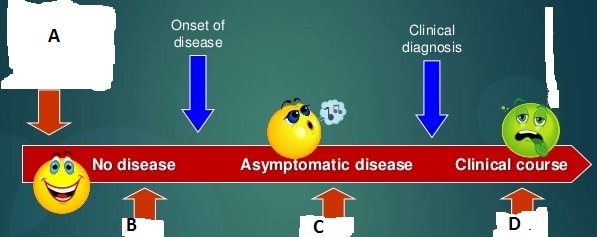
| A |
Health promotion |
|
| B |
Specific Protection |
|
| C |
Early Diagnosis and treatment |
|
| D |
Disability limitation |
Below are shown the levels of prevention.What is level D?
| A |
Health promotion |
|
| B |
Specific Protection |
|
| C |
Early Diagnosis and treatment |
|
| D |
Disability limitation |
Ans:D.)Disability limitation.
Level A:Primordial prevention is defined as prevention of risk factors themselves, beginning with change in social and environmental conditions in which these factors are observed to develop, and continuing for high risk children, adolescents and young adults..
Level B:Primary prevention is concerned with preventing the onset of disease; it aims to reduce the incidence of disease. It involves interventions that are applied before there is any evidence of disease or injury. Examples include protection against the effects of a disease agent, as with vaccination.
Level C:Secondary prevention has been defined as slowing the progression of a disease or its sequelae at any point after its inception.
Level D:Tertiary prevention refers to interventions designed to arrest the progress of an established disease and to control its negative consequences: to reduce disability and handicap, to minimize suffering caused by existing departures from good health, and to promote the patient’s adjustment to irremediable conditions.
Secondary level of prevention is important in all of the following except ‑
| A |
Coronary heart disease |
|
| B |
TB |
|
| C |
Leprosy |
|
| D |
None |
Secondary level of prevention is important in all of the following except ‑
| A |
Coronary heart disease |
|
| B |
TB |
|
| C |
Leprosy |
|
| D |
None |
Ans. is ‘a’ i.e., Coronary heart disease
- For non-communicable disease (e.g. CHD), primordial prevention is best intervention.