
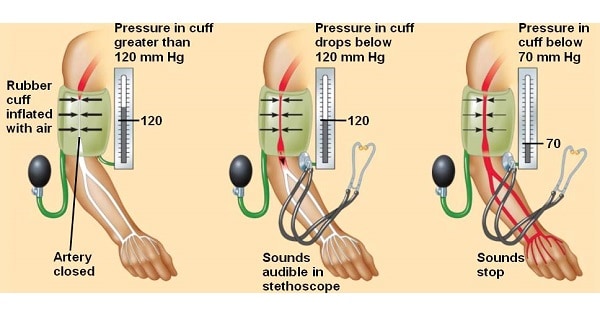
MEASUREMENT OF BLOOD PRESSURE
The blood pressure measured by a sphygmomanometer
| A |
Is lower than the intraarterial pressure |
|
| B |
Is higher than the intraarterial pressure |
|
| C |
Is same as the intraarterial pressure |
|
| D |
Is the same with different cuff sizes |
The blood pressure measured by a sphygmomanometer
| A |
Is lower than the intraarterial pressure |
|
| B |
Is higher than the intraarterial pressure |
|
| C |
Is same as the intraarterial pressure |
|
| D |
Is the same with different cuff sizes |
Answer is B (Is higher than intraarterial pressure)
Blood pressure measured by Sphygmomanometer with a standard cuff tend to overestimate ‘true’ arterial pressures as measured by arterial cannulation, especially in the elderly and the obese – Ganong.
Blood pressure Measurement with Sphygmomanometers
External pressure is applied with a sphygmomanometer cuff to the overlying tissues and the pressure required to occlude the artery is assumed to be equal to the intra arterial pressure.
- Sphygmomanometer is a device that measures blood pressures indirectly.
- The sphygmomanometer will give accurate readings only if no pressure (zero mm. of mercury) is dissipated in compressing the soft tissues overlying the artery.
However in practice, some pressure is always dissipated in compressing the blanket of soft tissues overlying the artery and hence blood pressure measured by the sphygmomanometer are slightly higher than true intra arterial pressures.
- The amount by which the sphygmomanometer overestimates the true blood pressure is influenced by the amount of overlying fat and the compressibility of the vessles
Sources of Error
Blood Pressure measured by Sphygmomanometer
- Thick overlying soft tissue blanket leads to overestimation of blood pressure
- Obese individzialsQ have a thick blanket of fat which dissibates cuff pressure. Hence Blood pressure is likely to be overestimated when measured by sphygmomanometer and a standard cuff.
Compressibility of vessels
- Vessels that arc difficult to compress lead to overestimation of blood pressure.
- Blood pressure measured in such individuals with sphygmomanometer will result in over estimation of blood pressure (Pseudohypertension)
- Such Patients include Elderly individuals, diabeticsQ and patients who may have rigid sclerotic vessels that are difficult to compress (Mokenberg’s asteriosclerosis).
Size of Cuff
- Small (Narrow) cite leads to falsely high blood pressure recordings (overestimation)
- Large (wide) cue leads to falsely lower blood pressure recordings (under estimation)
- If the standard arm cuff is used to measure blood pressure in the thigh falsely high blood pressure values will be obtained (due to relatively smaller cuff size and greater soft tissue blanket).
- If the standard arm cuff is used on the forearm falsely lower blood pressure values may be recorded.
Note
- More accurate pressure can he recorded in obese individuals by using a wider cuff size
- More accurate pressure can be recorded in the thigh by using a wider cuff size
True about blood pressure measurement is all/except:
| A |
Cuff width should be 40% of arm circumference |
|
| B |
Diastolic blood pressure is indicated by fourth Korotkoff sound |
|
| C |
Small cuff measures spuriously elevated Diastolic blood pressure |
|
| D |
Monkenberg sclerosis causes pseudohypertension |
True about blood pressure measurement is all/except:
| A |
Cuff width should be 40% of arm circumference |
|
| B |
Diastolic blood pressure is indicated by fourth Korotkoff sound |
|
| C |
Small cuff measures spuriously elevated Diastolic blood pressure |
|
| D |
Monkenberg sclerosis causes pseudohypertension |
Answer is B (Diastolic BP is indicated by 4th Kovotkoffs sound)
Diastolic blood pressure is indicated by the 5th fburth Korotkoff sound (not by fourth Korotkoff sound).
Diastolic blood pressure is best indicated by fifth Korotkoff sound
Korotkoff sounds are produced by turbulent flow in artery
| 1. |
Faint, clear, tapping sounds |
It indicates systolic Be |
|
2. |
Murmur / swishing sounds |
|
|
3. |
More intense, crisper sounds |
|
|
4. |
Distinct abrupt muffled f sounds |
Indicates diastolic BP in children. |
|
5. |
No sound |
Best correlates with diastolic BP in normal adults°. |
Artery cannulated most commonly for invasive blood pressure monitoring is:
March 2013 (f)
| A |
Femoral artery |
|
| B |
Carotid artery |
|
| C |
Radial artery |
|
| D |
Ulnar artery |
Artery cannulated most commonly for invasive blood pressure monitoring is:
March 2013 (f)
| A |
Femoral artery |
|
| B |
Carotid artery |
|
| C |
Radial artery |
|
| D |
Ulnar artery |
Ans. C i.e. Radial artery

