Mercury poisoning
Destroying of lead batteries releases all of the following contaminants except:
| A |
Arsenic |
|
| B |
Antimony |
|
| C |
Lead |
|
| D |
Mercury |
Destroying of lead batteries releases all of the following contaminants except:
| A |
Arsenic |
|
| B |
Antimony |
|
| C |
Lead |
|
| D |
Mercury |
Feer’s disease is caused by toxicity of:
| A |
Arsenic |
|
| B |
Antimony |
|
| C |
Lead |
|
| D |
Mercury |
Feer’s disease is caused by toxicity of:
| A |
Arsenic |
|
| B |
Antimony |
|
| C |
Lead |
|
| D |
Mercury |
True about Minamata disease are all except:
| A |
Caused by methyl mercury toxicity |
|
| B |
First occurred in Japan |
|
| C |
Found in babies born to mothers with overt symptoms of mercury poisoning |
|
| D |
Babies characterised by microcephaly, cerebral palsy, severe mental retardation |
True about Minamata disease are all except:
| A |
Caused by methyl mercury toxicity |
|
| B |
First occurred in Japan |
|
| C |
Found in babies born to mothers with overt symptoms of mercury poisoning |
|
| D |
Babies characterised by microcephaly, cerebral palsy, severe mental retardation |


Shaking palsy is associated with poisoning with :
| A |
Lead |
|
| B |
Mercury |
|
| C |
Arsenic |
|
| D |
Strontium |
Shaking palsy is associated with poisoning with :
| A |
Lead |
|
| B |
Mercury |
|
| C |
Arsenic |
|
| D |
Strontium |
B i.e Mercury
Which of the following is true regarding chronic mercury poisoning:
| A |
Coarse tremor seen |
|
| B |
Fine tremor seen |
|
| C |
Loss of skilled activity |
|
| D |
b and c |
Which of the following is true regarding chronic mercury poisoning:
| A |
Coarse tremor seen |
|
| B |
Fine tremor seen |
|
| C |
Loss of skilled activity |
|
| D |
b and c |
A i.e. Coarse tremors seen
Which of the following heavy metal poisoning may cause colitis that resembles diptheritic colitis?
| A |
Lead |
|
| B |
Arsenic |
|
| C |
Mercury |
|
| D |
Copper |
Which of the following heavy metal poisoning may cause colitis that resembles diptheritic colitis?
| A |
Lead |
|
| B |
Arsenic |
|
| C |
Mercury |
|
| D |
Copper |
C i.e. Mercury
The most poisonous Mercury salt is:
| A |
Chloride |
|
| B |
Oxide |
|
| C |
Cyanide |
|
| D |
Chromate |
The most poisonous Mercury salt is:
| A |
Chloride |
|
| B |
Oxide |
|
| C |
Cyanide |
|
| D |
Chromate |
A i.e. Chloride
Safe disposal of mercury is –
| A |
Collect carefully and recycle |
|
| B |
Controlled combustion |
|
| C |
Treatment with chemicals |
|
| D |
Deep burial |
Safe disposal of mercury is –
| A |
Collect carefully and recycle |
|
| B |
Controlled combustion |
|
| C |
Treatment with chemicals |
|
| D |
Deep burial |
Ans. is ‘a’ i.e., Collect carefully and recycle
o All mercury and mercury-containing items should be recycled.
o It should never be poured down a drain or sewer, flushed down a toilet, or thrown in the thrash.
o As long as mercury is recycled, it will stay in the recycling loop, going into new products rather than into the environment.
Mercury will affect which part of kidneys:
Al 07
| A |
PCT |
|
| B |
DCT |
|
| C |
Collecting duct |
|
| D |
Loop of Henle |
Mercury will affect which part of kidneys:
Al 07
| A |
PCT |
|
| B |
DCT |
|
| C |
Collecting duct |
|
| D |
Loop of Henle |
Ans. PCT
Disodium EDTA is used as an antidote for:
DNB 10
| A |
Mercury poisoning |
|
| B |
OPC poisoning |
|
| C |
Mushroom poisoning |
|
| D |
Belladona poisoning |
Disodium EDTA is used as an antidote for:
DNB 10
| A |
Mercury poisoning |
|
| B |
OPC poisoning |
|
| C |
Mushroom poisoning |
|
| D |
Belladona poisoning |
Ans. Mercury poisoning
Chelating agent for copper, mercury, lead which is given by oral route:
MAHE 12
| A |
BAL |
|
| B |
EDTA |
|
| C |
Penicillamine |
|
| D |
Succimer |
Chelating agent for copper, mercury, lead which is given by oral route:
MAHE 12
| A |
BAL |
|
| B |
EDTA |
|
| C |
Penicillamine |
|
| D |
Succimer |
Ans. Penicillamine
Mercury pollution is caused by all, except:
LIPSC 14
| A |
Compact fluorescent lamp |
|
| B |
Incandescent bulb |
|
| C |
LED bulb |
|
| D |
Fluorescent lamp |
Mercury pollution is caused by all, except:
LIPSC 14
| A |
Compact fluorescent lamp |
|
| B |
Incandescent bulb |
|
| C |
LED bulb |
|
| D |
Fluorescent lamp |
Ans. LED bulb
A factory worker presented with tremors, personality change and a blue line in gums. Probable diagnosis is chronic poisoning with:
Al 10
| A |
Lead |
|
| B |
Mercury |
|
| C |
Arsenic |
|
| D |
Thallium |
A factory worker presented with tremors, personality change and a blue line in gums. Probable diagnosis is chronic poisoning with:
Al 10
| A |
Lead |
|
| B |
Mercury |
|
| C |
Arsenic |
|
| D |
Thallium |
Ans. Mercury
Hatter’s shakes are seen in:
AIIMS 09; AP 10
| A |
Lead poisoning |
|
| B |
Mercury poisoning |
|
| C |
Arsenic poisoning |
|
| D |
Copper poisoning |
Hatter’s shakes are seen in:
AIIMS 09; AP 10
| A |
Lead poisoning |
|
| B |
Mercury poisoning |
|
| C |
Arsenic poisoning |
|
| D |
Copper poisoning |
Ans. Mercury poisoning
In mercury poisoning, brown reflex is from:
AP 08
| A |
Anterior cornea |
|
| B |
Posterior cornea |
|
| C |
Anterior lens capsule |
|
| D |
Posterior lens capsule |
In mercury poisoning, brown reflex is from:
AP 08
| A |
Anterior cornea |
|
| B |
Posterior cornea |
|
| C |
Anterior lens capsule |
|
| D |
Posterior lens capsule |
Ans. Anterior lens capsule
Acrodynia/Pink disease occurs in poisoning with:
Al 07; WB 07; TN 08; Rajasthan 11; Odisha 11; NEET 13,14
| A |
Mercury |
|
| B |
Arsenic |
|
| C |
Lead |
|
| D |
Thallium |
Acrodynia/Pink disease occurs in poisoning with:
Al 07; WB 07; TN 08; Rajasthan 11; Odisha 11; NEET 13,14
| A |
Mercury |
|
| B |
Arsenic |
|
| C |
Lead |
|
| D |
Thallium |
Ans. Mercury
Minamata Bay disease refers to chronic toxicity with:
TN 09
| A |
Ergot |
|
| B |
Dhatura |
|
| C |
Organophosphorus |
|
| D |
Mercury |
Minamata Bay disease refers to chronic toxicity with:
TN 09
| A |
Ergot |
|
| B |
Dhatura |
|
| C |
Organophosphorus |
|
| D |
Mercury |
Ans. Mercury
Chelating agent used in mercury poisoning is
| A |
Calcium disodium edetate |
|
| B |
Desferrioxamine |
|
| C |
Penicillamine |
|
| D |
BAL |
Chelating agent used in mercury poisoning is
| A |
Calcium disodium edetate |
|
| B |
Desferrioxamine |
|
| C |
Penicillamine |
|
| D |
BAL |
Ans. is ‘d’ i.e., BAL
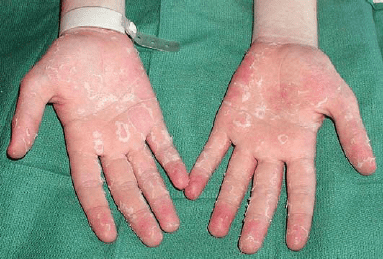
A factory worker presented with tremors and personality change. On Examination his hands show the Following picture. Most probable diagnosis is

| A |
Mercury Poisoining |
|
| B |
Lead Poisoining |
|
| C |
Arsenic Poisoining |
|
| D |
Narcotic Poisoining |
A factory worker presented with tremors and personality change. On Examination his hands show the Following picture. Most probable diagnosis is
| A |
Mercury Poisoining |
|
| B |
Lead Poisoining |
|
| C |
Arsenic Poisoining |
|
| D |
Narcotic Poisoining |
Symptoms described of Mercury Poisoining. The Image shows Acrodynia is also known as Feer’s disease or pink disease. It is caused by mercury toxicity.
The mechanism by which mercury causes damage ‑
| A |
Binds to -SH group of enzyme |
|
| B |
Directly toxic |
|
| C |
Inhibits ETC |
|
| D |
Inhibits protein synthesis |
The mechanism by which mercury causes damage ‑
| A |
Binds to -SH group of enzyme |
|
| B |
Directly toxic |
|
| C |
Inhibits ETC |
|
| D |
Inhibits protein synthesis |
Ans. is ‘a’ i.e., Binds to -SH group of enzyme
- Heavy metal toxicity is caused by tight binding of a metal such as mercury (Hg), lead (Pb), aluminium (Al), or iron (Fe) to a functional group of enzyme.
- Mercury, for example, binds to reactive sulfhydryl groups (-SH) in the active site of so many enzymes, that it has been difficult to determine which of the inhibited enzyme is responsible for mercury toxicity.
- Lead also has high affinity for sulfhydryl group.