
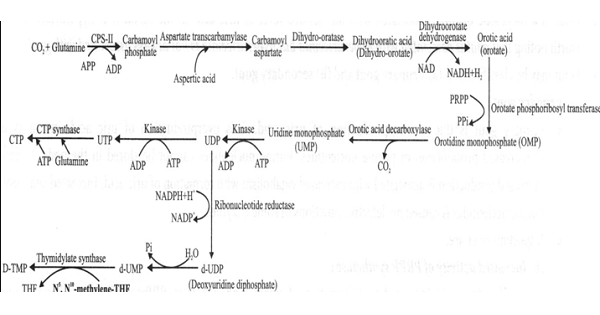
Metabolism of Pyrimidine
Nucleoside is made up of:
1. Pyrimidine
2. Histone
3. Sugar
4. Purine
5. Phosphate
| A |
1,2 & 3 |
|
| B |
1,3 & 4 |
|
| C |
1,3 & 5 |
|
| D |
2,3 & 4 |
Nucleoside is made up of:
1. Pyrimidine
2. Histone
3. Sugar
4. Purine
5. Phosphate
| A |
1,2 & 3 |
|
| B |
1,3 & 4 |
|
| C |
1,3 & 5 |
|
| D |
2,3 & 4 |
“The nucleoside is composed of purine purine or pyrimidine base linked to either D-ribose (in RNA) or D-2- deoxyribose (in DNA)”
- Nucleotides are nucleoside +P
- The Phosphodiester bond between the nucleotides is formed mainly between 3’OH group of sugar of one nucleotide to 3’OH group of sugar of another nucleotide.
Pyrimidine metabolism features a/e
| A |
Require CAD polypeptide chain |
|
| B |
6-azauridine 1/t oritidinuria |
|
| C |
DHOA-dehydrogenase is mitochondrial |
|
| D |
Reye syndrome decrease cytosolic carbamoyl phosphate |
Pyrimidine metabolism features a/e
| A |
Require CAD polypeptide chain |
|
| B |
6-azauridine 1/t oritidinuria |
|
| C |
DHOA-dehydrogenase is mitochondrial |
|
| D |
Reye syndrome decrease cytosolic carbamoyl phosphate |
D i.e. Reye syndrome decrease cytosolic carbamoyl phosphate
Apart from occurring in nucleic acids, pyrimidines are also found in:
| A |
Theophylline |
|
| B |
Theobromine |
|
| C |
Flavin mononucleotide |
|
| D |
Thiamine |
Apart from occurring in nucleic acids, pyrimidines are also found in:
| A |
Theophylline |
|
| B |
Theobromine |
|
| C |
Flavin mononucleotide |
|
| D |
Thiamine |
D i.e. Thiamine
Rate limiting step in pyrimidine synthesis ‑
| A |
Dihydro-orotase |
|
| B |
Ornithine transcarbomoylase |
|
| C |
Aspartate transcarbomoylase |
|
| D |
Carbamoyl phosphate synthase-I |
Rate limiting step in pyrimidine synthesis ‑
| A |
Dihydro-orotase |
|
| B |
Ornithine transcarbomoylase |
|
| C |
Aspartate transcarbomoylase |
|
| D |
Carbamoyl phosphate synthase-I |
Ans. is ‘c’ i.e., Aspartate transcarbomoylase
Which of the following is not a pyrimidine base ‑
| A |
Cytosine |
|
| B |
Uracil |
|
| C |
Guanine |
|
| D |
Thymine |
Which of the following is not a pyrimidine base ‑
| A |
Cytosine |
|
| B |
Uracil |
|
| C |
Guanine |
|
| D |
Thymine |
Ans. is ‘c’ i.e., Guanine
Purines Pyrimidines
Adenine Cytosine
Guanine Uraci I
Thymine
- Both purines (adenine and guanine) are found both in DNA & RNA.
- Among pyrimidines –
- Li Cytosine and uracil are found in RNA (thymine is not found in RNA).
- Cytosine and thymine are found in DNA (uracil is not found in DNA).
- In DNA, adenine is always paired with thymine by two hydrogen bonds; and guanine always paired with cytosine by three hydrogen bonds.

