
MOLECULAR CYTOGENETIC TECHNIQUE- (FISH)
| A |
Transfection |
|
| B |
Electroporation |
|
| C |
FISH |
|
| D |
Recombination |
Which of these is not a method for introducing genes into a cell?
| A |
Transfection |
|
| B |
Electroporation |
|
| C |
FISH |
|
| D |
Recombination |
Methods for introducing genes into a cell include, transfection (chemical based), electroporation (physical), infection (viral mediated) and recombination techniques.
| A |
FISH |
|
| B |
PCR |
|
| C |
SSCP |
|
| D |
Karyotyping |
Rapid method of chromosome identification in intersex is:
| A |
FISH |
|
| B |
PCR |
|
| C |
SSCP |
|
| D |
Karyotyping |
A i.e. FISH
FISH, chromosome painting and spectral karyotyping (SKY) are rapid methods of chromosome identificationQ.
Rapid method of chromosome identification in interphase is –
| A |
FISH |
|
| B |
PCR |
|
| C |
SSCP |
|
| D |
Karyotyping |
Rapid method of chromosome identification in interphase is –
| A |
FISH |
|
| B |
PCR |
|
| C |
SSCP |
|
| D |
Karyotyping |
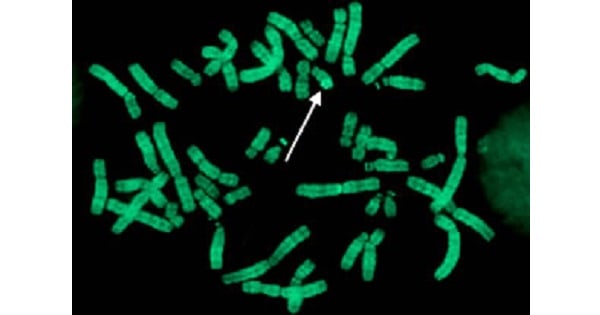
FISH is a cytogenetic technique that can be used to detect the presence or absence of specific DNA sequences (specific gene locus) on chromosomes.
It uses fluorescent probes that bind to only those parts of the chromosome with which they show a high degree of sequence similarity.
Fluorescence microscopy can then be used to find out where the fluorescent probe bound to the chromosome.
FISH can be used for rapid identification of chromosome during interphase.
FISH can be used in metaphase cells to detect specific microdeletions beyond the resolution of routine cytogenetics or identify extra material of unknown origin.
It can also help in cases where it is difficult to determine from routine cytogenetics if a chromosome has a simple deletion or is involved in a subtle or complex rearrangement.
In addition, metaphase FISH can detect some of the specific chromosome rearrangements seen in certain cancers.


