
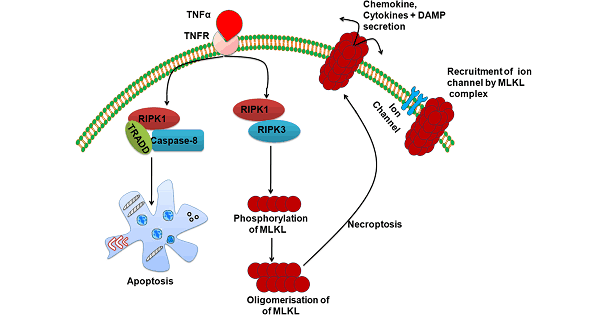
Necroptosis
The Fenton reaction leads to free radical generation when –
| A |
Radiant energy is absorbed by water |
|
| B |
Hydrogen peroxide is formed by myeloperoxidase |
|
| C |
Ferrous ions are converted to ferric ions |
|
| D |
Nitric oxide is converted to peroxynitrite anion |
The Fenton reaction leads to free radical generation when –
| A |
Radiant energy is absorbed by water |
|
| B |
Hydrogen peroxide is formed by myeloperoxidase |
|
| C |
Ferrous ions are converted to ferric ions |
|
| D |
Nitric oxide is converted to peroxynitrite anion |
Ans. is ‘c’ i.e., Ferrous ions are converted to ferric ions
o Free radicals are generated through Fenton’s reaction.
o In this reaction iron is converted from its ferrous to ferric form and a free radical is generated. i.e. (H202+Fe2+ —> Fe3++ OH++ OH-)
o Note :- H202 can also react with copper instead of iron to produce free radicals.
Free radicals
o Free radicals are chemical species that have a single unpaired electron in the outer orbit.
o Most of these are partially reduced reactive oxygen forms that are produced as an unavoidable byproduct of mitochondrial respiration —> also known as reactive oxygen species.
o The most important are hydrogen peroxide (11202), Superoxide anion (02) and hydroxyl radical (OH).
o Free radicals are highly reactive species and toxic —> they can damage the cell membrane and nucleic acids.
o Free radicals initiate autocatalytic reactions, whereby molecules with which they react are themselves converted
into free radicals to propagate the chain of damage.
o Free radicals are produced in several ways : ‑
I. Ionizing radiations (UV rays, X-rays) can hydrolyze water into hydroxyl (OH) and hydrogen (H) free radicals.
- Enzymatic metabolism of exogenous chemicals, e.g., CC14 can generate CC13.
- The reduction – oxidation reaction during normal metabolic process.
- During normal respiration, molecular oxygen is sequentially reduced by addition of electron to generate water.
- In this process small amount of H202, 02– and OH- are produced.
o H202 generated, can interact with 02 to generate OH through the Haber-weiss reaction.
H202+ 02 –> OH- + OH + 02
- Rapid burst of superoxide (02) occur in activated neutrophils during inflammation with the help ofNADPH oxidase.
- Some intracellular oxidases, e.g., xanthine oxidase generate superoxide radicals.
- Transition metal such as iron and copper donate or accept free electrons and catalyze free radical formation (see above fenton reaction).
- Nitric oxide (NO) generated in endothelium, macrophages and neurons can also act as free radical. o Free radicals cause cell injury by ‑
I. Lipid peroxidation and subsequent damage of cellular and mitochondrial membrane.
- Oxidative modification and subsequent degradation of intracellular proteins.
- DNA strand break.
All of the following are antioxidant except:
September 2005
| A |
Vitamin A |
|
| B |
Vitamin B |
|
| C |
Vitamin C |
|
| D |
Vitamin E |
All of the following are antioxidant except:
September 2005
| A |
Vitamin A |
|
| B |
Vitamin B |
|
| C |
Vitamin C |
|
| D |
Vitamin E |
Ans. B: Vitamin B
Antioxidants are a group of compounds that help to protect the body from the formation and elimination of free radicals. Free-radicals are formed from exposure to sunlight and pollution and also as a byproduct of cell metabolism. Alcohol, cigarette smoke, stress and even diet also affect the level of free-radical development in the body. Excellent antioxidants include Vitamin A, Vitamin E, Vitamin C, zinc, selenium, ginkgo biloba, grape seed extract, and green tea extract.
Enzyme that protects the brain from free radical injury is ‑
| A |
Myeloperoxidase |
|
| B |
MAO |
|
| C |
Superoxide dismutase |
|
| D |
Hydroxylase |
Enzyme that protects the brain from free radical injury is ‑
| A |
Myeloperoxidase |
|
| B |
MAO |
|
| C |
Superoxide dismutase |
|
| D |
Hydroxylase |
Ans. is ‘c’ i.e., Super oxide dismutase

Which of the following Vitamin is an antioxidant‑
| A |
Vitamin D |
|
| B |
Vitamin E |
|
| C |
Vitamin K |
|
| D |
Vitamin B1 |
Which of the following Vitamin is an antioxidant‑
| A |
Vitamin D |
|
| B |
Vitamin E |
|
| C |
Vitamin K |
|
| D |
Vitamin B1 |
Ans. is ‘b’ i.e., Vitamin E
Vitamin E (a-Tocopheroll
- Vitamin E is sometimes described as anti-sterility vitamin.
- However, its anti-sterility function is seen only in some animals and not in human beings.
- Vitamin E activiy is present in several tocopherols, the most important being a-, (3-, y- and 6- tocopherol. a Tocopherol is the most abundant and is taken as the standard.
- The most important function of vitamin E in human beings is to act as an anti-oxidant.
- It prevents the oxidation of other antioxidants, .e.g, carotenes, vitamin A and vitamin C.
- Vitamin E is the lipid-soluble antixodant in cell membranes and plasma lipoproteins.
- The main function of vitamin E is as a chain-breaking, free radical-trapping antioxidant in cell membranes and plasma lipoproteins by reacting with lipid peroxide radicals formed by peroxidation of polyunsatured fatty acid. o Vitamin E prevents rancidity of fats due to its antioxidant action.
Antioxidant vitamins are :-
- Vitamin -A (carotenes) Vitamin – C
- Vitamin – E
Programmed cell death without caspase activation
| A |
Autophagy |
|
| B |
Necroptosis |
|
| C |
Pyroptosis |
|
| D |
Gangrene |
Programmed cell death without caspase activation
| A |
Autophagy |
|
| B |
Necroptosis |
|
| C |
Pyroptosis |
|
| D |
Gangrene |
- Necroptosis is a hybrid of necrosis (consider this more) and apoptosis.
- It is a programmed cell death without caspase (cysteine- aspartic proteases) activation
Caspase dependent programmed cell death is
| A |
Necroptosis |
|
| B |
Pyroptosis |
|
| C |
Autophagy |
|
| D |
None of them |
Caspase dependent programmed cell death is
| A |
Necroptosis |
|
| B |
Pyroptosis |
|
| C |
Autophagy |
|
| D |
None of them |
- It is a caspase (caspase 1 & 11) dependent programmed cell death.
- It is a form of programmed cell death associated with antimicrobial responses during inflammation.

