
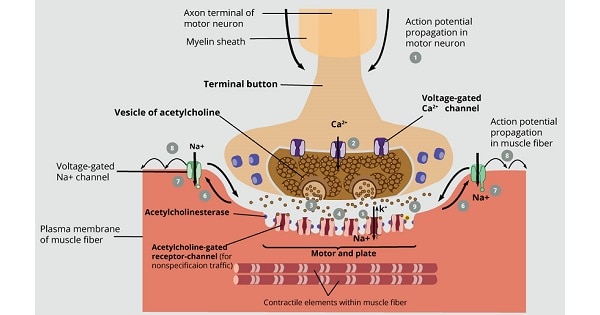
NEUROMUSCULAR JUNCTION AND EVENTS
| A | Action potentials on the alpha motor neuron release acetylcholine (Ach) from the axon terminal | |
| B | Ach stimulates nicotinic cholinergic receptors on the muscle endplate | |
| C | Cholinergic receptors on the muscle endplate are cation channels | |
| D | Alpha motor neurons excite, and Renshaw cells inhibit, the muscle endplate |
| A | Action potentials on the alpha motor neuron release acetylcholine (Ach) from the axon terminal | |
| B | Ach stimulates nicotinic cholinergic receptors on the muscle endplate | |
| C | Cholinergic receptors on the muscle endplate are cation channels | |
| D | Alpha motor neurons excite, and Renshaw cells inhibit, the muscle endplate |
There are no Renshaw cells at the neuromuscular junction. Renshaw cells inhibit motor neurons in the anterior gray horn of the spinal cord. Action potentials on the alpha motor neuron release acetylcholine (ACh) from the axon terminal. The ACh diffuses across the synaptic cleft and stimulates nicotinic receptors on the muscle endplate, generating an action potential that causes contraction of the muscle fiber. Cholinergic receptors on the muscle endplate are cation channels.
Which of the following happens when a nerve impulse arrives at the neuromuscular junction?
| A |
Release of calcium from Sarcoplasmic reticulum |
|
| B |
ACh binds to receptors in Sarcolemmal membrane |
|
| C |
Release of K+ into the Sarcoplasm |
|
| D |
Sodium ions rush outside the Sarcoplasm |
Which of the following happens when a nerve impulse arrives at the neuromuscular junction?
| A |
Release of calcium from Sarcoplasmic reticulum |
|
| B |
ACh binds to receptors in Sarcolemmal membrane |
|
| C |
Release of K+ into the Sarcoplasm |
|
| D |
Sodium ions rush outside the Sarcoplasm |
Molecules of ACh diffuse across the synaptic cleft and bind to ACh receptors on the motor end plate.
Ref: Human Anatomy And Phsyiology, edited by Sanghani, Page 204

At the neuromuscular junction:
| A |
The muscle membrane possesses muscarinic receptors |
|
| B |
The motor nerve endings secrete norepinephrine |
|
| C |
Curare leads to prolongation of neuromuscular transmission |
|
| D |
The motor nerve endings secrete acetylcholine |
At the neuromuscular junction:
| A |
The muscle membrane possesses muscarinic receptors |
|
| B |
The motor nerve endings secrete norepinephrine |
|
| C |
Curare leads to prolongation of neuromuscular transmission |
|
| D |
The motor nerve endings secrete acetylcholine |
The nerve impulse is transmitted to the muscle across the neuromuscular synapse (also called the neuromuscular junction). The transmitter at the neuromuscular synapse is ACh. The ACh molecule binds to the postsynaptic ACh receptor, a complex of 5 proteins that constitute the postsynaptic ion channel. Binding of ACh by this receptor causes a conformational change in the receptor that leads to a local increase in the conductance of Na and K and other small ions. This produces a depolarization known as the endplate potential.
Which of the following events happens when a nerve impulse arrives at the Neuromuscular Junction:
| A |
Release of Calcium from the Sarcoplasmic Reticulum |
|
| B |
Acetylcholine binds to receptors on the postsynaptic sarcolemmal membrane |
|
| C |
Acetylcholine binds to receptors on the postsynaptic sarcolemmal membrane |
|
| D |
Efflux of calcium through synaptic vesicles into the synaptic cleft |
Which of the following events happens when a nerve impulse arrives at the Neuromuscular Junction:
| A |
Release of Calcium from the Sarcoplasmic Reticulum |
|
| B |
Acetylcholine binds to receptors on the postsynaptic sarcolemmal membrane |
|
| C |
Acetylcholine binds to receptors on the postsynaptic sarcolemmal membrane |
|
| D |
Efflux of calcium through synaptic vesicles into the synaptic cleft |
B i.e. Acetylcholine binds to receptors on the postsynaptic sarcolemmal membrane
-Action potential conducted along the nerve fiber enhances the endocytic release of ACh (acetyl choline) from vesicles (packets) into the neuromuscular cleft by enhancing the permeability of presynaptic membrane to Ca++ ions (lit Ca++ influx not efflux through voltage gated channels).
– Sequence of events when a nerve impulse arrives at neuromuscular junction is: Calcium influx in presynaptic neural membrane though voltage gated Ca++ channels -> Exocytosis of ACh from synaptic vesicles into synaptic cleft -> ACh binds to Nm receptors on post synaptic sarcolemmal membrane which are ligand gated Na+ channels -+ Na+ influx; development of EPP & current sink -> AP conducted in both directions and enter muscle fiber via T-tubules -> Ca++ released (efflux) from sarcoplasmic reticulum (ryanodine receptor channels) in response to voltage change sensed by DHPR on T tubules Binding of Ca++ to troponin C, uncovering myosin binding sites of actin l/t formation of cross linkage (bridging) that allows muscle contraction.
Nerve impulse reach NM junction -+ Increased Ca++ permeability of presynaptic neural membrane d/t opening of voltage gated Ca++ channels –> Influx of calcium from synaptic space to interior of presynaptic nerve ending —> Calcium ion attracts acetyl choline (ACh) vesicles and draws
/ fuse them to neural membrane adjacent to dense bars leading to a marked increase in exocytosis/ release of ACh in synaptic cleft?
ACh diffuses through synaptic space and binds to nicotinic cholinergic (Nm) receptors in the post synaptic motor end plate. (ACh receptors are concentrated at the top of subneural clefts = junctional folds) —> Binding of ACh to ACh receptors (which are ligand gated sodium channel) increases Na+ and K+ conductance of muscle cell membrane.
Influx of positively charged Na+ ions into the muscle fibre creates a local positive potential change inside the muscle fiber i.e. end plate potential (EPP) -4 Current sink created between depolarized end plate (with EPP) and adjacent muscle plasma membrane on (both sides) initiates an action potential (ie depolarizes the adjacent muscle membrane to its firing level) —> Action potentials are generated on either side of end plate and are conducted away from end plate in both directions along the muscle fiber -+ AP (depolarization) spreads to all parts & to interior of muscle fibers by way of T (transverse) tubules (communicate externally with ECF, contain ECF and are actually internal extension of cell membrane) -4 As AP reaches T-tubules, the voltage change is sensed by DHPR (dihydro pyridine receptors) on T tubule -+ DHPRs are physically linked to calcium release (ryanodine receptor) channels in the adjacent sarcoplasmic reticular (SR) cisternae. AP in T-tubule cause conformational change in voltage sensing DHP receptors, which unlocks (opens) the Ca’+ release channels in terminal cistern of SR and permitting Ca” to rapidly diffuse into the sarcoplasm (thick & thin filament). The calcium induced Ca” release quickly amplifies the release of Ca” -4 Binding of Ca– to troponin C, uncovering myosin binding sites on actin -4 Formation of cross linkage between actin and myosin and sliding of thick on thin filaments producing movement.

