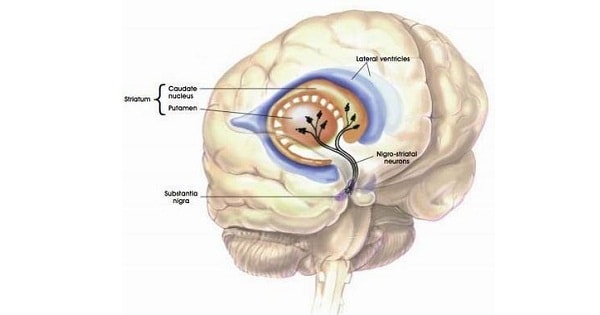
Parkinsonism
Patient presenting with pellagra, parkinsonism, convulsions, anemia and kidney stones has deficiency of
| A |
Coenzyme A |
|
| B |
FADH |
|
| C |
Niacin |
|
| D |
Pyridoxal phosphate |
Patient presenting with pellagra, parkinsonism, convulsions, anemia and kidney stones has deficiency of
| A |
Coenzyme A |
|
| B |
FADH |
|
| C |
Niacin |
|
| D |
Pyridoxal phosphate |
D i.e. Pyridoxal phosphate
Which of the following enzymes is believed to be deficient in Parkinsonism?
| A |
DOPA Decarboxylase |
|
| B |
Tyrosine Hydroxylase |
|
| C |
Phenylalanine Hydroxylase |
|
| D |
Dopamine oxidase |
Which of the following enzymes is believed to be deficient in Parkinsonism?
| A |
DOPA Decarboxylase |
|
| B |
Tyrosine Hydroxylase |
|
| C |
Phenylalanine Hydroxylase |
|
| D |
Dopamine oxidase |
Answer is B (Tyrosine Hydroxylase):
Tyrosine Hydroxylase is the most important (critical) enzyme, deficiency which leads to Parkinson’s disease
The main biochemical charachteristic of Parkinson’s Disease is the reduction of neurotransmitter and the dopamine synthesizing enzyme system including Tyrosine Hydroxylase (7’H) and Tetrahydrobiopterin (BH4) Cofactor in nigrostriatal neurons.
`The loss of Tyrosine Hydroxylase represents the critical failure in Parkinson’s Disease because this enzyme is the rate limiting enzyme dopamine synthesis.
With a deficiency of tyrosine hydroxylase the ever-shrinking pool of nigrostriatal tract neurons cannot sustain the essential synthetic pathway.
Once approximately 80% of these neurons degenerate, the nigrostriatal tract cannot synthesize adequate dopamine and Parkinson’s disease symptoms appear’ – ‘Clinical Neurology for Psychiatrits’.
Which of the following metal ions is associated with secondary Parkinsonisms:
| A |
Mangnese (Mn) |
|
| B |
Magnesium (Mg) |
|
| C |
Selenium (Se) |
|
| D |
Molybednum (Me) |
Which of the following metal ions is associated with secondary Parkinsonisms:
| A |
Mangnese (Mn) |
|
| B |
Magnesium (Mg) |
|
| C |
Selenium (Se) |
|
| D |
Molybednum (Me) |
Answer is A (Mangnese (Mn)):
Manganese ion exposure is implicated in the free radical damage of the basal ganglia causing Parkinsonism.
Toxins Implicated in Parkinsonism (Harrison)
- Manganese (Mn)
- MPTP (1 Methyl – > Phenyl –1, 2, 3, 6 tetrahydropyridine)
- Carbonmonoxide
- Carbondisulphide
- Ctanide
- Hexane
- Methanol
Toxins reported to induce Parkinonism: (Handbook of Atypical Parkinsonism)
- Betel nut (plus antiPsychotics)
- Carbon monoxide
- Contrast agent for cardiac catheterization
- Cyanide
- Ethanol intoxication, ethanol withdrawal
- Ethylene glycol
- Herbicides (paraquat, diquat, glyphosate)
- Heroin
- Hydrogen sulfide
- Kava-kava
- Manganese
- Maneb (Manganese Ethylene-Bis-Dithiocarbamate)
- Mercury
- Methanol
- Methcathinone (manganese ephedrone)
- MPTP (I-methyl-4-phenyl-1,2,3,6-tetrahydropyridine)
- Organic solvents (carbon disulfide, n-hexane, toluene, trichloroethylene)
- Organophosphate insecticide poisoning
- Petroleum products
Which of the following is not seen in Parkinsonism:
| A |
Preserved postural reflexes |
|
| B |
Hypokinesia |
|
| C |
Rigidity |
|
| D |
Static tremors |
Which of the following is not seen in Parkinsonism:
| A |
Preserved postural reflexes |
|
| B |
Hypokinesia |
|
| C |
Rigidity |
|
| D |
Static tremors |
Answer is A (Preserved postural reflexes):
In Parkinsonism, the postural reflexes are not preserved.
There is difficulty in maintaining balance.
The posture is stooped, and the attitude is flexed.
Dinesh, a 56 yr aged man presents with complaints of slowness of movements, postural instability, tremors, rigidity and memory loss. Most likely diagnosis is :
| A |
Multi infarct dementia |
|
| B |
Alzheimer’s disease |
|
| C |
Parkinsonism |
|
| D |
None of the above |
Dinesh, a 56 yr aged man presents with complaints of slowness of movements, postural instability, tremors, rigidity and memory loss. Most likely diagnosis is :
| A |
Multi infarct dementia |
|
| B |
Alzheimer’s disease |
|
| C |
Parkinsonism |
|
| D |
None of the above |
Answer is C (Parkinsonism):
Patient is present with the characteristic triad of Parkinsonism.
Triad of Parkinsonism.
- Rigidity
- Bradykinesia
- Tremor at rest,
- A characteristic disturbance of gait and posture is seen
- – this explains slowness of movements
- A depressed mood is common and an impairment of cognitive functions sometimes amounting to frank dementia is frequently evident in advanced cases
- – this explains the memory loss present in the patient
- Parkinsonism is caused by a disturbance in substantia nigra.Q
- Tremor is typically at rest Q with frequency 4 – 6 Hz.Q
- Tendon reflexes are unaltered Q (Normal deep tendon reflexes)Q
- Plantar reflex is typically flexor Q (Negative Babiniski) Q
- Gait is festinating gait Q
- Small handwriting Q
- Normal intelligence Q
- Emotional ability Q
- Masked expressionless facies Q
- Slurred indistinct speechQ
Parkinsonism is characterised by all of the following characteristic features except :
| A |
Rigidity |
|
| B |
Akinesia |
|
| C |
Tremors at rest |
|
| D |
Past pointing |
Parkinsonism is characterised by all of the following characteristic features except :
| A |
Rigidity |
|
| B |
Akinesia |
|
| C |
Tremors at rest |
|
| D |
Past pointing |
Answer is D (Past pointing):
Past pointing is a feature of ‘Cerebellar disease’.
It is not seen in an extrapyramidal syndrome.
Other features mentioned are all true for Parkinsonism.
Which of the following is the most commonly used site for Transcranial Magnetic Stimulation to reduce frequency of Parkinsonism symptoms:
| A |
Striatus |
|
| B |
Globus Pallidus |
|
| C |
Subthalamic Nucleus |
|
| D |
Putamen |
Which of the following is the most commonly used site for Transcranial Magnetic Stimulation to reduce frequency of Parkinsonism symptoms:
| A |
Striatus |
|
| B |
Globus Pallidus |
|
| C |
Subthalamic Nucleus |
|
| D |
Putamen |
Answer is C (Subthalamic Nucleus):
Primary Targets
- Subthalamic Nucleus (STN)
- Globus Pallidus Internus (GPI)
- Subthalamic Nucleus (STN) is the single most common preferred site for Deep Brain Stimulation in patients with Parkinsonism.
- Globus Pallidus Internus (GPi) is the second most common site for Deep Brain Stimulation in patients with Parkinsonism and provides comparable results to DBS of STN.
- Subthalamic nucleus and Globus Pallidus Internus both provide comparable efficacy (Believed to be equally effective)
Other Targets
- Ventral Intermediate Nucleus of Thalamus (VMI) (Efficacious only in relieving Tremor from Parkinsonism.
- Other Parkinsonian motor symptoms may not respond and hence this target is not preferred)
- Pedunculopantine Nucleus
- (DBS of Pedunculopontine nucleus may be beneficial for patients with advanced parkinsonism and predominant axial symptoms, postural instability and gait disturbance. Results are however still limited to only a few patients)
(Springer) 2007/180; Mardsen’s Book of movement Disorders (Oxford) 2012/298
Subthalamic Nucleus is widely accepted as the preferred site for Deep Brain Stimulation (Transcranial Magnetic Stimulation) for patients with Parkinsonism.
Deep Brain Stimulation for Parkinson’s Disease (Taken from Operative Neuromodulation)
- Deep Brain Stimulation has become a standard therapy for patients with advanced Parkinson’s Disease
- Although clinical efficacy of both GPi and STN stimulation is comparable it has become widely accepted to prefer STN over GPi
- The Rationale for STN targeting include:
(i) The stimulation energy required to gain maximum clinical improvement seem to be lower for STN than for GPi
(ii) STN stimulation seems to have more prominant and stable effects on L-DOPA responsive off-period symptoms in the long term.
Subthalamic Nucleus Stimulation effectively improves all cardinal motor symptoms including gait, posture and balance and is the preferred target in Europe and North America’
– Mardsen’s Book of MOvement Disorders (Oxford) 2012/298
Note:
STN stimulation bears a higher risk of cognitive and neuropsychiatric behavioural complications in comparison to GPi stimulation.
GPI stimulation may be preferred over STN stimulation for patients with pre-existing conditions like depression.
Deep Brain Stimulation for Parkison’s Disease: Review
What is Deep Brain Stimulation (DBS)
- DBS is a relatively new procedure that uses an implantable electrode into a specific target in the brain and is attached to a programmable pulse generator.
- The pulse generator is implanted in a pocket below the clavicle and connected to the DBS electrode in the Brain.
- (The pulse generation is just like a cardiac pacemaker but the wire goes to the specific site in the brain)
What is the principle of DBS in Parkinson’s Disease
- Parkinson’s disease is characterized by loss of dopaminergic input to the striatium, which has been shown to be associated with hyperactivity of two key nuclei within the basal ganglia, namely the subthalamic nucleus and the
- Globus Pallidus Internus.
- Dopaminergic dennervation in PD leads to increased firing of neurons in the STN and GPi resulting in excessive inhibition of the thalamus, reduced activation of the cortical motor systems and development of Parkinsonian Features.
- DBS is believed to reduce the neuronal overactivity of the STN and/or the GPi and thereby improve features of PD.
What specific regions in the brain are targetted by DBS
- There are three brain targets that have been FDA approved for use in Parkinson’s Disease for Deep Brain Stimulation
- Subthalamic nucleus (STN): Most preferred & commonly used target
- Globus pallidus Internus (GPi): Effective target (Results comparable with STN)
- Thalamus (Ventral Intermediate Nucleus): Only effective in relieving Tremor (not preferred anymore)
What are the indications for DBS (Ideal candidate)
- The procedure is primarily indicated for patients who suffer disability from levodopa induced motor complications that cannot be satisfactorily controlled with drug manipulation.
- Symptoms that improve DBS are essentially the same individual symptoms that improve with levodopa (dopamine) with the exception of medication refractory tremor and dyskinesias.
- DBS provides effective relief from all cardinal dopaminergic motor symptoms including gait, posture and balance.
- Improves tremor, rigidity bradykinesia. It provides dramatic result with respect to “off’ time and dyskinesias but does not improve features that fail to respond to levodopa.
- It does not prevent the development or progression of non-dopaminergic features such as freezing, falling and dementia.
- DBS does not improve cognitive (thinking ability).
- Decrease the dose of medications required (in many but not all cases)
Which of the following is NOT seen in Parkinsonism:
March 2013
| A |
Preserved postural reflexes |
|
| B |
Hypokinesia |
|
| C |
Rigidity |
|
| D |
Static tremors |
Which of the following is NOT seen in Parkinsonism:
March 2013
| A |
Preserved postural reflexes |
|
| B |
Hypokinesia |
|
| C |
Rigidity |
|
| D |
Static tremors |
Ans. A i.e. Preserved postural reflexes
Parkinsonism like features are evident in surviving patients of which poisoning ‑
| A |
CO |
|
| B |
CO2 |
|
| C |
H2S |
|
| D |
N2O |
Parkinsonism like features are evident in surviving patients of which poisoning ‑
| A |
CO |
|
| B |
CO2 |
|
| C |
H2S |
|
| D |
N2O |
Ans. is ‘a’ i.e., CO
- In persons surviving after severe Carbon monoxide exposure and in delayed deaths from carbon monoxide poisoning bilateral symmetrical necrosis and cavitation of the basal ganglia in the brain, especially the putamen and globus pallidus, is the most characteristic lesion.
- This is similar to the degenerative findings seen in parkinsonism and thus patient with CO exposure may develop features of parkinsonism
Deep brain stimulation used in treatment of‑
| A |
Depression |
|
| B |
Parkinsonism |
|
| C |
Dementia |
|
| D |
Delirium |
Deep brain stimulation used in treatment of‑
| A |
Depression |
|
| B |
Parkinsonism |
|
| C |
Dementia |
|
| D |
Delirium |
Ans. B.)Parkinsonism
Deep brain stimulation
- It is a neurosurgical procedure involving the implantation of a medical device called a neurostimulator (sometimes referred to as a ‘brain pacemaker’), which sends electrical impulses, through implanted electrodes, to specific targets in the brain (brain nuclei) for the treatment of movement and neuropsychiatric disorders.
- DBS in select brain regions has provided therapeutic benefits for otherwise-treatment-resistant disorders such as Parkinson’s disease, essential tremor, dystonia, chronic pain, major depression and obsessive–compulsive disorder (OCD).
-
The Food and Drug Administration (FDA) approved DBS as a treatment for essential tremor and Parkinson’s disease in 1997, dystonia in 2003, and OCD in 2009.
DBS is also used in research studies to treat chronic pain, PTSD,and has been used to treat various affective disorders, including major depression; none of these applications of DBS have yet been FDA-approved.