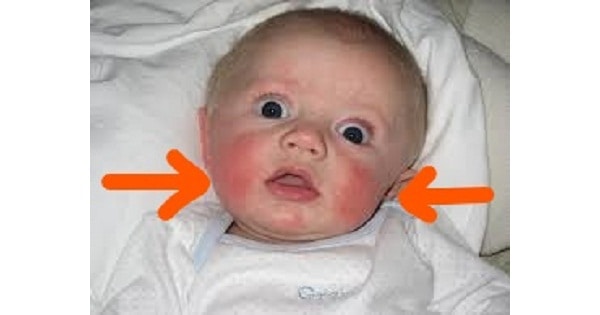
Parvovirus
| A | Rubella | |
| B | Varicella- zoster | |
| C | Parvovirus | |
| D | Rubella |
| A | Rubella | |
| B | Varicella- zoster | |
| C | Parvovirus | |
| D | Rubella |
Parvovirus
B 19 is the causative agent of erythema infectiosum (fifth disease). It is associated with transient aplastic crisis in persons with hereditary hemolytic anemia. In adults, it is also associated with polyarthralgia.
Nonimmume hydrops foetalis is seen in all of the following conditions except :
| A |
a- Thalassemia |
|
| B |
Parvovirus-19R |
|
| C |
Rh-incompatibility |
|
| D |
All |
Nonimmume hydrops foetalis is seen in all of the following conditions except :
| A |
a- Thalassemia |
|
| B |
Parvovirus-19R |
|
| C |
Rh-incompatibility |
|
| D |
All |
Ans. is c i.e. Rh incompatibility
One of the following is not a cultivable virus –
| A |
Papova |
|
| B |
Parvovirus B-19 |
|
| C |
Herpes |
|
| D |
Adenovirus |
One of the following is not a cultivable virus –
| A |
Papova |
|
| B |
Parvovirus B-19 |
|
| C |
Herpes |
|
| D |
Adenovirus |
Ans. is ‘b’ i.e., Parvovirus B-19
“The Parvovirus B-19 is difficult to grow. Virus isolation is not used to detect infection.”
. Herpes virus grows in a variety of primary and continuous cell cultures.
. Adenoviruses grow in tissue cultures
Papoviruses can be grown in tissue cultures
Parvovirus causes –
| A |
Erythema infectiosum |
|
| B |
Exanthema subitum |
|
| C |
Roseola infantum |
|
| D |
Sixth disease |
Parvovirus causes –
| A |
Erythema infectiosum |
|
| B |
Exanthema subitum |
|
| C |
Roseola infantum |
|
| D |
Sixth disease |
Ans. is `a’ i.e., Erythema infectiosum
- Parvovirus causes erythema infectiosum (fifth disease).
In Parvovirus infection what is common in adult
| A |
Bone marrow aplasia |
|
| B |
PRCA |
|
| C |
Erythema infectiosum |
|
| D |
Arthropathy |
In Parvovirus infection what is common in adult
| A |
Bone marrow aplasia |
|
| B |
PRCA |
|
| C |
Erythema infectiosum |
|
| D |
Arthropathy |
Ans. is ‘d’ i.e. Arthopathy
Parvovirus infection in adult commonly causes acute arthalgia and arthritis. The characteristic feature of Parvovirus arthritis is that it is peripheral involves wrist, hand and knees and arthritis resolves by three weeks and it is nondestructive. Sometimes it is associated with rash.
Parvovirus infection is associated with –
| A |
Hydrops fetalis |
|
| B |
Aplastic anemia |
|
| C |
Abortion |
|
| D |
All |
Parvovirus infection is associated with –
| A |
Hydrops fetalis |
|
| B |
Aplastic anemia |
|
| C |
Abortion |
|
| D |
All |
Ans. is. `a’ i.e., Hydrops fetalis, `b’ i.e., Aplastic anemia, ‘c’ i.e., Abortion
. Most of the Parvo-B19 infections are asymptomatic.
. Most common manifestation of symptomatic B 19 infections is erythema infectiosum also known as fifth disease or slapped cheek disease.
. Parvo-B19 infection during pregnancy can lead to hydrops fetalis and fetal loss.
. Parvo-B19 occasionaly causes hemophagocytic syndrome.
All of the following statements about parvovirus B-19 are true, except –
| A |
<10% spread by transplacental route |
|
| B |
Respiratory route is the primary mode of transmission |
|
| C |
It is a DNA virus |
|
| D |
Affects erythroid progenitors |
All of the following statements about parvovirus B-19 are true, except –
| A |
<10% spread by transplacental route |
|
| B |
Respiratory route is the primary mode of transmission |
|
| C |
It is a DNA virus |
|
| D |
Affects erythroid progenitors |
Ans. is `a’ i.e., <10% spread by transplacental route
. Vertical (transplacental) transmission rates are estimated to be 300/0 or higher.
. Transmission is primarily by respiratory route and also through blood.
. Parvovirus is a DNA virus.
. Parvovirus affects erythroid progenitors.
Parvovirus BI 9 does not cause –
| A |
Roseola infantum |
|
| B |
Aplastic anemia in sickle cell disease |
|
| C |
Fetal hydrops |
|
| D |
All |
Parvovirus BI 9 does not cause –
| A |
Roseola infantum |
|
| B |
Aplastic anemia in sickle cell disease |
|
| C |
Fetal hydrops |
|
| D |
All |
Ans. is `a’ i.e., Roseola infantum
Infection with which of the following agents is particularly dangerous for anemic patients –
| A |
Adenovirus |
|
| B |
Cytomegalovirus |
|
| C |
Herpes simplex virus |
|
| D |
Parvovirus |
Infection with which of the following agents is particularly dangerous for anemic patients –
| A |
Adenovirus |
|
| B |
Cytomegalovirus |
|
| C |
Herpes simplex virus |
|
| D |
Parvovirus |
Ans. is ‘d’ i.e., Parvovirus
Parvovirus B-19 induces aplastic crisis in children with hemolytic anemias as in sickle cell disease
Which of the following is the common clinical manifestation of human parvovirus B 19 (HPV-B 19) infection ?
| A |
Aplastic crisis in hemolytic anemia patients |
|
| B |
Anemia in neonatal period |
|
| C |
Erythema infectiosum |
|
| D |
Hydrops fetalis |
Which of the following is the common clinical manifestation of human parvovirus B 19 (HPV-B 19) infection ?
| A |
Aplastic crisis in hemolytic anemia patients |
|
| B |
Anemia in neonatal period |
|
| C |
Erythema infectiosum |
|
| D |
Hydrops fetalis |
Ans. is ‘c’ i.e., Erythema infectiosum
Aplastic anemia in hereditary spherocytosis precipitated by-
| A |
Parvo virus |
|
| B |
HIV |
|
| C |
Adenovirus |
|
| D |
Influenza virus |
Aplastic anemia in hereditary spherocytosis precipitated by-
| A |
Parvo virus |
|
| B |
HIV |
|
| C |
Adenovirus |
|
| D |
Influenza virus |
Answer is A (Parvovirus)
Aplastic crisis is usually triggered by an acute parvovirus infection.
Smallest Virus is ‑
| A |
Herpes virus |
|
| B |
Adenovirus |
|
| C |
Parvovirus |
|
| D |
Poxvirus |
Smallest Virus is ‑
| A |
Herpes virus |
|
| B |
Adenovirus |
|
| C |
Parvovirus |
|
| D |
Poxvirus |
Ans. is `c’ i.e. Parvovirus
Which of the following is true about the condition shown in the picture below ? 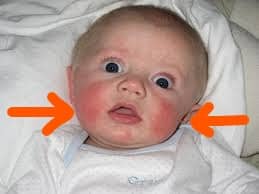
| A |
Slapped check appearance seen. |
|
| B |
Caused by parvovirus. |
|
| C |
Defervescene before rash. |
|
| D |
a and b. |
Which of the following is true about the condition shown in the picture below ?
| A |
Slapped check appearance seen. |
|
| B |
Caused by parvovirus. |
|
| C |
Defervescene before rash. |
|
| D |
a and b. |
The condition shown in the picture above represents erythema infectiosum characterized by slapped check appearance seen, and is causd by parvovirus.
Usually associated with parvovirus B19 infection in those with hereditary spherocytosis
| A |
Mild to moderate splenomegaly |
|
| B |
Aplastic crisis |
|
| C |
Gallstones |
|
| D |
Hemolytic crisis |
Usually associated with parvovirus B19 infection in those with hereditary spherocytosis
| A |
Mild to moderate splenomegaly |
|
| B |
Aplastic crisis |
|
| C |
Gallstones |
|
| D |
Hemolytic crisis |
Ans. is ‘b’ i.e., Aplastic crisis
- Parvovirus B19 selectively infects erythroid precursors and is the most common aetiological agent that induces
- aplastic crisis in patients with hereditary spherocytosis (and other Hemolytic disorders).
Transient aplastic crisis
- Persons with decreased erythrocytes caused by conditions such as iron deficiency anemia, human immunodeficiency virus sickle cell disease, spherocytosis or thalassemia are at risk of transient aplastic crisis if infected with parvovirus B19.
- The virus causes a cessation of erythrocyte production.
- Parvovirus infection may be the first manifestation in HS.
- It begins with reticulocytosis and thrombocytosis
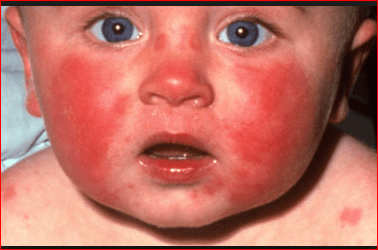
What might be the probable cause for the condition shown in the image?
| A |
Rubella |
|
| B |
Measles |
|
| C |
Parvo Virus |
|
| D |
Roseola |
What might be the probable cause for the condition shown in the image?
| A |
Rubella |
|
| B |
Measles |
|
| C |
Parvo Virus |
|
| D |
Roseola |
Ans:C.)Parvo Virus
Erythema infectiosum(Slapped Cheek Syndrome) is shown in the image.
ERYTHEMA INFECTIOSUM
- Erythema infectiosum or fifth disease is one of several possible manifestations of infection by parvovirus B19.
- The name “fifth disease” comes from its place on the standard list of rash-causing childhood diseases, which also includes measles (1st), scarlet fever (2nd), rubella (3rd), Dukes’ disease (4th, however is no longer widely accepted as distinct) and roseola (6th).
- Fifth disease starts with a low-grade fever, headache, rash, and cold-like symptoms, such as a runny or stuffy nose. These symptoms pass, then a few days later the rash appears. The bright red rash most commonly appears in the face, particularly the cheeks. This is a defining symptom of the infection in children (hence the name “slapped cheek disease”).
- Teenagers and adults may present with a self-limited arthritis.
- Transmission:
- Fifth disease is transmitted primarily by respiratory secretions (saliva, mucus, etc.) but can also be spread by contact with infected blood. The incubation period (the time between the initial infection and the onset of symptoms) is usually between 4 and 21 days. Individuals with fifth disease are most infectious before the onset of symptoms.