PERIARTHRITIS SHOULDER (‘FROZEN’ SHOULDER)
54-year-old female with decreased range of motion and right shoulder pain increasing over the last 2 months. Identify the Underlying disorder by shown in Photograph .
In both the images,left side is a normal picture to compare with the abnormal right side.


| A |
Fracture head humerus |
|
| B |
Rotator cuff injury |
|
| C |
Frozen shoulder |
|
| D |
Painful arc syndrome |
54-year-old female with decreased range of motion and right shoulder pain increasing over the last 2 months. Identify the Underlying disorder by shown in Photograph .
In both the images,left side is a normal picture to compare with the abnormal right side.
| A |
Fracture head humerus |
|
| B |
Rotator cuff injury |
|
| C |
Frozen shoulder |
|
| D |
Painful arc syndrome |
Ans:C.) Frozen shoulder
First image shows thickening of the capsule of the shoulder joint.
Second image shows absent axillary recess.
Frozen shoulder (adhesive capsulitis)
- A condition characterised by thickening and contraction of the shoulder joint capsule and surrounding synovium.
- It typically affects women in the 5th to 6th decades of life.
- The incidence in patients with diabetes is reported to be 2 to 4 times higher than in the general population.
Clinical presentation:
Adhesive capsulitis presentation can be broken into three distinct stages:
- freezing: painful stage
- patients may not present during this stage because they think that eventually, the pain will resolve if self-treated.
- as the symptoms progress, pain worsens and both active and passive range of motion (ROM) becomes more restricted
- typically lasts between 3 and 9 months and is characterised by an acute synovitis of the glenohumeral joint
- frozen: transitional stage
- most patients will progress to the second stage
- because of pain at end ROM, use of the arm may be limited causing muscular disuse
- can last between 4 to 12 months
- diminishing motions with external shoulder rotation being the most limited, followed closely by shoulder flexion, and internal rotation
- thawing stage
- begins when ROM begins to improve
- lasts anywhere from 12 to 42 months and is defined by a gradual return of shoulder mobility
Radiographic features :
- Fluoroscopic arthrography
- limited injectable fluid capacity of the glenohumeral joint
- small subscapularis bursa
- irregularity of the anterior capsular insertion at the anatomic neck of the humerus
- lymphatic filling may be present
- Ultrasound
- Limitation of movement of the supraspinatus is considered a sensitive feature
- A thickened coracohumeral ligament .
- MRI/MR arthrography
- joint capsule thickening
- abnormal soft tissue thickening within the rotator interval with signal alteration
- abnormal soft tissue encasing the biceps anchor
- variable enhancement of the capsule and synovium within the axillary recess and rotator interval
- absent axillary recess
- thickening of the coracohumeral ligament (CHL).
Treatment options :
- physiotherapy
- corticosteroid injections
- glenohumeral hydrodilatation
- closed manipulation under anaesthesia
- arthroscopic capsular release with lysis of adhesions
Identify the underlying disorder as marked by a red arrow shown in the photograph below ?
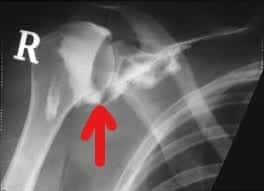
| A |
Fracture head humerus. |
|
| B |
Rotator cuff injury. |
|
| C |
Frozen shoulder. |
|
| D |
Painful arc syndrome. |
Identify the underlying disorder as marked by a red arrow shown in the photograph below ?
| A |
Fracture head humerus. |
|
| B |
Rotator cuff injury. |
|
| C |
Frozen shoulder. |
|
| D |
Painful arc syndrome. |
Frozen shoulder (adhesive capsulitis) is stiffness, pain, and limited range of movement in the shoulder. It may happen after an injury or overuse or from a disease such as diabetes or a stroke. The tissues around the joint stiffen, scar tissue forms, andshoulder movements become difficult and painful.