pH & DRUGS – RELATIONSHIP
The pK of acetic acid is 4.8. what is the approximate pH of an acetate solution containing 0.2 M acetic acid and 2 M acetate ion?
| A | 0.48 | |
| B | 4.8 | |
| C | 5.8 | |
| D | 6.8 |
The pK of acetic acid is 4.8. what is the approximate pH of an acetate solution containing 0.2 M acetic acid and 2 M acetate ion?
| A | 0.48 | |
| B | 4.8 | |
| C | 5.8 | |
| D | 6.8 |
The calculation of pH requires substitution of the concentrations of acid and base into the Henderson Hasselbalch
equation. For the given ratio of acetate and acetic acid, the pH equals the pK of 4.8 plus the log of the concentration of base/acid (2 M acetate / 0.2 M acetic acid). This simplifies to: PH = 4.8 + log 10 = 4.8 + 1 = 5.8
The extent to which ionisation of a drug takes place is dependent upon pKa of the drug and the pH of the solution in which the drug is dissolved. Which of the following statements is not correct:
| A |
pKa of a drug is the pH at which the drug is 50% ionized |
|
| B |
Small changes of pH near the pKa of a weak acidic drug will not affect its degree of ionization |
|
| C |
Knowledge of pKa of a drug is useful in predicting its behaviour in various body fluids |
|
| D |
Phenobarbitone with a pKa of 7.2 is largely ionized at acid pH and will be about 40% non-ionised in plasma |
One scale change in pH causes a ten fold change in ionisation.
With the change of pH, the rate of change of ionization is greatest at pH value near pKa.

An acidic drug has pKa value 4.5. Percentage of ionized drug at pH 3.5-
| A |
1% |
|
| B |
10% |
|
| C |
90% |
|
| D |
99% |
An acidic drug has pKa value 4.5. Percentage of ionized drug at pH 3.5-
| A |
1% |
|
| B |
10% |
|
| C |
90% |
|
| D |
99% |
Ans. is ‘b’ i.e., 10%
o The degree of ionization of a drug (an organ electrolyte) depends on its pKa value and pH of the environment. 1. For acidic drugs
Acidic drug is more ionized at-
| A |
Alkaline |
|
| B |
Acidic pH |
|
| C |
Neutral pH |
|
| D |
None |
Acidic drug is more ionized at-
| A |
Alkaline |
|
| B |
Acidic pH |
|
| C |
Neutral pH |
|
| D |
None |
Ans. is ‘a’ i.e., Alkaline pH
Implication of ionization
Acidic drugs ionize more at alkaline pH.
o Basic drugs ionize more at acidic pH.
o Unionized drug is lipid-soluble and diffusible.
o Ionised drug is lipid-insoluble and nondiffusible.
o Acidic drugs (salicylates, barbiturates) are predominently unionized in acid gastric juice and are absorbed from stomach.
Basic drugs (morphine, quinine) are predominently unionized in intestinal alkaline pH and are absorbed from intestine.
o In the stomach acidic drug (aspirin, pKa – 3.5) arc unionised (lipid soluble & diffusable) and so diffuses into gastric
epithelial cells. In gastric epithelial cell, it will ionize (pH-7.4) becomes less diffusable and so will localize there. This
ion trapping is one mechanism where by aspirin is concentrated in, and so harms, gastric mucosa. o Basic drugs attain higher concentration intracellularly (pH 7.0 Vs 7.4 of plasma).
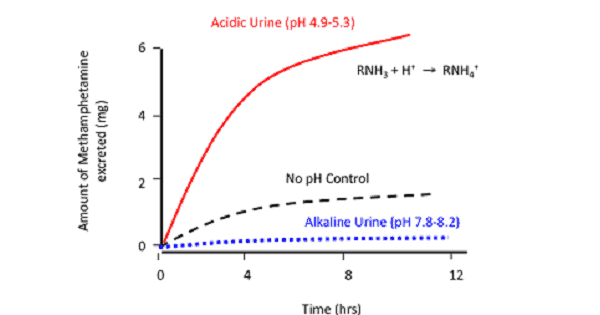
o Acidic drugs are ionized more in alkaline urine – do not back diffuse in the kidney tubules and arc excreted faster. o Similarly basic drugs are excreted faster in acidic urine.