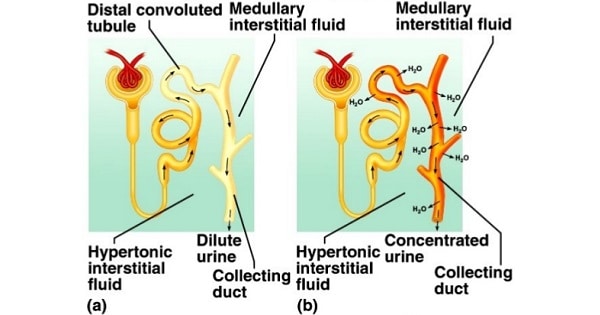
REABSORPTION & SECRETION IN COLLECTING DUCTS
The cortical part of collecting duct is functionally similar to which part of kidney?
| A |
DCT |
|
| B |
Thin ascending part of Henle loop. |
|
| C |
Thick ascending part of Henle loop. |
|
| D |
Medullary part collecting duct. |
The cortical part of collecting duct is functionally similar to which part of kidney?
| A |
DCT |
|
| B |
Thin ascending part of Henle loop. |
|
| C |
Thick ascending part of Henle loop. |
|
| D |
Medullary part collecting duct. |
DCT.
Collecting ducts has mainly 2 portions:
- Cortical portion of collecting duct.
- Medullary portion/Medullary Collecting Duct (MCD).
PROCESS IN CORTICAL COLLECTING DUCT:
- Functionally similar to late segment of distal tubule.
- Facultative absorption type:
- Reabsorption of solutes/water depends on body water/electrolyte balance.
- Hence, facultative type.
- Cells involved in reabsoprtion:
- Principal (P) cells.
- Intercalated (I) cells.
What are the types of cells present in cortical collecting duct?
| A |
Both Principal (P) cells & Intercalated (I) cells. |
|
| B |
Only P cells |
|
| C |
Only I cells |
|
| D |
No cellular content |
What are the types of cells present in cortical collecting duct?
| A |
Both Principal (P) cells & Intercalated (I) cells. |
|
| B |
Only P cells |
|
| C |
Only I cells |
|
| D |
No cellular content |
Both Principal (P) cells & Intercalated (I) cells.
Cells involved in reabsorption in cortical collecting duct:
- Principal (P) cells.
- Intercalated (I) cells.
FUNCTIONS OF ‘P’ CELLS:
1. Sodium & water reabsorption:
- Reabsorbed from lumen.
- Occurs through Na2+ channels (ENaC channels).
- Approximately 3% Na reabsorption occurs.
2. Potassium secretion:
- Secreted into lumen.
- K+ both secreted & reabsorbed.
- Na2+-K+-ATPase activity in basolateral membrane.
- Aldosterone.
3. Water reabsorption:
- ADH Controlled.
- Stimulates water channel, aquaporin-2.
- Reabsorb potassium ion.
- Secrete hydrogen ions into tubular lumen.
What are the major functions of “P” cells present in cortical collecting ducts?
| A |
Sodium & water reabsorption from the lumen. |
|
| B |
Potassium secretion into the lumen. |
|
| C |
ADH controlled water reabsorption. |
|
| D |
All of the above |
What are the major functions of “P” cells present in cortical collecting ducts?
| A |
Sodium & water reabsorption from the lumen. |
|
| B |
Potassium secretion into the lumen. |
|
| C |
ADH controlled water reabsorption. |
|
| D |
All of the above |
- Sodium & water reabsorption from the lumen.
- Potassium secretion into the lumen.
- ADH controlled water reabsorption.
FUNCTIONS OF ‘P’ CELLS:
1. Sodium & water reabsorption:
- Reabsorbed from lumen.
- Occurs through Na2+ channels (ENaC channels).
- Approximately 3% Na reabsorption occurs.
2. Potassium secretion:
- Secreted into lumen.
- K+ both secreted & reabsorbed.
- Na2+-K+-ATPase activity in basolateral membrane.
- Aldosterone.
3. Water reabsorption:
- ADH Controlled.
- Stimulates water channel, aquaporin-2.
What are the major functions of “I” cells present in cortical collecting ducts?
| A |
Reabsorb potassium ion. |
|
| B |
Secrete hydrogen ions into tubular lumen. |
|
| C |
ADH controlled water reabsorption. |
|
| D |
Both A & B |
What are the major functions of “I” cells present in cortical collecting ducts?
| A |
Reabsorb potassium ion. |
|
| B |
Secrete hydrogen ions into tubular lumen. |
|
| C |
ADH controlled water reabsorption. |
|
| D |
Both A & B |
Collecting ducts has mainly 2 portions:
- Cortical portion of collecting duct.
- Medullary portion/Medullary Collecting Duct (MCD).
PROCESS IN CORTICAL COLLECTING DUCT:
- Functionally similar to late segment of distal tubule.
- Facultative absorption type:
- Reabsorption of solutes/water depends on body water/electrolyte balance.
- Hence, facultative type.
- Cells involved in reabsoprtion:
- Principal (P) cells.
- Intercalated (I) cells.
- Reabsorb potassium ion.
- Secrete hydrogen ions into tubular lumen.