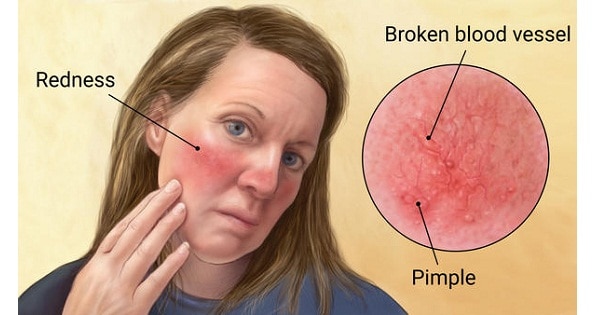
Rosacea
An 76 year lady had a history of a red facial rash suffered venous eczema of legs. She was treated for acne rosacea by her GP. On examination, she had bluish pigmentation on both the legs. What drug is likely to have caused this?
| A |
Amiodarone |
|
| B |
Hydroxychloroquine |
|
| C |
Minicycline |
|
| D |
Amocycillin |
An 76 year lady had a history of a red facial rash suffered venous eczema of legs. She was treated for acne rosacea by her GP. On examination, she had bluish pigmentation on both the legs. What drug is likely to have caused this?
| A |
Amiodarone |
|
| B |
Hydroxychloroquine |
|
| C |
Minicycline |
|
| D |
Amocycillin |
Ans:C.)Minocycline
A 40-year-old woman presents with a 2-year history of erythematous papulopustular lesions on the convexities of the face. There is a background of erythema and telangiectasia. The most likely diagnosis in the patient is:
| A |
Acne vulgaris |
|
| B |
Rosacea |
|
| C |
Systemic lupus erythematosus |
|
| D |
Polymorphic light eruption |
A 40-year-old woman presents with a 2-year history of erythematous papulopustular lesions on the convexities of the face. There is a background of erythema and telangiectasia. The most likely diagnosis in the patient is:
| A |
Acne vulgaris |
|
| B |
Rosacea |
|
| C |
Systemic lupus erythematosus |
|
| D |
Polymorphic light eruption |
Rosacea is a chronic inflammatory disorder of the skin of the facial convexities characterized by persistent erythema and telangiectasias punctuated by acute episodes of swelling, papules and pustules.
Which of the following is not a feature of rosacea?
| A |
Flushing |
|
| B |
Telangiectasia |
|
| C |
Mucosal ulcerations |
|
| D |
Rhinophyma |
Which of the following is not a feature of rosacea?
| A |
Flushing |
|
| B |
Telangiectasia |
|
| C |
Mucosal ulcerations |
|
| D |
Rhinophyma |
Rosacea is a chronic disease affecting fair skinned middle aged adults characterised by flushing and telangiectasia in early stage, papules and pustules in inflammatory stage, papules and induction and rhinophyma in chronic stage.
Ref: Rook textbook of Dermatology, 8th edition, Page : 43.1-3
A 50 year old female presents with lesions on cheek, chin and forehead. On examination the skin is erythematous, with dilated blood vessels, nodules and pustules without any comedones. What is the MOST likely diagnosis in this patient?
| A |
Folliculitis |
|
| B |
Rosacea |
|
| C |
Mild acne vulgaris |
|
| D |
Acne conglobata |
A 50 year old female presents with lesions on cheek, chin and forehead. On examination the skin is erythematous, with dilated blood vessels, nodules and pustules without any comedones. What is the MOST likely diagnosis in this patient?
| A |
Folliculitis |
|
| B |
Rosacea |
|
| C |
Mild acne vulgaris |
|
| D |
Acne conglobata |
- Middle aged women
- Episodes of flushing
- Intolerance to heat and spicy food
- Background of erythema and telangiectasia with episodes of papules and pustules
- Absence of comedones
Rhinophyma is (a complication of –
| A |
Glandular form of acne rosacea |
|
| B |
Form of acne vulgaris |
|
| C |
Affects the scalp |
|
| D |
A form of dermatofibroma |
Rhinophyma is (a complication of –
| A |
Glandular form of acne rosacea |
|
| B |
Form of acne vulgaris |
|
| C |
Affects the scalp |
|
| D |
A form of dermatofibroma |
A i.e. Glandular form of acne rosacea
A 40 year old woman presents with a 2 year old h/o erythematous papulo pustular lesions on convexities of the face. There in a background of erytherma & telengiec-tasia. The most likely diagnosis is:
| A |
Acne valgaris |
|
| B |
Rosacea |
|
| C |
SLE |
|
| D |
Polymorphic light eruption |
A 40 year old woman presents with a 2 year old h/o erythematous papulo pustular lesions on convexities of the face. There in a background of erytherma & telengiec-tasia. The most likely diagnosis is:
| A |
Acne valgaris |
|
| B |
Rosacea |
|
| C |
SLE |
|
| D |
Polymorphic light eruption |
B i.e. Rosacea
True about rhinophyma:
| A |
Premalignant |
|
| B |
Common in alcoholics |
|
| C |
Acne rosacea |
|
| D |
Fungal etiology |
True about rhinophyma:
| A |
Premalignant |
|
| B |
Common in alcoholics |
|
| C |
Acne rosacea |
|
| D |
Fungal etiology |
- Rhinophyma is a slow-growing benign tumor which occurs due to hypertrophy of the sebaceous glands° of the tip of the nose.
- Seen in long standing cases of acne rosacea.
- Mostly affects men past middle age.
- Presents as a pink, lobulated mass over the nose.
Treatment
- Paring down the bulk of the tumor with a sharp knife, or carbon dioxide laser or scalpel (dermabraions), and the area is allowed to re-epithelize.
- Sometimes tumor is completely excised and the raw area is covered with skin graft.
A 25-year old girl presented with erythematous papules on the face as seen in the figure. The lesions were exacerbated on excessive sweating, sun exposure and emotional disturbance. What is the next best investigation?
| A |
Acne vulgaris |
|
| B |
Scabies |
|
| C |
Lupus erythematosus |
|
| D |
Acne Rosacea |
A 25-year old girl presented with erythematous papules on the face as seen in the figure. The lesions were exacerbated on excessive sweating, sun exposure and emotional disturbance. What is the next best investigation?
| A |
Acne vulgaris |
|
| B |
Scabies |
|
| C |
Lupus erythematosus |
|
| D |
Acne Rosacea |
Ans. d. Acne Rosacea
Potato nose is seen in ‑
| A |
Acne vulgaris |
|
| B |
Rhinosporoidosis |
|
| C |
Acne rosacea |
|
| D |
Lupus vulgaris |
Potato nose is seen in ‑
| A |
Acne vulgaris |
|
| B |
Rhinosporoidosis |
|
| C |
Acne rosacea |
|
| D |
Lupus vulgaris |
Ans. is ‘c’ i.e., Acne rosacea
Acne rosacea
- Acne rosacea, commonly called rosacea, is a chronic non-curable skin disease with periodic ups and down.
- It occurs in middle age (30-50 years). It is more common in females, but is more severe in males.
- Rosacea is a centrofacial disease, i.e., it involves the central face →Cheeks, Chin, Forehead, Nose, making typical cruciate pattern of involvement.
- Periorbital & perioral areas are spared.
- Clinical features are intermittant flushing followed by more permanent erythma and telangiectasia.
- On this back-ground, erythmatous papules, papulo pustules and rarely nodules develop.
- Lesions may be exacerbated by light (photosensitive) and spicy foods.
- Complications are : ‑
- Rhinophyma : – Rhinophyma is large, bulbous, ruddy appearance of nose caused by granulomatous infiltration of skin. It is slowly progressive condition due to hypertrophy of sebaceous gland on the tip of nose. It is also known as Potato nose.
- Ophthalmologic : – Blephritis, Conjuctivits, Keratitis,.
- Lymph edema : – Infra-orbital and on forehead.