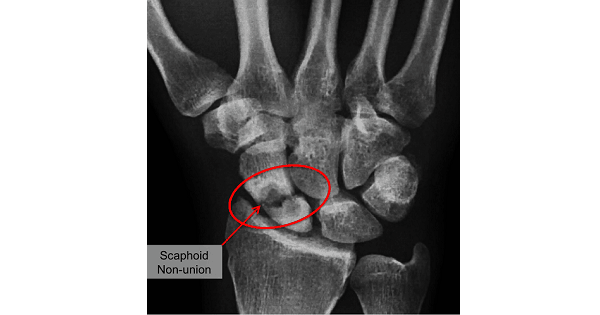
SCAPHOID FRACTURE
Most common site of scaphoid fracture is:
| A |
Waist |
|
| B |
Proximal fragment |
|
| C |
Distal fragment |
|
| D |
Tilting of the lunate |
Most common site of scaphoid fracture is:
| A |
Waist |
|
| B |
Proximal fragment |
|
| C |
Distal fragment |
|
| D |
Tilting of the lunate |
A i.e. Waist
A patient reported with a history of fall on an outstretched hand, complains of pain in the anatomical snuffbox and clinically no deformities visible. The diagnosis is:
| A |
Colles’ fracture |
|
| B |
Lunate dislocation |
|
| C |
Barton’s fracture |
|
| D |
Scaphoid fracture |
A patient reported with a history of fall on an outstretched hand, complains of pain in the anatomical snuffbox and clinically no deformities visible. The diagnosis is:
| A |
Colles’ fracture |
|
| B |
Lunate dislocation |
|
| C |
Barton’s fracture |
|
| D |
Scaphoid fracture |
D i.e. Scaphoid
If an adolescent boy falls on a out-stretched hand, the most common bone to be injured is
| A |
Fracture of lower end of radius |
|
| B |
Fracture of both bones of forearm |
|
| C |
Scaphoid fracture |
|
| D |
Supracondylar fracture of humerus |
If an adolescent boy falls on a out-stretched hand, the most common bone to be injured is
| A |
Fracture of lower end of radius |
|
| B |
Fracture of both bones of forearm |
|
| C |
Scaphoid fracture |
|
| D |
Supracondylar fracture of humerus |
C i.e. Scaphoid

In Scaphoid fracture, important views are all except:
| A |
AP |
|
| B |
Lateral |
|
| C |
Oblique |
|
| D |
Cone |
In Scaphoid fracture, important views are all except:
| A |
AP |
|
| B |
Lateral |
|
| C |
Oblique |
|
| D |
Cone |
D i.e. Cone
Which of the following Scaphoid fracture is most prone to develop Avanscular necrosis?
| A |
Fracture of waist of scaphoid |
|
| B |
Fracture of tubercle |
|
| C |
Fracture of distal pole |
|
| D |
All of the above |
Which of the following Scaphoid fracture is most prone to develop Avanscular necrosis?
| A |
Fracture of waist of scaphoid |
|
| B |
Fracture of tubercle |
|
| C |
Fracture of distal pole |
|
| D |
All of the above |
A i.e. Fracture of waist of Scaphoid
Fracture scaphoid is usually seen in:
| A |
Elderly male |
|
| B |
Elderly postmenopausal female |
|
| C |
Young active adult |
|
| D |
Children |
Fracture scaphoid is usually seen in:
| A |
Elderly male |
|
| B |
Elderly postmenopausal female |
|
| C |
Young active adult |
|
| D |
Children |
C i.e. Young active adult
19 year old boy had a history of fall on out stretched hand while playing. He developed slight radial side pain and tenderness. On examination pressure along the axis of thumb is painful and x rays are normal.
| A |
Fracture lower end radius |
|
| B |
Wrist sprain |
|
| C |
Scaphoid fracture |
|
| D |
Perilunate dislocation |
C i.e. Scaphoid fracture
Best radiological view for diagnosis of fracture scaphoid is:
| A |
Anteroposterior |
|
| B |
Lateral |
|
| C |
Oblique |
|
| D |
Any of the above |
Best radiological view for diagnosis of fracture scaphoid is:
| A |
Anteroposterior |
|
| B |
Lateral |
|
| C |
Oblique |
|
| D |
Any of the above |
Ans. Oblique
Most common complication of scaphoid fracture‑
| A |
Malunion |
|
| B |
Avascular necrosis |
|
| C |
Wrist stiffners |
|
| D |
Arthritis |
Most common complication of scaphoid fracture‑
| A |
Malunion |
|
| B |
Avascular necrosis |
|
| C |
Wrist stiffners |
|
| D |
Arthritis |
Ans. is `b’ i.e., Avascular necrosis
Complication of scaphoid fracture
- Fractures of the scaphoid bone, even when undisplaced, are potentially troublesome and the incidence of complications is high.
- The most important complications are :-
- Delayed union
- Non-union
- Avascular necrosis
- Osteoarthritis of wrist
“AVN is the most common complication of a scaphoid fracture, occuring in 15% to 30% of cases”.
- o Risk of AVN depends on the location of the fracture :-
- Fracture of proximal segment (proximal 1/3) has the highest risk
- Fracture of middle segment (waist) has moderate risk
- Fracture of distal segment rarely causes AVN
- The proximal part is more susceptible for AVN because of retrograde vascular supply. Most of the blood supply to the scaphoid enters distally, and proximal part has precarious supply after fracture through waist or proximal part of the bone.
- Therefore, AVN occurs in proximal part.