
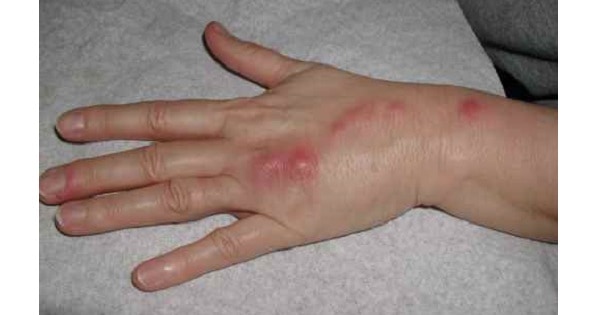
Sporothrix schenckii
| A | Sporothrix | |
| B | Sporotrichosis | |
| C | Phialophora | |
| D | Aspergillus |
| A | Sporothrix | |
| B | Sporotrichosis | |
| C | Phialophora | |
| D | Aspergillus |
Sporotrichosis
A man developed a pustule after striking by a thorn in the garden. Laboratory examination of the tissue specimen shows cigar-shaped budding yeasts. Most probable causative agent is:
| A |
Sporothrix |
|
| B |
Sporotrichosis |
|
| C |
Phialophora |
|
| D |
Aspergillus |
A man developed a pustule after striking by a thorn in the garden. Laboratory examination of the tissue specimen shows cigar-shaped budding yeasts. Most probable causative agent is:
| A |
Sporothrix |
|
| B |
Sporotrichosis |
|
| C |
Phialophora |
|
| D |
Aspergillus |
A gardener has multiple vesicles on hand and multiple eruptions along the lymphatics. Most common fungus responsible is ?
| A |
Sporothrix schenckii |
|
| B |
Cladosporium |
|
| C |
Histoplasma |
|
| D |
Candida |
A gardener has multiple vesicles on hand and multiple eruptions along the lymphatics. Most common fungus responsible is ?
| A |
Sporothrix schenckii |
|
| B |
Cladosporium |
|
| C |
Histoplasma |
|
| D |
Candida |
Ans. is ‘a’ i.e., Sporothrix schenckii
- Multiple vesicles on hand and multiple eruptions along the lymphatics in a gardner suggest the diagnosis of cutaneous sporotrichosis.

A woman who pricked her finger while pruning some rose bushes develops a local pustule that progressed to an ulcer. Several nodules then developed along the local lymphatic drainage. The most likely etiological agent would be?
| A |
Aspergillus fumigatus |
|
| B |
Candida albicans |
|
| C |
Histoplasma capsula turn |
|
| D |
Sporothrix schenckii |
A woman who pricked her finger while pruning some rose bushes develops a local pustule that progressed to an ulcer. Several nodules then developed along the local lymphatic drainage. The most likely etiological agent would be?
| A |
Aspergillus fumigatus |
|
| B |
Candida albicans |
|
| C |
Histoplasma capsula turn |
|
| D |
Sporothrix schenckii |
Ans. is ‘d’ i.e., Sporothrix schenckii
A patient, resident of Himachal Pradesh presented with a series of ulcers in a row, on his right leg. The biopsy from the affected area was taken and cultured on Sabouraud’s Dextrose agar. What would be the most likely causative organism ?
| A |
Sporothrix schenckii |
|
| B |
Cladosporium spp. |
|
| C |
Pseudoallescheria boydii |
|
| D |
Nocardia |
A patient, resident of Himachal Pradesh presented with a series of ulcers in a row, on his right leg. The biopsy from the affected area was taken and cultured on Sabouraud’s Dextrose agar. What would be the most likely causative organism ?
| A |
Sporothrix schenckii |
|
| B |
Cladosporium spp. |
|
| C |
Pseudoallescheria boydii |
|
| D |
Nocardia |
Ans. is ‘a’ i.e., Sporothrix schenckii
. Series of ulcers in a row suggests the diagnosis of sporotrichosis.
A former from the sub-Himalayan region presents with multiple leg ulcers. The most likely causative agent is –
| A |
Trichophyton Rubrum |
|
| B |
Cladosporium species |
|
| C |
Sporothrix Schenckii |
|
| D |
Aspergillus |
A former from the sub-Himalayan region presents with multiple leg ulcers. The most likely causative agent is –
| A |
Trichophyton Rubrum |
|
| B |
Cladosporium species |
|
| C |
Sporothrix Schenckii |
|
| D |
Aspergillus |
Ans. is ‘c’ i.e., Sporothrix Schenckii
- Presence of multiple ulcers in the leg (along the lymphatic channels) in a farmer (out door worker) from the sub himalyan region suggests a diagnosis of Sporothrix Schenkii.
Asteroid bodies and cigar shaped globi may be produced by-
| A |
Sporothrix |
|
| B |
Sporotrichosis |
|
| C |
Phialophora |
|
| D |
a and b |
Asteroid bodies and cigar shaped globi may be produced by-
| A |
Sporothrix |
|
| B |
Sporotrichosis |
|
| C |
Phialophora |
|
| D |
a and b |
Ans. is ‘a’ i.e., Sporothrix; ‘b’ i.e., Sporotrichosis
. Some times ‘asteroid bodies’ are seen in the lesion of sporotrichosis, composed of a central fungus cell with eosinophilic material radiating from it.
Which of the following is a dimorphic
| A |
Rhizopus |
|
| B |
Sporothrix schenckii |
|
| C |
Tinea versicolor |
|
| D |
Microsporum |
Which of the following is a dimorphic
| A |
Rhizopus |
|
| B |
Sporothrix schenckii |
|
| C |
Tinea versicolor |
|
| D |
Microsporum |
Ans. is ‘b’ i.e., Sporothrix schenckii

