
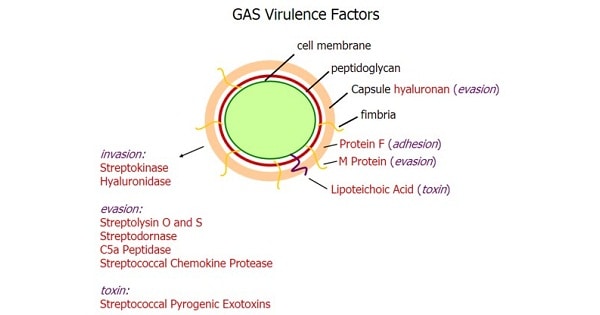
Streptococcus Pyogens: Clinical manifestation, Diagnosis and Treatment
True/False statements regarding cellulitis are:
1. Caused by streptococcus pyogenes
2. Causes SIRS
3. Localised infection
4. Abscess if any should be drained
5. I & D should not be done
| A |
1,2,3 true and 4,5 false |
|
| B |
1,3,5 true and 2,4 false |
|
| C |
3,5 false and 1,2,4 true |
|
| D |
1,2 false and 3,4,5 true |
True/False statements regarding cellulitis are:
1. Caused by streptococcus pyogenes
2. Causes SIRS
3. Localised infection
4. Abscess if any should be drained
5. I & D should not be done
| A |
1,2,3 true and 4,5 false |
|
| B |
1,3,5 true and 2,4 false |
|
| C |
3,5 false and 1,2,4 true |
|
| D |
1,2 false and 3,4,5 true |
It is a non suppurative inflammation spreading along the subcutaneous tissue planes and across intercellular spaces.
The term is a misnomer, as the lesion is one of the connective and interstitial tissue and not of the cells.
The causative organism is mostly the streptococcus pyogenes, through a variety of aerobic and anaerobic bacteria may produce cellulitis.
False regarding streptococcus pyogenes
| A |
Causes necrotizing fascitis |
|
| B |
Beta hemolytic |
|
| C |
M. protein is virulece factor |
|
| D |
Resistant to bacitracin |
False regarding streptococcus pyogenes
| A |
Causes necrotizing fascitis |
|
| B |
Beta hemolytic |
|
| C |
M. protein is virulece factor |
|
| D |
Resistant to bacitracin |
Ans. is ‘d’ i.e., Resistant to bacitracin
- Streptococcus pyogenes is bacitracin sensitive.
- All other options are correct.
Streptococcus causing rheumatic heart disease is ‑
| A |
Streptococcus milleri |
|
| B |
Streptococcus mutans |
|
| C |
Streptococcus pyogenes |
|
| D |
Streptococcus equisimilis |
Streptococcus causing rheumatic heart disease is ‑
| A |
Streptococcus milleri |
|
| B |
Streptococcus mutans |
|
| C |
Streptococcus pyogenes |
|
| D |
Streptococcus equisimilis |
Ans. is ‘c’ i.e., Streptococcus pyogenes
Causative agent of sore throat is:
September 2005
| A |
Staphylococcus aureus |
|
| B |
Streptococcus pyogenes |
|
| C |
H. Influenzae |
|
| D |
Corynebacterium diphtheriae |
Causative agent of sore throat is:
September 2005
| A |
Staphylococcus aureus |
|
| B |
Streptococcus pyogenes |
|
| C |
H. Influenzae |
|
| D |
Corynebacterium diphtheriae |
Ans. B: Streptococcus pyogenes
The primary site of invasion of human body by streptococcus pyogenes is the throat.
Primary bacterial pathogens that account for approximately 30% of cases of pharyngitis include Streptococcus pyogenes /Group A Beta Hemolytic Streptococci (common), group C streptococci (uncommon), group G streptococci (uncommon), Neisseria gonorrhoeae (uncommon), Corynebacterium diphtheriae (rare), and Corynebacterium hemolyticum (extremely rare). Viruses are isolated in approximately 40% of cases and include rhinovirus, adenovirus, parainfluenza virus, coxsackievirus, coronavirus, echovirus, herpes simplex virus, Epstein-Barr virus (mononucleosis), and cytomegalovirus. Other probable copathogens for pharyngitis in children include Staphylococcus aureus, Haemophilus influenzae, Branhamella catarrhalis, Bacteroides fragilis, Bacteroides oralis, Bacteroides melaninogenicus, Fusobacterium species, and Peptostreptococcus species.
Scarlet fever is caused by
| A |
Streptococcus agalactie |
|
| B |
Streptococcus pyogenes |
|
| C |
Streptococcus pneumoniae |
|
| D |
Streptococcus equisimilus |
Scarlet fever is caused by
| A |
Streptococcus agalactie |
|
| B |
Streptococcus pyogenes |
|
| C |
Streptococcus pneumoniae |
|
| D |
Streptococcus equisimilus |
Ans. is ‘b’ i.e., Streptococcus pyogenes
Infections caused by streptococcus pvogenes
- Respiratory infections
- Sore throat is the most common of streptocococcal disease . It may be localised as tonsillitis as in older children and adults or it may involve the pharynx more diffusely (pharyngitis) as in younger children. Otitis media

