SYMPATHETIC Vs. PARASYMPATHETIC NERVOUS SYSTEM
Craniosacral outflow is mediated by which of the following nervous system?
| A |
Sympathetic postganglionic fibers |
|
| B |
Sympathetic preganglionic fibers |
|
| C |
Parasympathetic postganglionic fibers |
|
| D |
Parasympathetic preganglionic fibers |
Craniosacral outflow is mediated by which of the following nervous system?
| A |
Sympathetic postganglionic fibers |
|
| B |
Sympathetic preganglionic fibers |
|
| C |
Parasympathetic postganglionic fibers |
|
| D |
Parasympathetic preganglionic fibers |
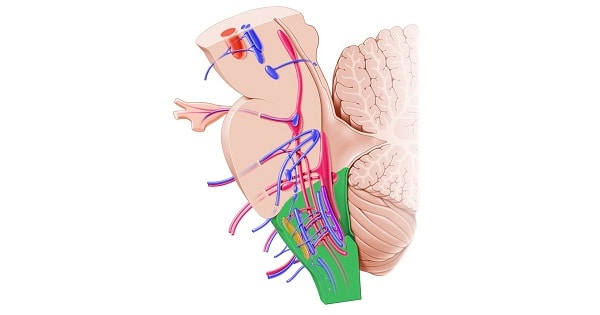
Parasympathetic nerve fibers arise from the central nervous system with the S2, S3, and S4 spinal nerves and from the third, seventh, ninth, and tenth cranial nerves. Because of its location, the parasympathetic system is commonly referred to as having “craniosacral outflow”, which stands in contrast to the sympathetic nervous system, which is said to have “thoracolumbar outflow”.
The parasympathetic nerves that arise from the S2, S3, and S4 spinal nerves are commonly referred to as the ‘pelvic splanchnic nerves’ or the “nervi erigentes”.
Parasympathetic stimulation of nerves innervating the islets of the pancreas will:
| A |
Have no effect |
|
| B |
Increase secretion of insulin from B cells |
|
| C |
Decrease secretion of insulin from B cells |
|
| D |
Increase secretion of glucagon from B cells |
Parasympathetic stimulation of nerves innervating the islets of the pancreas will:
| A |
Have no effect |
|
| B |
Increase secretion of insulin from B cells |
|
| C |
Decrease secretion of insulin from B cells |
|
| D |
Increase secretion of glucagon from B cells |
Sympathetic stimulation of nerves innervating the islets of the pancreas will:
| A |
Have no effect |
|
| B |
Increase secretion of insulin from B cells |
|
| C |
Decrease secretion of insulin from B cells |
|
| D |
Increase secretion of glucagon from A cells |
Sympathetic stimulation of nerves innervating the islets of the pancreas will:
| A |
Have no effect |
|
| B |
Increase secretion of insulin from B cells |
|
| C |
Decrease secretion of insulin from B cells |
|
| D |
Increase secretion of glucagon from A cells |

A research physiologist is performing an experiment in which he stimulates sympathetic cholinergic neurons. Which of the following responses is expected?
| A |
Bradycardia |
|
| B |
Bronchoconstriction |
|
| C |
Diaphoresis |
|
| D |
Increased gastrointestinal motility |
A research physiologist is performing an experiment in which he stimulates sympathetic cholinergic neurons. Which of the following responses is expected?
| A |
Bradycardia |
|
| B |
Bronchoconstriction |
|
| C |
Diaphoresis |
|
| D |
Increased gastrointestinal motility |
The vast majority of sweat glands in the body are innervated by sympathetic cholinergic neurons. Sympathetic cholinergic neurons are sympathetic postganglionic neurons that happen to release acetylcholine instead of norepinephrine.
Preganglionic parasympathetic nerve fiber which supply pelvic viscera is/are;
| A |
Ventral rami of S2,3,4 |
|
| B |
Hypogastric plexus |
|
| C |
Pudendal nerve |
|
| D |
All |
Preganglionic parasympathetic nerve fiber which supply pelvic viscera is/are;
| A |
Ventral rami of S2,3,4 |
|
| B |
Hypogastric plexus |
|
| C |
Pudendal nerve |
|
| D |
All |
A. i.e. Ventral rami of Sz, S3 and S4
All are effects of sympathetic stimulation, EXCEPT:
| A |
Increased conduction velocity |
|
| B |
Increased heart rate |
|
| C |
Increased refractory period |
|
| D |
Increased contractility of heart |
All are effects of sympathetic stimulation, EXCEPT:
| A |
Increased conduction velocity |
|
| B |
Increased heart rate |
|
| C |
Increased refractory period |
|
| D |
Increased contractility of heart |
C i.e. Increased refractory period
|
Effect of sympathetic system on heart mediated by Pi and (ix receptors |
|
|
SA node |
Increase in heart rate |
|
A.V. node |
Increase in conduction velocity |
|
His- Purkinje system |
Increase in conduction velocity |
|
Atria |
Increase in contractility & conduction velocity |
|
Ventricles |
Increase in contractility |
Parasympathetic stimulation causes :
| A |
Decrease GI secretion |
|
| B |
Bronchodilation |
|
| C |
Sweat-secretion |
|
| D |
Pupillary constriction |
Parasympathetic stimulation causes :
| A |
Decrease GI secretion |
|
| B |
Bronchodilation |
|
| C |
Sweat-secretion |
|
| D |
Pupillary constriction |
D i.e. Pupillary constriction
Preganglionic neurotransmitter in sympathetic division of autonomic nervous system is:
March 2013
| A |
Noradrenergic |
|
| B |
Adrenergic |
|
| C |
Acetylcholine |
|
| D |
Dopamine |
Preganglionic neurotransmitter in sympathetic division of autonomic nervous system is:
March 2013
| A |
Noradrenergic |
|
| B |
Adrenergic |
|
| C |
Acetylcholine |
|
| D |
Dopamine |
Ans. C i.e. Acetylcholine
In the autonomic nervous system, acetylcholine is released in the following sites:
- All pre- and post-ganglionic parasympathetic neurons
- All preganglionic sympathetic neurons
– Preganglionic sympathetic fibers to suprarenal medulla, the modified sympathetic ganglion; on stimulation by acetylcholine, the suprarenal medulla releases epinephrine and nor epinephrine
- Some postganglionic sympathetic fibers
– Sudomotor neurons to sweat glands.
Sympathetic stimulation increases blood flow except:
| A |
Skin |
|
| B |
Coronary circulation |
|
| C |
Cerebral |
|
| D |
Renal |
Sympathetic stimulation increases blood flow except:
| A |
Skin |
|
| B |
Coronary circulation |
|
| C |
Cerebral |
|
| D |
Renal |
Ans. a. Skin
Sympathetic stimulation decreases blood flow in skin.
Sympathetic Stimulation
- Stimulation of sympathetic fibers causes vasoconstriction but it is not important, as the vasocontricor system is not well developed in cerebral vascular bed.
- Sympathetic stimulation increases myocardial blood flow through an increased metabolic demand and a predominance of beta-receptor activation.
Sympathetic ganglion develops from ‑
| A |
Surface ectoderm |
|
| B |
Mesoderm |
|
| C |
Neural crest |
|
| D |
Mesenchymal neuroectoderm |
Sympathetic ganglion develops from ‑
| A |
Surface ectoderm |
|
| B |
Mesoderm |
|
| C |
Neural crest |
|
| D |
Mesenchymal neuroectoderm |
Ans. is ‘c’ i.e., Neural crest
Affect of sympathetic stimulation on GFR ‑
| A |
Increased GFR with afferent arteriolar dilatation |
|
| B |
Increased GFR with efferent arteriolar constriction |
|
| C |
Decreased GFR with afferent arteriolar constriction |
|
| D |
Decreased GFR with efferent arteriolar dilatation |
Affect of sympathetic stimulation on GFR ‑
| A |
Increased GFR with afferent arteriolar dilatation |
|
| B |
Increased GFR with efferent arteriolar constriction |
|
| C |
Decreased GFR with afferent arteriolar constriction |
|
| D |
Decreased GFR with efferent arteriolar dilatation |
Ans. is ‘c’ i.e., Decreased GFR with afferent arteriolar constriction
Sympathetic stimulation causes afferent arteriolar constriction with decrease in RBF and GFR.
Effect of sympathetic discharge on the renal regulation of body fluid and electrolytes
Sympathetic discharge on the kidney results in :-
- Decreased GRF.
- Increased reabsorption of Na+ and water from the PCT.
- Increased reabsorption of Na+ and water from the DCT.
- Thirst (due to angiotensin II production).
- The overall effect is fluid and electrolyte retention due to :-
- Decreased urinary output.
- Decreased urinary Na’ excretion.
- Increased water intake.
Origin of sympathetic fibers ‑
| A |
Cranial |
|
| B |
Sacral |
|
| C |
Dorsolumbar |
|
| D |
None |
Origin of sympathetic fibers ‑
| A |
Cranial |
|
| B |
Sacral |
|
| C |
Dorsolumbar |
|
| D |
None |
Ans. is ‘c’ i.e., Dorsolumbar
In sweat glands, the sympathetic neurotransmitter‑
| A |
Norepinephrine |
|
| B |
Epinephrine |
|
| C |
Dopamine |
|
| D |
Acetylcholine |
In sweat glands, the sympathetic neurotransmitter‑
| A |
Norepinephrine |
|
| B |
Epinephrine |
|
| C |
Dopamine |
|
| D |
Acetylcholine |
Ans. is ‘d’ i.e., Acetylcholine
- Neurotransmitter in all preganglionic autonomic nerves (both sympathetic and parasympathetic) is acetylcholine (ACH)
- Neurotransmitter in all ganglia (both sympathetic and parasympathetic) is acetylcholine.
- Neurotransmitter in postganglionic parasympathetic fibres is acetylcholine.
- In posganglionic sympathetic fibres, the major neurotransmitter is noradrenaline (NA) except in renal and mesentric vasculature where it is dopamine, in sweat glands, some blood vessels where it is acetylcholine and in adrenal medulla where it is adrenaline.
- Most of the visceral organs are supplied by both sympathetic and parasympathetic system except;
- Blood vessels, spleen, sweat glands and hair follicles receive only sympathetic innervation.
- Ciliary muscle gastric and pancreatic glands receive only parasympathetic innervation.
- In general sympathetic and parasympathetic systems are antagonistic except;
- Refractory period of atrial fibres is decreased by both.
- At almost all organs except heart, cholinergic system has excitatory activity and adrenergic system has relaxing properties Sympathetic system stimulates (Tachycardia, Positive inotropic) and parasympathetic system depresses (Bradycardia, Negative inotropic) the heart.