



Thyrotoxicosis
A patient suffering from thyrotoxicosis is given propanolol. Which of the following is not controlled by propranolol given to this patient?
| A |
Anxiety |
|
| B |
Tachycardia |
|
| C |
Tremor |
|
| D |
O 2 consumption |
A patient suffering from thyrotoxicosis is given propanolol. Which of the following is not controlled by propranolol given to this patient?
| A |
Anxiety |
|
| B |
Tachycardia |
|
| C |
Tremor |
|
| D |
O 2 consumption |
The primary role of propranolol in thyrotoxicosis is to attenuate the effects of catecholamines, and it is also a weak inhibitor of extrathyroid conversion of T4 to T3. When given it is useful in reducing the heart rate, tremor, agitation, psychotic behavior, diarrhea, fever and diaphoresis. It doesn’t alter the metabolic rate.
One of the following is an absolute contraindication for treatment of Thyrotoxicosis in pregnancy of 6 months duration:
| A |
Anti thyroid drug |
|
| B |
I131 therapy |
|
| C |
Telepaque |
|
| D |
Surgery |
One of the following is an absolute contraindication for treatment of Thyrotoxicosis in pregnancy of 6 months duration:
| A |
Anti thyroid drug |
|
| B |
I131 therapy |
|
| C |
Telepaque |
|
| D |
Surgery |
Radioactive Iodine therapy should not be given to patients wanting pregnancy within one year.
If pregnancy occurs inadvertently termination should be considered.
Ref: Textbook of Obstetrics By Dutta, 6th Edition, Page 290 ; Williams Obstetrics, 21st Edition, Page 1342
Topic : Thyrotoxicosis
| A |
1, 2 – True & 3, 4, 5 – False |
|
| B |
3, 4 – True & 1, 2, 5 – False |
|
| C |
1, 2, 3, 4 – True & 5 – False |
|
| D |
4, 5 – True & 1, 2, 3 – False |
Topic : Thyrotoxicosis
| A |
1, 2 – True & 3, 4, 5 – False |
|
| B |
3, 4 – True & 1, 2, 5 – False |
|
| C |
1, 2, 3, 4 – True & 5 – False |
|
| D |
4, 5 – True & 1, 2, 3 – False |
Initial investigation in a case of thyrotoxicosis includes estimation of TSH and unbound T4 levels.


In which of the following patients, thyrotoxicosis should not be suspected –
| A |
Patients with unexplained weight loss |
|
| B |
Patients with unexplained weight loss |
|
| C |
Patients with distal muscle weakness |
|
| D |
Patients with paroxysmal atrial tachycardia |
In which of the following patients, thyrotoxicosis should not be suspected –
| A |
Patients with unexplained weight loss |
|
| B |
Patients with unexplained weight loss |
|
| C |
Patients with distal muscle weakness |
|
| D |
Patients with paroxysmal atrial tachycardia |
Ans. is ‘c’ i.e., Patients with distal muscle weakness
In hyperthyroidism there is proximal muscle weakness.
Thyrotoxicosis (Hyperthyroidism)
o Most common cause of thyrotoxicosis is diffuse hyperplasia of thyroid, i.e., Graves disease. Clinical features
o Hyperthyroidism is a hypermetabolic state.
o The effects are due to increased level of thyroxin as well as due to overactivity of the sympathetic nervous system. o Features are :
- Metabolism –> T BMR, Intolerance to heat, weight loss, increased sweating, postprandial hyperglycemia, L cholesterol, phospholipd, triglyceride, T FFA, Increased appetite.
- CVS T Systolic BP, Hyperdynamic precordium, wide pulse pressure, sinus tachycardia, mid systolic murmur, Means lerman scratch, atrial fibrillation, Angina & CHF.
- Respiration —> T Respiratory rate.
- GIT–> Diarrhoea
- CNS Nervousness, anxiety
- Musculoskeletal system -s Proximal muscle weakness, fine tremors, osteoporosis.
- Others -s Extreme fatiguibility but inability to sleep, infertility.
o In Graves disease there is exophthalmos, and wide eyed, Staring gaze.
The drug of choice for the treatment of Thyrotoxicosis during pregnancy is ‑
| A |
Carbimazole |
|
| B |
Iodine therapy |
|
| C |
Propylthiouracil |
|
| D |
Metimazole |
The drug of choice for the treatment of Thyrotoxicosis during pregnancy is ‑
| A |
Carbimazole |
|
| B |
Iodine therapy |
|
| C |
Propylthiouracil |
|
| D |
Metimazole |
Ans. is ‘c’ i.e., Propylthiouracil
o Both carbimazole and propylthiourcil can be used during pregnancy, but propyl-thiouracil is the drug of choice because its greater protein binding allows low doses of propylthioracil to be transferred across the placenta and therefore less chance of hypothyroidism.
o Historically, prophylthiouracil has been preferred over methimazole because transplacental passage was thought to be lower; However, according to recent studies, both propylthiouracil and methimazole cross the placenta equally and either may be used safety in the pregnant patient.
Note : However, if you will have to choose one option, prophylthiouracil is still the best because all other books still mention prophylthiouracil as the DOC in pregnancy.
Most common cause of thyrotoxicosis in childhood?
| A |
Toxic nodular goitre |
|
| B |
Toxic adenoma |
|
| C |
Graves disease |
|
| D |
Thryotoxicosis factitia |
Most common cause of thyrotoxicosis in childhood?
| A |
Toxic nodular goitre |
|
| B |
Toxic adenoma |
|
| C |
Graves disease |
|
| D |
Thryotoxicosis factitia |
Ans. is ‘c’ i.e., Graves disease
Treatment of choice in childhood thyrotoxicosis‑
| A |
Radio Iodine |
|
| B |
Lugols Iodine |
|
| C |
Carbimazole |
|
| D |
Surgery |
Treatment of choice in childhood thyrotoxicosis‑
| A |
Radio Iodine |
|
| B |
Lugols Iodine |
|
| C |
Carbimazole |
|
| D |
Surgery |
Ans. is ‘c’ i.e., Carbimazole
o Most pediatric endocrinologists recommend initial medical therapy using antithyroid drugs rather than radioiodine or subtotal thyroidectomy.
o The 2 antithyroid drugs in widest use are methimazole and propylthiouracil.
Cardiovascular findings in an elderly Thyrotoxicosis patient are all, except –
| A |
Early diastolic murmur |
|
| B |
Systolic ejection murmur |
|
| C |
Scratch in left 2nd inter costal spaced) |
|
| D |
Irregularly Irregular pulse |
Cardiovascular findings in an elderly Thyrotoxicosis patient are all, except –
| A |
Early diastolic murmur |
|
| B |
Systolic ejection murmur |
|
| C |
Scratch in left 2nd inter costal spaced) |
|
| D |
Irregularly Irregular pulse |
Ans. is ‘a’ i.e., Early Diastolic Murmur
- Effect of thyroid hormone increases the heart rate and myocardial contractility. This along with decreased systemic vascular resistance in thyrotoxicosis, increases the stroke volume and cardiac output.
- CVS findings in thyrotoxicosis
- The most common cardiovascular manifestation is sinus tachycardia, often associated with palpitations. The restign heart rate is > 90/min
- Exertional dyspnea
- Hyperactive precordium with a loud first heart sound, an accentuated pulmonic component of the second heart sound, and a third heart sound.
- Systolic ejection click
- Midsystolic murmur along the left sternal border
- A systolic scratch also known as Means-Lerman Scratch, is occasionally heard in the 2″4 left intercoastal space during expiration (this is probably generated by the pleura and pericardium rubbing together).
- Systolic hypertension is common (diastolic hypertension can also occur).
- Atrial fibrillation (more common in elderly patients).
A 25 year male presents with ophthalmologic signs of Thyrotoxicosis. All are possibilities, except :
| A |
Diffused Thyroid goitre |
|
| B |
Hashimoto’s Thyroiditis |
|
| C |
Riedel’s Thyroditis |
|
| D |
Adenomatous Goitre |
A 25 year male presents with ophthalmologic signs of Thyrotoxicosis. All are possibilities, except :
| A |
Diffused Thyroid goitre |
|
| B |
Hashimoto’s Thyroiditis |
|
| C |
Riedel’s Thyroditis |
|
| D |
Adenomatous Goitre |
Ans is C i.e. Subacute thyroiditis
We are regretful that we gave a wrong answer in our previous editions (uptil 4th edition).
Though there is close call between Acute and Subacute thyroiditis, we are now more in favour of subacute ds. after reading Schwartz and Sabiston.
Lets go through features of Acute thyroiditis.
Acute (Suppurative) Thyroiditis
- Acute suppurative thyroiditis is extremely rare and usually the result of a severe pyogenic infection of the upper airway
- Streptococcus and anaerobes account for about 70% of cases, but Escherichia coli, Pseudomonas aeruginosa, Haemophilus influenzae, Eikenella corrodens, Corynebacterium, and Coccidiomycosis species also have been cultured.15
- Acute suppurative thyroiditis is more common in children and is often preceded by an upper respiratory tract infection or otitis media. It is characterized by severe neck pain radiating to the jaws or ear, fever, chills, odynophagia, and dysphonia. Rarely, complications such as systemic sepsis, tracheal or esophageal rupture, jugular vein thrombosis, laryngeal chondritis or perichondritis and sympathetic trunk paralysis may result.
- The diagnosis is established by leukocytosis on blood tests and FNA biopsy for Gram’s stain, culture, and cytology.
- CT scans may help to delineate the extent of infection.
- Treatment consists of parenteral antibiotics and drainage of abscesses.
- So after reading the above given signs and symptoms of acute thyroiditis, the patient in the question appears to be having subacute thyroiditis.
In thyrotoxicosis which of the following is seen ‑
| A |
Pretibial myxedema |
|
| B |
Glycosuria |
|
| C |
Unilateral exophthalmos |
|
| D |
All |
In thyrotoxicosis which of the following is seen ‑
| A |
Pretibial myxedema |
|
| B |
Glycosuria |
|
| C |
Unilateral exophthalmos |
|
| D |
All |
Ans. is ‘d’ i.e. All
A 25 year old young woman has recurrent episodes of headache and sweating. Her mother had renal calculi and died after having a neck mass. The physical examination reveals a thyroid nodule but no clinical sign of thyrotoxicosis. Before performing thyroid surgery, the surgeon should order :
| A |
Measurement of thyroid hormones |
|
| B |
Serial determinations of serum calcium, phosphorus protein and alkaline phosphatase |
|
| C |
24-hours urine test for 5 hydroxyindoleacetic acid excretion. |
|
| D |
Serial 24 hours test for catecholamines, metanephrines and vanillylamandelic acid excretion. |
A 25 year old young woman has recurrent episodes of headache and sweating. Her mother had renal calculi and died after having a neck mass. The physical examination reveals a thyroid nodule but no clinical sign of thyrotoxicosis. Before performing thyroid surgery, the surgeon should order :
| A |
Measurement of thyroid hormones |
|
| B |
Serial determinations of serum calcium, phosphorus protein and alkaline phosphatase |
|
| C |
24-hours urine test for 5 hydroxyindoleacetic acid excretion. |
|
| D |
Serial 24 hours test for catecholamines, metanephrines and vanillylamandelic acid excretion. |
Answer is D (Serial 24 hours test for catecholamines, metanephrines and vanillylamandelic acid excretion) :
Theochromocytoma, must be excluded by measurement of urinary catecholamines levels in all cases before embarking upon thyroid surgery to avoid the potential hazards. of this condition’ – Bailey
Essays employed for diagnosis of pheochromocytoma include those for:
- Vanillyl mandelic acid (VMA)
- Metanephrines
- Free catecholamines
The patient in question is a case of inherited Men II a syndromes
The presence of ‘headache and sweating’ in a patient with thyroid nodule warrants prompt investigation for a possible pheochromocytoma as part of MEN II syndrome, more so in a patient with a positive family history (as suggested by presence of renal calculi and thyroid nodule in mother).
Pheochromocytoma secrete large amounts of catecholamines, the secretion of which is further increased during surgery. This may result in large swings in blood pressure and arrhythmias, and increases the risk of surgical mortality. Stable a adrenergic blockage is essential before embarking on thyroid surgery.
All of the following are features of thyrotoxicosis, EXCEPT-
| A |
Diastolic murmur |
|
| B |
Soft non ejection systolic murmur |
|
| C |
Irregularly, irregular pulse |
|
| D |
Scratching sound in systole |
All of the following are features of thyrotoxicosis, EXCEPT-
| A |
Diastolic murmur |
|
| B |
Soft non ejection systolic murmur |
|
| C |
Irregularly, irregular pulse |
|
| D |
Scratching sound in systole |
Answer is A (Diastolic murmur) :
Thyrotoxicosis is associated with a systolic murmur. ur. It is not associated with any diastolic murmur.
Cardiovascular manifestations of thyrotoxicosis:
- Sinus tachycardiaQ is the most commonQ manifestation of Thyrotoxicosis.
- Midsystolic murmurQheard best at left sternal border with or without Systolic ejection click.
- Means lerman scratchy: It is a systolic scratchy sound heard at the 2nd left intercostal space during expiration. It is thought to result from rubbing of hyperdynamic pericardium against the pleura
- Angina and heart failure may be precipitated by hyperthyroidism in patients with underlying heart disease.
In Thyrotoxicosis,f1-blockers do not control:
| A |
Anxiety |
|
| B |
Tremors |
|
| C |
Tachycardia |
|
| D |
Oxygen consumption |
In Thyrotoxicosis,f1-blockers do not control:
| A |
Anxiety |
|
| B |
Tremors |
|
| C |
Tachycardia |
|
| D |
Oxygen consumption |
Answer is D (Oxygen consumption):
Betablockers do not correct the underlying metabolic abnormalities (i.e. does not affect the oxygen consumptionQ).
This is why propanolol should only be used as an adjunctive therapy.
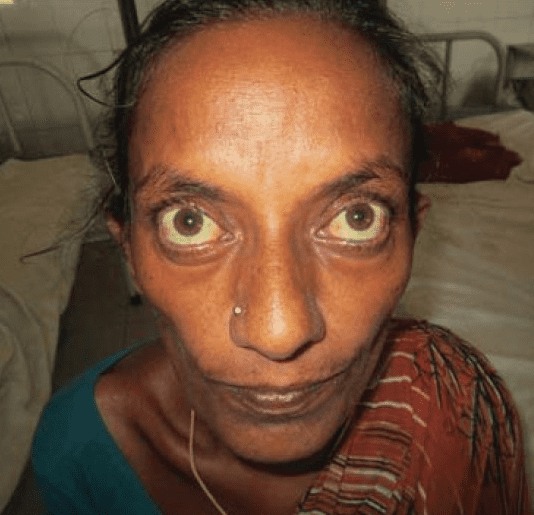
This patient is suffering from thyrotoxicosis.When she looks up,following picture is seen.Identify this sign.

| A |
Von Graefe’s sign |
|
| B |
Joffroy’s sign |
|
| C |
Moebius sign |
|
| D |
Dalrymple’s sign |
This patient is suffering from thyrotoxicosis.When she looks up,following picture is seen.Identify this sign.
| A |
Von Graefe’s sign |
|
| B |
Joffroy’s sign |
|
| C |
Moebius sign |
|
| D |
Dalrymple’s sign |
Ans:B.)Joffroy’s sign
Eye signs in thyrotoxicosis
• Stellwag’s sign: staring look, absent of normal blinking, first sign to appear(mild hyperthyroidism)
• Von Graefe’s sign(Lid Lag sign): inability of upper eyelid to keep pace with the eyeball (mild)
• Joffroy’s sign: absence of wrinkling on forehead when the patient looks up(frowns)(moderate)
• Moebius sign: lack of convergence of eyeball(severe hyperthyroidism)
• Dalrymple’s sign: upper eyelid retraction, sclera visible
• Jellinek’s sign: increased pigmentation of eyelid margins
• Enroth sign: edema of eyelids and conjunctiva
• Rosenbach’s sign: tremor of closed eyelids
• Gifford’s sign: difficulty in everting upper eyelid in primary toxic thyroid. Differentiates exophthalmos from other causes
• Loewi’s sign: dilation of pupil with weak adrenaline solution
• Knie’s sign: unequal dilation of pupil
• Cowen’s sign: jerky papillary contraction to consensual light
• Kocher’s sign: when clinician places his hands on patient’s eyes and lifts it higher, patient’s upper eyelid springs up more quickly than eye brows
• Naffziger’s sign: with patient in sitting position and neck fully extended, protruded eyeball can be visualized when observed from behind
• Proptosis due to infiltration of retrobulbar tissues with fluid and round cells
• Weakness of extraocular muscles(particularly inferior oblique) results in diplopia
• The most common ocular motility defect is a unilateral elevator palsy caused by the involvement of inferior rectus; next common – failure of abduction due to involvement of medial rectus

