

VENOUS DRAINAGE OF LOWER LIMB
Short saphenous vein in a tributary of:
| A |
Medial marginal vein |
|
| B |
Lateral marginal vein |
|
| C |
Posterior tibial vein |
|
| D |
Dorsal venous arch |
Short saphenous vein in a tributary of:
| A |
Medial marginal vein |
|
| B |
Lateral marginal vein |
|
| C |
Posterior tibial vein |
|
| D |
Dorsal venous arch |
Lateral marginal vein
The femoral ring is bounded by the following structures except?
| A |
Femoral vein |
|
| B |
Inguinal ligament |
|
| C |
Femoral artery |
|
| D |
Lacunar ligament |
The femoral ring is bounded by the following structures except?
| A |
Femoral vein |
|
| B |
Inguinal ligament |
|
| C |
Femoral artery |
|
| D |
Lacunar ligament |
The femoral ring is not bounded by Femoral artery.
An obese patient is brought into the casualty in shock and in need of intravenous fluids. No superficial veins can be seen or palpated. The emergency room physician decides to make an incision to locate the great saphenous vein for the insertion of a cannula (“saphenous cutdown”). In which of the following locations should the incision be made?
| A |
Anterior to the lateral malleolus |
|
| B |
Anterior to the medial malleolus |
|
| C |
On the dorsum of the foot, lateral to the extensor hallucis longus tendon |
|
| D |
Posterior to the lateral malleolus |
An obese patient is brought into the casualty in shock and in need of intravenous fluids. No superficial veins can be seen or palpated. The emergency room physician decides to make an incision to locate the great saphenous vein for the insertion of a cannula (“saphenous cutdown”). In which of the following locations should the incision be made?
| A |
Anterior to the lateral malleolus |
|
| B |
Anterior to the medial malleolus |
|
| C |
On the dorsum of the foot, lateral to the extensor hallucis longus tendon |
|
| D |
Posterior to the lateral malleolus |
The great saphenous vein is one of the two major superficial veins of the lower limb. It is found in the superficial fascia, where it is accessible for procedures such as saphenous cutdown and saphenous venous graft. As the vein ascends along the lower limb, it passes anterior to the medial malleolus at the ankle and posterior to the medial side of the knee. The vein then passes through the saphenous hiatus of the fascia lata to empty into the femoral vein slightly below the inguinal ligament.
- No major vein is found anterior to the lateral malleolus.
- Veins on the dorsum of the foot are small tributaries of the great and small saphenous veins.
- The small saphenous vein passes posterior to the lateral malleolus.
Which of the following structures passes behind the inguinal ligament?
1. Femoral branch of genitofemoral nerve
2. Superficial epigastric artery
3. Psoas major
4. Femoral vein
5. Saphenous vein
| A |
1,2 & 3 |
|
| B |
3 & 4 |
|
| C |
1,3,4 & 5 |
|
| D |
All |
Which of the following structures passes behind the inguinal ligament?
1. Femoral branch of genitofemoral nerve
2. Superficial epigastric artery
3. Psoas major
4. Femoral vein
5. Saphenous vein
| A |
1,2 & 3 |
|
| B |
3 & 4 |
|
| C |
1,3,4 & 5 |
|
| D |
All |
Three small cutaneous arteries (superficial external pudendal, superficial epigastric and superficial circumflex iliac arteries) arising from the femoral artery can be seen a little below the inguinal ligaments.
Femoral branch of the genitofemoral nerve pierces the femoral sheath and overlying deep fascia 2 cm below the mid inguinal point.
The great saphenous vein pierces the saphenous opening in the deep fascia (fascia lata) of the thigh and joins the femoral vein 4 cm below and lateral to the pubic tubercle.
So from the above discussion it is clear that femoral branch of the genitofemoral nerve, superficial epigastric artery and saphenous vein passes below (not behind) the inguinal ligament.
Psoas major insertion: The muscle passes behind the inguinal ligament and in front of the hip joint to enter the thigh.
Femoral vein leaves the thigh by passing behind the inguinal ligament.
Short saphenous vein is a tributary of which of the following vein?
| A |
Medial marginal vein |
|
| B |
Lateral marginal vein |
|
| C |
Posterior tibial vein |
|
| D |
Dorsal venous arch |
Short saphenous vein is a tributary of which of the following vein?
| A |
Medial marginal vein |
|
| B |
Lateral marginal vein |
|
| C |
Posterior tibial vein |
|
| D |
Dorsal venous arch |
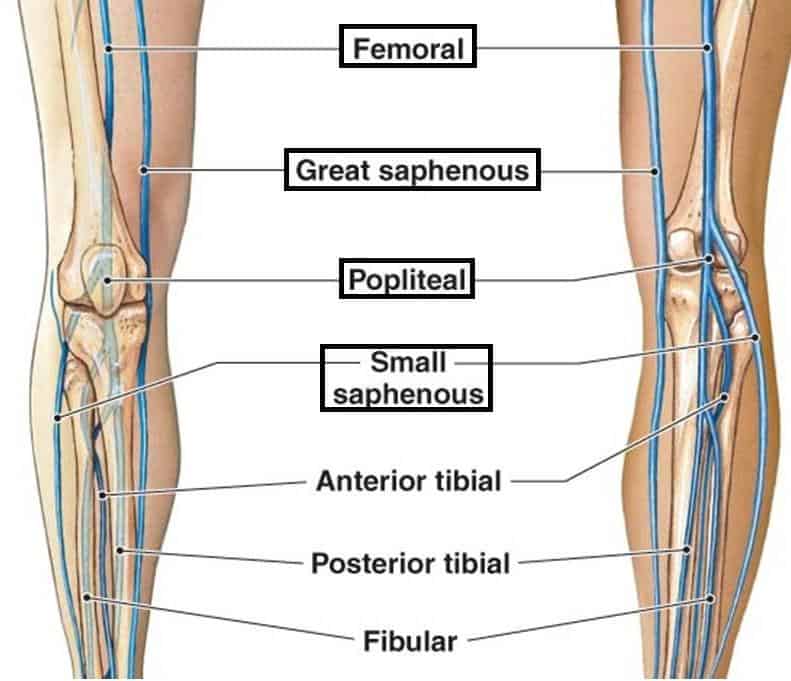
- The great saphenous vein originates from the medial side of the dorsal venous arch in the foot and drains in the femoral vein.
- The small saphenous vein originates from the lateral side of the dorsal venous arch in the foot and drains in the popliteal vein.
True about the anatomy of great saphenous vein:
| A |
Starts as a continuation of medial marginal vein |
|
| B |
Ends of femoral vein 2.5 cm below the inguinal ligament |
|
| C |
There are 2 – 5 valves below the knee. |
|
| D |
Ascends 2.5 – 3 cm behind tibial malleolus |
True about the anatomy of great saphenous vein:
| A |
Starts as a continuation of medial marginal vein |
|
| B |
Ends of femoral vein 2.5 cm below the inguinal ligament |
|
| C |
There are 2 – 5 valves below the knee. |
|
| D |
Ascends 2.5 – 3 cm behind tibial malleolus |
A i.e. Starts as continuation- of medial marginal vein
The most important perforator of the Lower limb is between –
| A |
Long saphenous and posterior tibial vein |
|
| B |
Short saphenous and posterior tibial vein |
|
| C |
Short saphenous and popliteal vein |
|
| D |
Long saphenous and femoral vein |
The most important perforator of the Lower limb is between –
| A |
Long saphenous and posterior tibial vein |
|
| B |
Short saphenous and posterior tibial vein |
|
| C |
Short saphenous and popliteal vein |
|
| D |
Long saphenous and femoral vein |
Ans. is `d’ i.e., Long saphenous and femoral vein
All of the following veins lack valves except
| A |
Femoral vein |
|
| B |
Portal vein |
|
| C |
IVC |
|
| D |
Dural venous sinuses |
All of the following veins lack valves except
| A |
Femoral vein |
|
| B |
Portal vein |
|
| C |
IVC |
|
| D |
Dural venous sinuses |
Veins which do not have valves are:
- IVC
- SVC
- Hepatic, ovarian, uterine, renal, emissary, cerebral, pulmonary, and umbilical veins
- Portal venous system is a valveless system
The Diagram Shows the Venous Drainage of Lower Limb. Identify Vein Marked as Vein B in the Diagram ?

| A |
Femoral Vein |
|
| B |
Great Saphenous Vein |
|
| C |
Popliteal Vein |
|
| D |
Small Saphenous Vein |
The Diagram Shows the Venous Drainage of Lower Limb. Identify Vein Marked as Vein B in the Diagram ?
| A |
Femoral Vein |
|
| B |
Great Saphenous Vein |
|
| C |
Popliteal Vein |
|
| D |
Small Saphenous Vein |
All are true about short saphenous vein except‑
| A |
Runs behind lateral malleolus |
|
| B |
Runs on lateral side of leg |
|
| C |
Accompanied by sural nerve |
|
| D |
Achillis tendon is medial to vein |
All are true about short saphenous vein except‑
| A |
Runs behind lateral malleolus |
|
| B |
Runs on lateral side of leg |
|
| C |
Accompanied by sural nerve |
|
| D |
Achillis tendon is medial to vein |
Ans. is ‘b’ i.e., Runs on lateral side of leg
Short saphanous vein runs in the back (posteriorly) of leg (not laterally).
Short saphanous vein
- It is formed by union of the lateral end of the dorsal venous arch with the lateral marginal vein.
- It enters the back of leg by passing behind the lateral malleolus and is accompanied by sural nerve.
- In leg it ascends lateral to tendocalcaneous (tendoachillis). Thus tendoachillis is medial to vein.
- It usually has 7-13 valves. It terminates into the popliteal vein.
- It is connected with peroneal vein through the lateral ankle perforators.
Structure which lies outside the femoral sheath
| A |
Femoral artery |
|
| B |
Femoral nerve |
|
| C |
Femoral vein |
|
| D |
Genitofemoral nerve |
Structure which lies outside the femoral sheath
| A |
Femoral artery |
|
| B |
Femoral nerve |
|
| C |
Femoral vein |
|
| D |
Genitofemoral nerve |
Femoral nerve
Femoral sheath
Femoral sheath is a funnel shaped fascial prolongation around proximal part of femoral vessels, situated in the femoral triangle, below the inguinal ligament. It is 3-4 cm long. It is formed by fascia iliaca.
Femoral sheath is divided into 3 separate fascial compartements by septa :‑
i) Lateral compartment :- It contains femoral artery and femoral branch of genitofemoral nerve.
ii) Intermediate compartment :- Femoral vein.
iii) Medial compartment (femoral canal) :- It is conical in shape, wider above adn narrow below. The wider upper opening is known as femoral ring, which is potentially a weak point in lower abdomen and is the site for femoral hernia. Femoral ring is bounded : Anteriorly by inguinal ligament, medially by lacunar ligament, posteriorly by pectineus with its covering fascia, and laterally by septum separating it from femoral vein. Femoral canal contains lymph node of cloquet or Rosenmuller and lymphatics.
Not a content of Hunter’s canal ‑
| A |
Femoral artery |
|
| B |
Femoral vein |
|
| C |
Femoral nerve |
|
| D |
Sphenous nerve |
Not a content of Hunter’s canal ‑
| A |
Femoral artery |
|
| B |
Femoral vein |
|
| C |
Femoral nerve |
|
| D |
Sphenous nerve |
Ans. is ‘c’ i.e., Femoral nerve
Contents of adductor canal are femoral artery, femoral vein, Saphenous nerve, nerve to vastus medialis, descending genicular artery, deep lymph vessels, and two terminal divisions of obturator nerve.
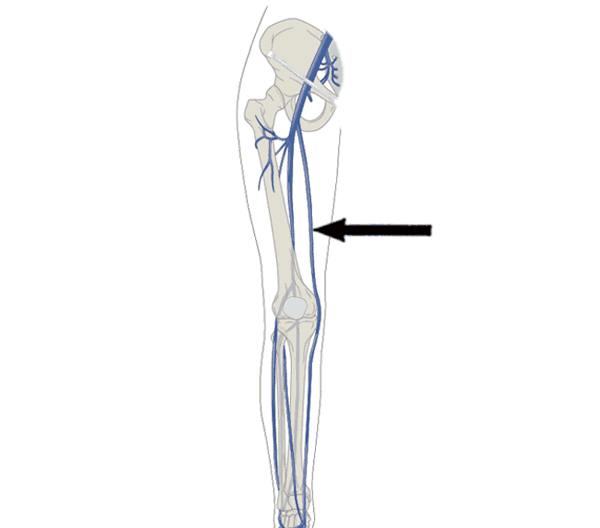
True about the anatomy of this vein (presented by arrow) in this image
| A |
Starts as a continuation of medial marginal vein |
|
| B |
Ends of femoral vein 2.5 cm below the inguinal ligament |
|
| C |
There are 2 – 5 valves below the knee. |
|
| D |
Ascends 2.5 – 3 cm behind tibial malleolus |
True about the anatomy of this vein (presented by arrow) in this image
| A |
Starts as a continuation of medial marginal vein |
|
| B |
Ends of femoral vein 2.5 cm below the inguinal ligament |
|
| C |
There are 2 – 5 valves below the knee. |
|
| D |
Ascends 2.5 – 3 cm behind tibial malleolus |
Ans;A).Starts as a continuation of medial marginal vein
Vein is Great Saphenous vein
- Starts as continuation- of medial marginal vein
- The great saphenous vein (GSV, alternately “long saphenous vein“) is a large, subcutaneous, superficial vein of the leg.
- It is the longest vein in the body, running along the length of the lower limb.

