
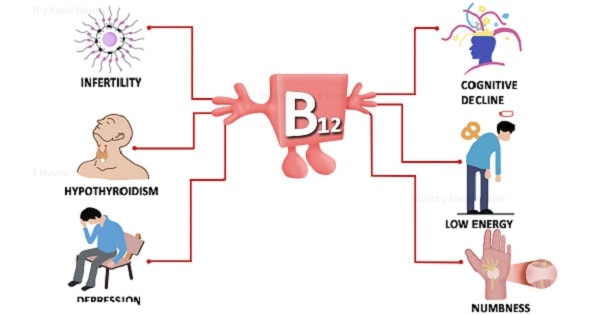
Vitamin B12 & Deficiency
| A |
Duodenum |
|
| B | Jejunum | |
| C |
Ileum |
|
| D |
Colon |
| A |
Duodenum |
|
| B | Jejunum | |
| C |
Ileum |
|
| D |
Colon |
Ileum REF: Ganong, 22nd edition, p471
- Bile salts and vitamin B12 are mainly absorbed by ileum
- Iron and vitamins (other than B12) are absorbed mainly from proximal small intestine (duodenum and jejunum)
- Maximum fat absorption- Jejunum
- Long chain fatty acid absorption- Duodenum+ Jejunum
- Short chain fatty acid- Colon
| A | Bitemporal hemianopia | |
| B | Binasal hemianopia | |
| C | Heteronymous hemianopia | |
| D | Centrocecal scotoma |
| A | Bitemporal hemianopia | |
| B | Binasal hemianopia | |
| C | Heteronymous hemianopia | |
| D | Centrocecal scotoma |
[Centrocecal scotoma]
• Vitamin B12 deficiency causes optic neuropathy and impaired acuity and central scotoma
• Annular or ring shaped scotoma is a typical features of Retinitis pigmentosa
Requirement of vitamin B12 per day for adults is:
| A |
1 mcg |
|
| B |
3 mcg |
|
| C |
5 mcg |
|
| D |
7 mcg |
Requirement of vitamin B12 per day for adults is:
| A |
1 mcg |
|
| B |
3 mcg |
|
| C |
5 mcg |
|
| D |
7 mcg |
|
Requirement of vitamin B12 per day |
|
|
Healthy adults |
1 mcg |
|
Pregnancy |
1.2 mcg |
|
Lactation |
1.5 mcg |
|
children |
0.2 mcg |

Vitamin B12 acts as co-enzyme to which one of the following enzymes?
| A |
Isocitrate dehydrogenase |
|
| B |
Homocysteine methyl transferase |
|
| C |
Glycogen synthase |
|
| D |
G-6-P dehydrogenase |
Vitamin B12 acts as co-enzyme to which one of the following enzymes?
| A |
Isocitrate dehydrogenase |
|
| B |
Homocysteine methyl transferase |
|
| C |
Glycogen synthase |
|
| D |
G-6-P dehydrogenase |
Vitamin B 12 acts s a co-enzyme for homocysteine methyl transferase or methionine synthase, which is involved in the synthesis of methionine from homocysteine.
Vitamin B12 is required for a number of metabolic processes. Which of the following lesions would NOT lead to a deficiency of this vitamin?
| A |
Chronic gastritis resulting in achlorhydria |
|
| B |
Autoimmune destruction of gastric parietal cells |
|
| C |
Surgical resection of the jejunum |
|
| D |
Surgical resection of the ileum |
Vitamin B12 is required for a number of metabolic processes. Which of the following lesions would NOT lead to a deficiency of this vitamin?
| A |
Chronic gastritis resulting in achlorhydria |
|
| B |
Autoimmune destruction of gastric parietal cells |
|
| C |
Surgical resection of the jejunum |
|
| D |
Surgical resection of the ileum |
Which of the following is the main site of absorption of vitamin B12?
| A |
Duodenum |
|
| B |
Jejunum |
|
| C |
Ileum |
|
| D |
Colon |
Which of the following is the main site of absorption of vitamin B12?
| A |
Duodenum |
|
| B |
Jejunum |
|
| C |
Ileum |
|
| D |
Colon |
Most vitamins are absorbed in the upper small intestine, but vitamin B12 is absorbed in the ileum. This vitamin binds to intrinsic factor, a protein secreted by the parietal cells of the stomach, and the complex is absorbed across the ileal mucosa. Vitamin B12 absorption and folate absorption are Na+-independent.
Vitamin B12 deficiency has A/E
| A |
Folate trap |
|
| B |
Decreased methyl malonyl CoA |
|
| C |
SACD |
|
| D |
Megaloblastic anemia |
Vitamin B12 deficiency has A/E
| A |
Folate trap |
|
| B |
Decreased methyl malonyl CoA |
|
| C |
SACD |
|
| D |
Megaloblastic anemia |
B i.e. Decreased methylmalonyl CoA
Vitamin B12 deficiency is likely to cause:
| A |
Bitemporal hemianopia |
|
| B |
Binasal hemianopia |
|
| C |
Heteronymous hemianopia |
|
| D |
Centrocecal scotoma |
Vitamin B12 deficiency is likely to cause:
| A |
Bitemporal hemianopia |
|
| B |
Binasal hemianopia |
|
| C |
Heteronymous hemianopia |
|
| D |
Centrocecal scotoma |
D i.e. Cetrocecal scotoma
Vitamin B12 deficiency is likely to cause optic neuritis; in which most common field defect is central or centro-caecal scotoma Q
Vitamin B12 deficiency can give rise to all of the following, except:
| A |
Myelopathy. |
|
| B |
Optic atrophy |
|
| C |
Peripheral neuropathy |
|
| D |
Myopathy |
Vitamin B12 deficiency can give rise to all of the following, except:
| A |
Myelopathy. |
|
| B |
Optic atrophy |
|
| C |
Peripheral neuropathy |
|
| D |
Myopathy |
Answer is D (Myopathy) :
Vitamin B12 deficiency does not produce myopathy. All other neurological manifestations may be seen with vitamin B,2 deficiecny.
Causes of vitamin B12 deficiency is:
September 2006
| A |
Lack of intrinsic factor |
|
| B |
Diseases affecting terminal ileum |
|
| C |
Fish tapeworm infestation |
|
| D |
All of the above |
Causes of vitamin B12 deficiency is:
September 2006
| A |
Lack of intrinsic factor |
|
| B |
Diseases affecting terminal ileum |
|
| C |
Fish tapeworm infestation |
|
| D |
All of the above |
Ans. D: All of the above
Causes of Vitamin B12 deficiency:
- Inadequate Consumption: Vitamin B12 deficiency develops in people who do not consume any animal products (vegetarians) unless they take supplements.
- Inadequate Absorption: The most common cause of vitamin B17 deficiency is inadequate absorption. The following conditions can cause absorption to be inadequate:
– Overgrowth of bacteria in part of the small intestine
Malabsorption disorders
– Inflammatory bowel disease
– Fish tapeworm infection
– Surgery that removes the part of the small intestine where vitamin B12 is absorbed
Drugs such as antacids and metformin
– Lack of intrinsic factor- Intrinsic factor may be lacking because abnormal antibodies, produced by an overactive immune system, attack and destroy the parietal/ oxyntic cells that produce intrinsic factor—an autoimmune reaction
– Decreased stomach acidity
- Inadequate storage: Liver disorders may interfere with the storage of vitamin B12.
Richest source of vitamin B12 ‑
| A |
Meat |
|
| B |
Green leafy vegetables |
|
| C |
Corn oil |
|
| D |
Sunflower oil |
Richest source of vitamin B12 ‑
| A |
Meat |
|
| B |
Green leafy vegetables |
|
| C |
Corn oil |
|
| D |
Sunflower oil |
Ans. is ‘a’ i.e., Meat

