
SCOLIOSIS
SCOLIOSIS


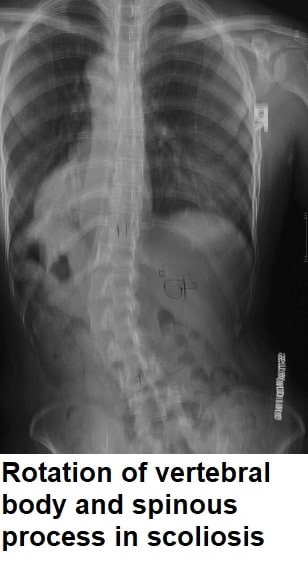
- Scoliosis is the sideways curvature of the spine.
CLASSIFICATION
- Non-structural (transient)
- Structural (permanent)
- In structural scoliosis, the vertebrae, in addition to sideways tilt, are rotated along their long axis.
- In non-structural scoliosis they are not.
Non-structural scoliosis:
- Mobile ortransient scoliosis.
Has 3 subtypes:
- Postural scoliosis: commonest
- Compensatory scoliosis
- Sciatic scoliosis
Structural scoliosis:
- Scoliosis with a component of permanent deformity.
The following are the different subtypes:
- Idiopathic: commonest type of structural scoliosis
- Congenital scoliosis
- Paralytic scoliosis
- Sharp kyphoscoliosis (Neurofibromatosis)
PATHOLOGY
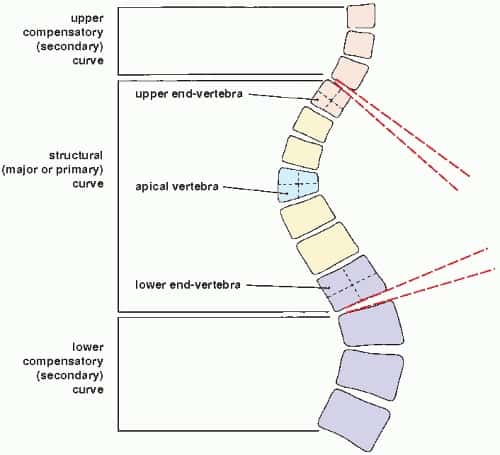
- The main pathology is lateral curvature of a part of the spine.
- This is called the primary curve.
- The spine above or below the primary curve undergoes compensatory curvature in the opposite direction.
- These are called the compensatory or secondary curves.
- The lateral curvature is associated with rotation of the vertebrae.
- In curves of the thoracic spine, rotation of the vertebrae leads to prominence of the rib cage on the convex side, giving rise to a rib hump.
Clinical features:
- In most cases, visible deformity is the only symptom.
- Pain is occasionally a feature in adults with a long-standing deformity.
- Sharp angulation of the spinal cord over the apex of the curve may result in interference with cord functions, leading to a neurological deficit.
Radiographic assessment of the scoliosis patient
Cobb method for measurement of scoliosis
- Cobb’s angle – an angle between the line passing through the margins of the vertebrae at the ends of the curve.
Reisser’s sign
- The Risser Sign identifies the amount of ossification (the process of cartilage becoming bone) of the human pelvis as a measure of skeletal maturity.
- The amount of ossification is graded from 0 – 5. The process begins at the front of the pelvis and moves towards the spine.
The grades are as follow:
- Grade 0 – no epiphysis present
- Grade 1 – 25% of the epiphysis present
- Grade 2 – 50% of the epiphysis present
- Grade 3 – 75% of the epiphysis present
- Grade 4 – 100% of the epiphysis present
- Grade 5 – Fusion of epiphysis to the ilium
- The risser sign is very important in calculating the risk of progression of a scoliosis, as it is a sign of skeletal maturity.
- The lower the risser score the higher the risk of progression of a scoliosis (as skeletal growth is still occurring).
Rotation of a vertebra
- Appreciated by looking at the position of the spinous processes and pedicles on AP view.
- Normally, a spinous process is in the centre of the vertebral body.
TREATMENT
Principles of treatment:
- Aim of treatment is to assess the prognosis of the curve in terms of the visible deformity it is likely to produce.
This depends upon:
- the type of the curve
- age at onset
- the site of the curve
Non-operative methods:
- Milwaukee brace
- Boston brace
- Reisser’s turn-buckle cast
- Localiser cast: This is a body cast applied with the spine in traction.
Operative methods:
- Comprise of fusion of the spine.
- In congenital scoliosis, simple fusion is sufficient.
- In idiopathic scoliosis, the spine is fused after achieving some correction by stretching the spine.
Exam Important
- Progression of congenital scoliosis is least likely in Block vertebra.
- Scoliosis is the most common skeletal manifestation in Type-1 Neurofibromatosis
- Increased RV/TLC is seen in a preoperative pulmonary function test, done in a patient with severe kyphoscoliosis
- Spastic quadriplegia is commonly associated with scoliosis and other orthopedic problems
- Musculo skeletal abnormality in neurofibromatosis is Scoliosis , Cafe au lait spots & Hypertrophy of limb.
- Unilateral elevation of diaphragm is commonly due to Scoliosis.
- Vertebral rotation in scoliosis is checked in Forward bending.
- Milwalkee brace is used in treatment of Scoliosis
- Turn-buckle cast is used for Scoliosis.
- Risser Localiser cast is used in the management of Idiopathic scoliosis.
Don’t Forget to Solve all the previous Year Question asked on SCOLIOSIS
Click Here to Start Quiz
Click Here to Start Quiz

