Question
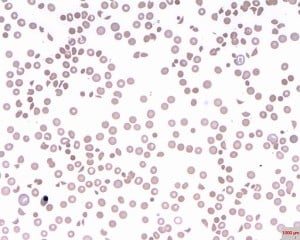
A 24 year old man presented with history of generalized weakness and lethargy for last few years. He had history of pain and discomfort in right hypochondrium on and off. USG abdomen revealed two gall stones of 4mm and 6 mm size. His blood reports show Hemoglobin- 8 gm%, Total bilirubin- 4.2 , Direct bilirubin- 1.6, Indirect bilirubin- 3.6, . Osmotic fragility of RBC increased. The Peripheral blood film show following blood smear represented below.What is the most likely diagnosis?
A. Hereditary spherocytosis.
B. Elliptiocytosis.
C. G6PD deficiency.
D. None of the above.
Show Answer
|
Correct Answer » A
Explanation
|
|
Ans:A. Hereditary spherocytosis
The Peripheral Blood Film in the image shows Spherocytes which are sphere-shaped RBCs rather than bi-concave disk shaped.
SPHEROCYTOSIS
- It is an auto-hemolytic anemia (a disease of the blood) characterized by the production of spherocytes (red blood cells (RBCs) or erythrocytes) that are sphere-shaped rather than bi-concave disk shaped.
- Hereditary spherocytosis and autoimmune hemolytic anemia are characterized by having only spherocytes.
Hereditary Spherocytosis:
- The most common mode of inheritance in Hereditary Spherocytosis is Autosomal Dominant (Classical Inheritance). Autosomal Recessive inheritance however may also be seen but is less common.
- The disorder is caused by mutations in genes relating to membrane proteins leading to defect in one or more of the proteins of the red blood cell cytoskeleton, including spectrin, ankyrin,etc that allow for the erythrocytes to change shape.
- The abnormal erythrocytes are sphere-shaped (spherocytosis) rather than the normal biconcave disk shaped. Dysfunctional membrane proteins interfere with the cell’s ability to be flexible to travel from the arteries to the smaller capillaries. \
- This difference in shape also makes the red blood cells more prone to rupture.
- The classic laboratory features of hereditary spherocytosis (HS) include the following :
- Mild to moderate anemia,Reticulocytosis,Increased MCHC,Spherocytes on the peripheral blood smear,Hyperbilirubinemia,Abnormal results on the osmotic fragility test.
- Coomb’s test is also done to rule out Auto-immune hemolytic Anemia(as Spherocytes are also found in this case)
- Symptoms include anemia, jaundice, splenomegaly, and fatigue.
Cholecystitis and cholelithiasis are common complications of HS.Treatment:
- Primary treatment for patients with symptomatic HS has been total splenectomy, which eliminates the hemolytic process, allowing normal hemoglobin, reticulocyte and bilirubin levels.
- Cholecystectomy may be needed in case of significant Gall stones.