Question
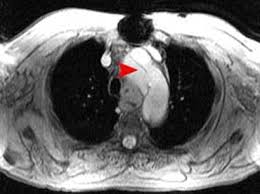
What would be the drug of choice in a 50 year old male suffering from sudden onset of severe chest pain with a tearing quality,BP-90/60mm Hg and Interarm blood pressure differential greater than 20 mm Hg and the MRI showing the following feature?
A. Propranolol.
B. Labetalol.
C. Metoprolol.
D. Phentolamine.
Show Answer
|
Correct Answer » B
Explanation
|
|
Ans: B. Labetelol.
The condition marked by a red arrow in the MRI above represents aortic dissection.
Aortic dissection
- It occurs when blood enters the medial layer of the aortic wall through a tear or penetrating ulcer in the intima and tracks along the media, forming a second blood-filled channel within the wall.
- More common in males than females, with a male-to-female ratio of 2-3:1.
- Approximately 75% of dissections occur in those aged 40-70 years
- Sudden onset of severe chest pain that often has a tearing or ripping quality (classic symptom).
Possible physical examination findings include the following:
- Hypertension or Hypotension
- Interarm blood pressure differential greater than 20 mm Hg
- Signs of aortic regurgitation (eg, bounding pulses, wide pulse pressure, diastolic murmurs)
- Findings suggestive of cardiac tamponade (eg, muffled heart sounds, hypotension, pulsus paradoxus, jugular venous distention, Kussmaul sign).
- MRI- It is the most sensitive method for diagnosing aortic dissection .It shows the site of intimal tear, type and extent of dissection, and presence of aortic insufficiency, as well as the surrounding mediastinal structures.
Acute aortic dissection can be treated surgically or medically.
- In surgical treatment, the area of the aorta with the intimal tear is usually resected and replaced with a Dacron graft.
- Medical management remains the treatment of choice for descending aortic dissections unless they are leaking or ruptured.Medical management consists of decreasing the blood pressure and the shearing forces of myocardial contractility in order to decrease the intimal tear and propagation of the dissection. Medical management with antihypertensive therapy, including beta blockers, is the treatment of choice for all stable chronic aortic dissections.
- Labetalol is drug of choice:it has a dual effect of decreasing blood pressure and cardiac contractility