
Question
A 26 year old woman presents with a complain in the ear which started 8 months ago when she was pregnant with her second child.
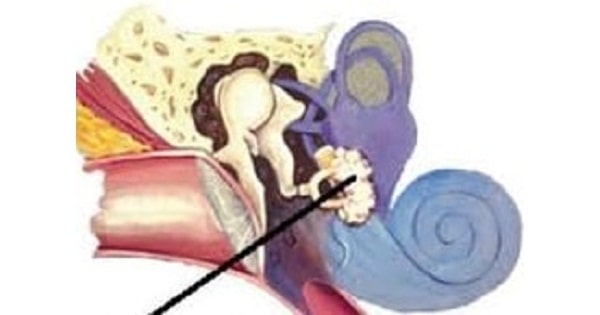
The condition of her ear is shown in this image.Characteristic feature of this condition are all except:
A. Conductive deafness
B. Autosomal recessive disease
C. Paracusis willisii
D. Mobile ear drum
Show Answer

|
Correct Answer » B Explanation |
 |
Ans:B. Autosomal recessive
This condition is otosclorosis
Otosclerosis
- It is characterized by abnormal removal of mature dense otic capsule bone by osteoclasts, and replacement with the woven bone of greater thickness, cellularity, and vascularity.
- Mainly affects Stapes.
- Begins in ‘fossula antefenestrum.’
- Autosomal dominant
- Common in females.
- 50% of patients of otosclerosis have positive family history.
- Age = most common between 20-30 years and is rare before 10 and after 40 years.
- Deafness is increased by pregnancy, menopause, trauma and major operations.
Symptoms of otosclerosis
- Hearing loss :- Bilateral conductive deafness which is painless and progressive with insidious onset. In cochlear otosclerosis sensorineural hearing loss also occurs along with conductive deafness.
- Paracusis willissii :- An otosclerotic patient hears better in noisy than quiet surroundings.
- Tinnitus :- More common in cochlear otosclerosis.
- Speech :- Monotonous, well modulated soft speech.
- Vertigo :- is uncommon.
Signs in otosclerosis
- Tympanic membrane is quite normal and mobile.
- In 10% of cases flamingo – pink blush is seen through the tympanic membrane called as Schwartz sign. Various tests show conductive hearing loss.
- Stapes footplate—Shows a rice grain / biscuit type appearance
- Blue mantles are seen histopathologically.
Tuning fork tests in otosclerosis
- As otosclerotic patients have conductive deafness, the tuning fork tests results will be as follows :‑
- Rinnes :- Negative
- Webers :- Lateralized to the ear with greater conductive loss.
- Absolute bone conduction (ABC) :- Normal (can be decreased in cochlear otosclerosis).
- Gelles test :- No change in the hearing through bone conduction when air pressure of ear canal is increased by Siegle’s speculum.
Audiometry in otosclerosis
1) Pure tone audiometry
- Shows loss of air conduction, more for lower frequencies with characteristic rising pattern.
- Bone conduction is normal. However in some cases, there is a dip in bone conduction curve which is maximum at 2000 Hz (2 KHz) and is called the Carhart’s notch.
2) Impedance audiometry
1.Tympanometry
- Patient with early disease may show type A tympanogram (because middle ear areation is not affected) Progressive stapes fixation results in classical As type tympanogram.
2. Acoustic (stapedial reflex)
- It is one of the earliest sign of otosclerosis and precedes the development of airbone gap. In early stage, diphasic on-off pattern is seen in which there is a brief increase in compliance at the onset and at the termination, stimulus occurs. This is pathognomonic of otosclerosis. In later stage the reflex is absent.
Treatment
- Conservative approach/Hearing aid
- Medical : Sodium Fluoride supplementation has met with variable response
- Surgery : total stapedectomy, partial stapedectomy, and stapedotomy
