A. Early ocular sign is vesicles on eyelids
B. Oculomotor Nerve involvement
C. May lead to Uveitis,Glaucoma,Cataract
D. Frontal Nerve is most commonly affected.
|
Correct Answer » B
Explanation
|
|
Ans:B. Oculomotor Nerve involvement.
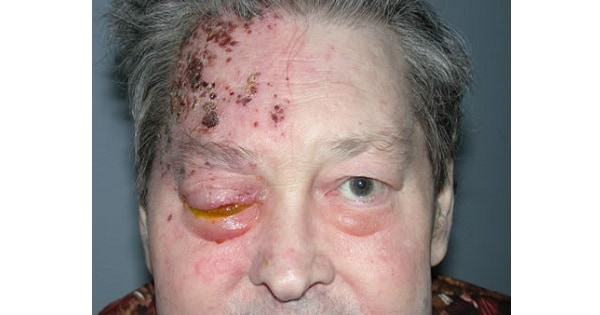
The patient is suffering from Herpes Zoster Ophthalmicus.
Herpes zoster ophthalmicus .
- It is a disease characterised by reactivation of dormant varicella zoster virus residing within the ophthalmic nerve (the first division of the trigeminal nerve).
- The frontal nerve is more commonly affected than the nasociliary nerve or lacrimal nerve.
Signs and symptoms
- Viral prodrome:Preherpetic neuralgia
Skin
- Rash, transitioning from papules to vesicles to pustules to scabs.
- Hutchinson’s sign: cutaneous involvement of the tip of the nose, indicating nasociliary nerve involvement.
Cornea
- Epithelial: punctate epithelial erosions and pseudodendrites: often have anterior stromal infiltrates.
- Stromal:Nummular keratitis: have anterior stromal granular deposits. Occurs within 10 days of onset of rash. Uncommon
- Necrotising interstitial keratitis
- Disciform Keratitis(Disciform Endotheliitis).
- Neurotrophic: corneal nerve damage causes persistent epithelial defect, thinning and even perforation. Cornea becomes susceptible to bacterial and fungal keratitis. Chronic.
Uvea
- Anterior uveitis develops in 40–50% of cases with HZO within 2 weeks of onset of the skin rashes.
- HZO uveitis is associated with complications such as iris atrophy and secondary glaucoma ,. Complicated cataract .
Treatment
- Treatment is usually with antivirals such as aciclovir orally.
- Topical steroids and cycloplegics in Uveal lesion