Question
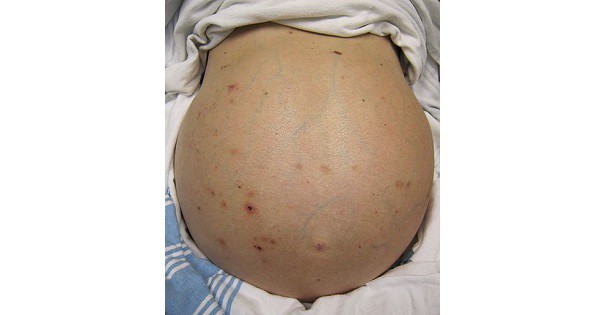
An alcoholic patient presented with the following condition of Abdomen.On examination,fluid thrill is present.SAAG is more than 1.1 g/dL.What can be the probable cause out of following options?
A. Cirrhosis
B. Primary peritoneal carcinomatosis
C. Pancreatitis.
D. Serositis
Show Answer
|
Correct Answer » A
Explanation
|
|
Ans:A. Cirrhosis.
The patient in question is suffering from Ascites.
Ascites
- It is a gastroenterological term for an accumulation of fluid in the peritoneal cavity that exceeds 25 mL.
Physical examination:
- Ascites is detected on physical examination of the abdomen by visible bulging of the flanks in the reclining patient (“flank bulging”), “shifting dullness” (difference in percussion note in the flanks that shifts when the patient is turned on the side) or in massive ascites with a “fluid thrill” or “fluid wave” (tapping or pushing on one side will generate a wave-like effect through the fluid that can be felt in the opposite side of the abdomen).
Causes
Serum-ascites albumin gradient (SAAG) :
- A high gradient (> 1.1 g/dL) indicates the ascites is due to portal hypertension. A low gradient (< 1.1 g/dL) indicates ascites of non-portal hypertensive as a cause.
Causes of high SAAG (“transudate”) are:
- Cirrhosis – 81% (alcoholic in 65%, viral in 10%, cryptogenic in 6%)
- Hepatic venous occlusion: Budd–Chiari syndrome or veno-occlusive disease
- Constrictive pericarditis
- Kwashiorkor (childhood protein-energy malnutrition)
Causes of low SAAG (“exudate”) are:
- Cancer (metastasis and primary peritoneal carcinomatosis) – 10%
- Infection: Tuberculosis – 2% or spontaneous bacterial peritonitis
Other rare causes:
Complications of Ascites:
- Spontaneous bacterial peritonitis(most common)