Question
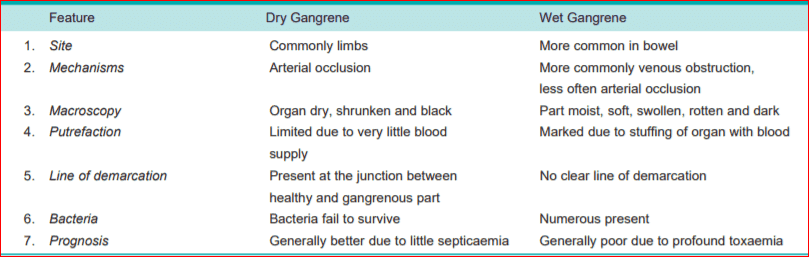
From the folowing given options,which statement is false about the pathological process shown in this image?
A. Black colour is due to formation of iron sulfide.
B. Puterfaction limited due to very little blood supply
C. More commonly occurs due to venous occlusion
D. Bacteria fail to survive
Show Answer
|
Correct Answer » C
Explanation
|
|
Ans:C. More commonly occurs due to venous occlusion
Dry Gangrene is shown in the image.
GANGRENE
- Gangrene is a form of necrosis of tissue with superadded putrefaction.
- The type of necrosis is usually coagulative due to ischaemia (e.g. in gangrene of the bowel, gangrene of limb).
- There are 2 main forms of gangrene—dry and wet, and a variant form of wet gangrene called gas gangrene.
Dry Gangrene
- This form of gangrene begins in the distal part of a limb due to ischaemia.
- The typical example is the dry gangrene in the toes and feet of an old patient due to arteriosclerosis.
- Other causes of dry gangrene foot include thromboangiitis obliterans (Buerger’s disease), Raynaud’s disease, trauma, ergot poisoning.
- It is usually initiated in one of the toes which is farthest from the blood supply, containing so little blood that even the invading bacteria find it hard to grow in the necrosed tissue.
- The gangrene spreads slowly upwards until it reaches a point where the blood supply is adequate to keep the tissue viable.
- A line of separation is formed at this point between the gangrenous part and the viable part.
- MORPHOLOGIC FEATURES. Grossly, the affected part is dry, shrunken and dark black, resembling the foot of a mummy.
- It is black due to liberation of haemoglobin from haemolysed red blood cells which is acted upon by hydrogen disulfide (H2S) produced by bacteria resulting in formation of black iron sulfide.
- The line of separation usually brings about complete separation with eventual falling off of the gangrenous tissue if it is not removed surgically.
- Histologically, there is necrosis with smudging of the tissue. The line of separation consists of inflammatory granulation tissue.