Question
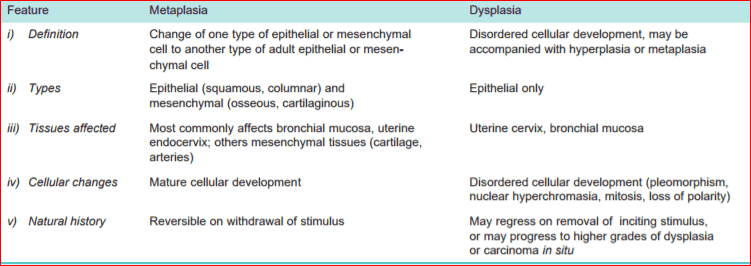
All the following statements are true about the cell modification marked by “E” in the image except:


A. Divided into 2 types: epithelial and mesenchymal.
B. Disordered cellular development
C. May regress on removal of inciting stimulus
D. May progress to carcinoma in situ
Show Answer


|
Correct Answer » A Explanation |
 |

Ans:A. Divided into 2 types: epithelial and mesenchymal.
Dysplasia is shown in the image.
DYSPLASIA
- Dysplasia means ‘disordered cellular development’, also referred to as atypical hyperplasia.
- Dysplasia occurs most often in epithelial cells.
- Epithelial dysplasia is characterised by cellular proliferation and cytologic changes.
-
- Increased number of layers of epithelial cells
- Disorderly arrangement of cells from basal layer to the surface layer
- Loss of basal polarity i.e. nuclei lying away from basement membrane
- Cellular and nuclear pleomorphism
- Increased nucleocytoplasmic ratio
- Nuclear hyperchromatism
- Increased mitotic activity.
- The two most common examples of dysplastic changes are the uterine cervix and respiratory tract.
- Dysplastic changes often occur due to chronic irritation or prolonged inflammation.
- On removal of the inciting stimulus, the changes may disappear. In a proportion of cases, however, dysplasia progresses into carcinoma in situ (cancer confined to layers superficial to basement membrane) or invasive cancer.