


Acute myeloid leukemia (AML)
ACUTE MYELOID LEUKEMIA (AML)
- AML is a heterogenous disease characterised by infiltration of malignant myeloid cells into blood, bone marrow.
- AML is due to inhibition of maturation of myeloid stem cells due to mutations.
- Seen in mainly in adults (50 years).
- Chromosomal mutations in AML are
- translocation t (8: 21) & t (15: 17)
- Inversion 16 or t (16: 16)

Etiology-
- Hereditary – Down syndrome, Klinefelter’s Syndrome, Patau Syndrome.
- Radiation
- Chemical- smoking
Pathogenesis-
- t (8: 21) disrupt the RUNXL gene & Inv (16) disrupts the CDF1β gene both have good prognosis.
- t (15: 17) (acute promyelocytic leukaemia-M3) have good prognosis.
- Gene mutation encoding components of cohesion complex.
- Most common congenital AML (in infants) are AML M5 (acute monocytic leukemia)
- Most common AML in children is AML M7 (acute megakaryoblastic anaemia)
- Most common translocation- MLL gene rearrangements on chromosome 11q.
- Monosomy is associated with a poor prognosis.
Clinical features-
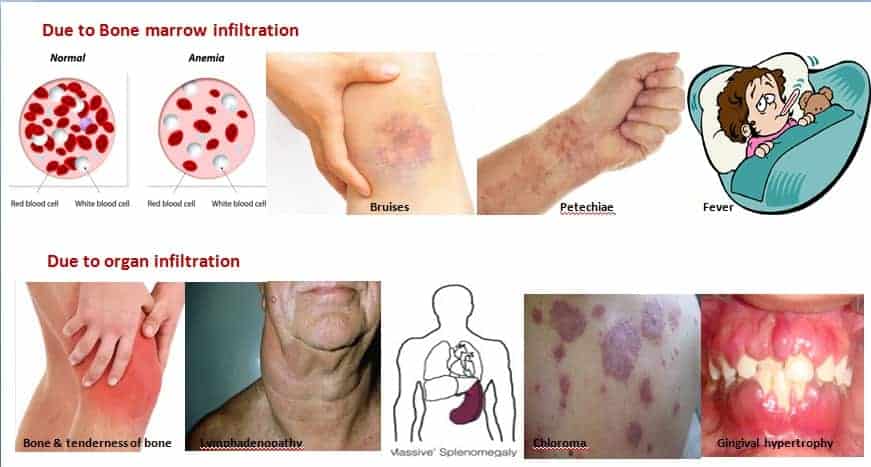
1. Due to bone marrow failure-
- Anaemia
- Bruises, petechiae, bleeding from gum
- Infection
- Fever
2. Due to organ infiltration-
- Pain & tenderness of bones
- Lymphadenopathy, enlargement of tonsils
- Splenomegaly
- Hepatomegaly
- Gum hypertrophy
- Chloroma

Investigations-
1. Blood picture-
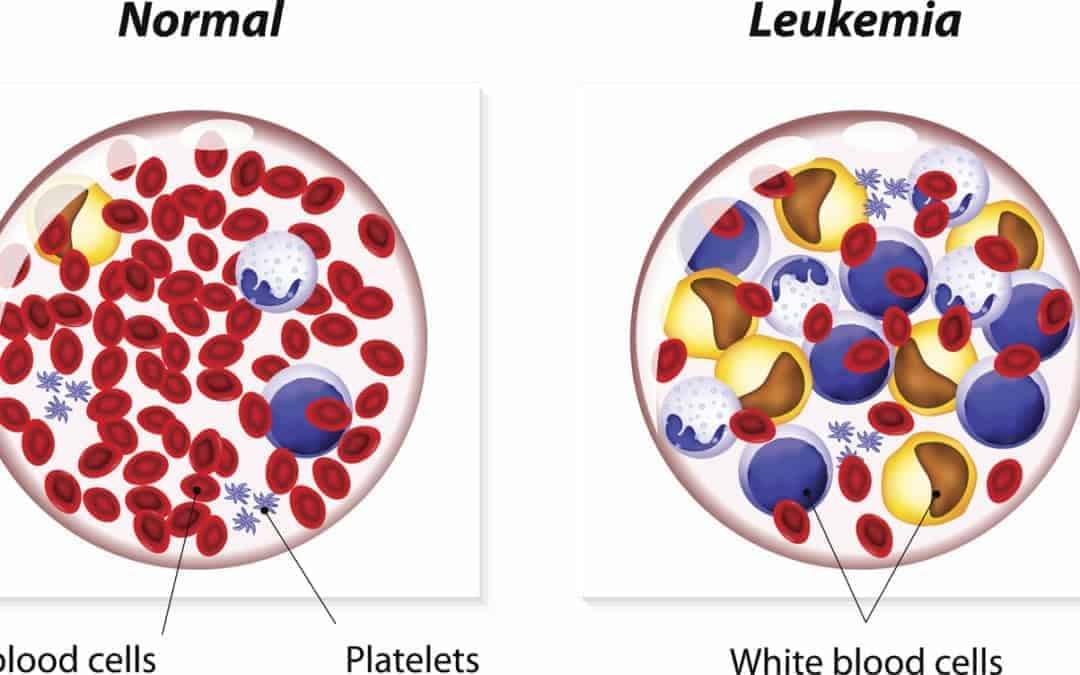
- Anemia
- Thrombocytopenia
- WBC increased
2. Bone marrow examination
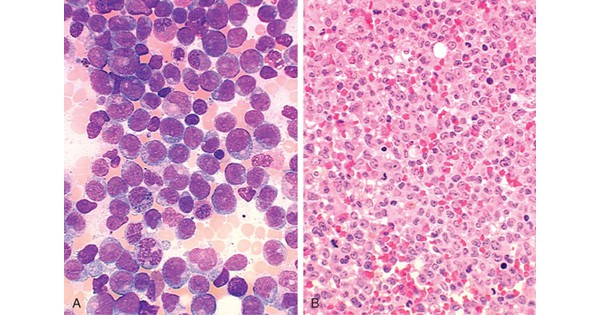
- Cellularity- marrow is hypercellular but blood tap or dry tap is seen.
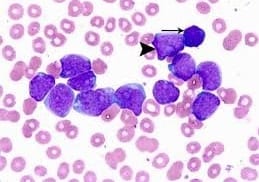
- Leukemic cells- Blast cell count >20% (WHO)
- Dyserythropoiesis, megaloblastic features & ring sideroblasts are common.
- Megakaryocytes.
3. Cytochemistry-
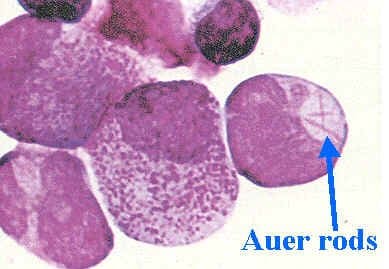
- Myeloperoxidase- Positive in immature myeloid cells containing granules & Auer rods (most definitive sign of myeloid differentiation)
- Cluster of Auer rods called as Faggot.
- Auer rods, distinctive needle like azurophilic granules,they are particularly numerous in AML with the t (15: 17) (acute promyelocytic leukaemia-M3).
- Non specific esterase (NSE)- positive in monocytic series (M3, M4 & M5)
- Investigation of choice is flow cytometry.


Treatment-
- Blood transfusion & platelet transfusion.
- Cytotoxic drug therapy- most effective treatment of AML is cytosine, arabinoside, anthracyclines.
- Promyelocytic leukemia (M3)- tretinoin orally
- Bone marrow transplantation.
Exam Important
- AML is due to inhibition of maturation of myeloid stem cells due to mutations.
- Seen in mainly in adults (50 years).
- Chromosomal mutations in AML are
- translocation t (8: 21) & t (15: 17)
- Inversion 16 or t (16: 16)
Pathogenesis-
- t (8: 21) disrupt the RUNXL gene
- Inv (16) disrupts the CDF1β gene.
- Gene mutation encoding components of cohesion complex.
- Most common congenital AML (in infants) are AML M5 (acute monocytic leukemia)
- Most common AML in children is AML M7 (acute megakaryoblastic anaemia)
- Most common translocation- MLL gene rearrangements on chromosome 11q.
Investigations-
- Leukemic cells- Blast cell count >20% (WHO)
- Dyserythropoiesis, megaloblastic features & ring sideroblasts are common
- Myeloperoxidase- Positive in immature myeloid cells containing granules & Auer rods (most definitive sign of myeloid differentiation)
- Cluster of Auer rods called as Faggot.
- Non specific esterase (NSE)- positive in monocytic series (M3, M4 & M5)
- Investigation of choice is flow cytometry
Treatment-
- Cytotoxic drug therapy- most effective treatment of AML is cytosine, arabinoside, anthracyclines.
Don’t Forget to Solve all the previous Year Question asked on Acute myeloid leukemia (AML)

