
ANATOMY & PHYSIOLOGY OF LENS
ANATOMY & PHYSIOLOGY OF LENS
- Lens is a transparent, bi-convex, crystalline structure
- Placed b/w iris & the vitreous in a saucer shaped depression called patellar fossa.
- Its equatorial diameter is 10 mm.
- Refractive index is 1.39.
- Total power is 15-16 D.
ANATOMY OF CRYSTALLINE LENS
- There are 3 structural elements that make up lens-
1) Lens capsule:
- Thickest at pre- equator region & thinnest at the posterior pole.
- Hyaloideocapsular ligament of Weiger or retrolental ligament is a strong adhesion b/w the lens & posterior capsule.
- It is a circular adhesion 8-9 mm in diameter.
- This attachment is termed as Egger’s line.
- Within this circle is a potential space called as Space of Burger or Erggelet’s space.
2) Lens epithelium :
- Single layer on the anterior (front) surface of the lens.
- There is no epithelium on posterior surface.
3) Lens fibres
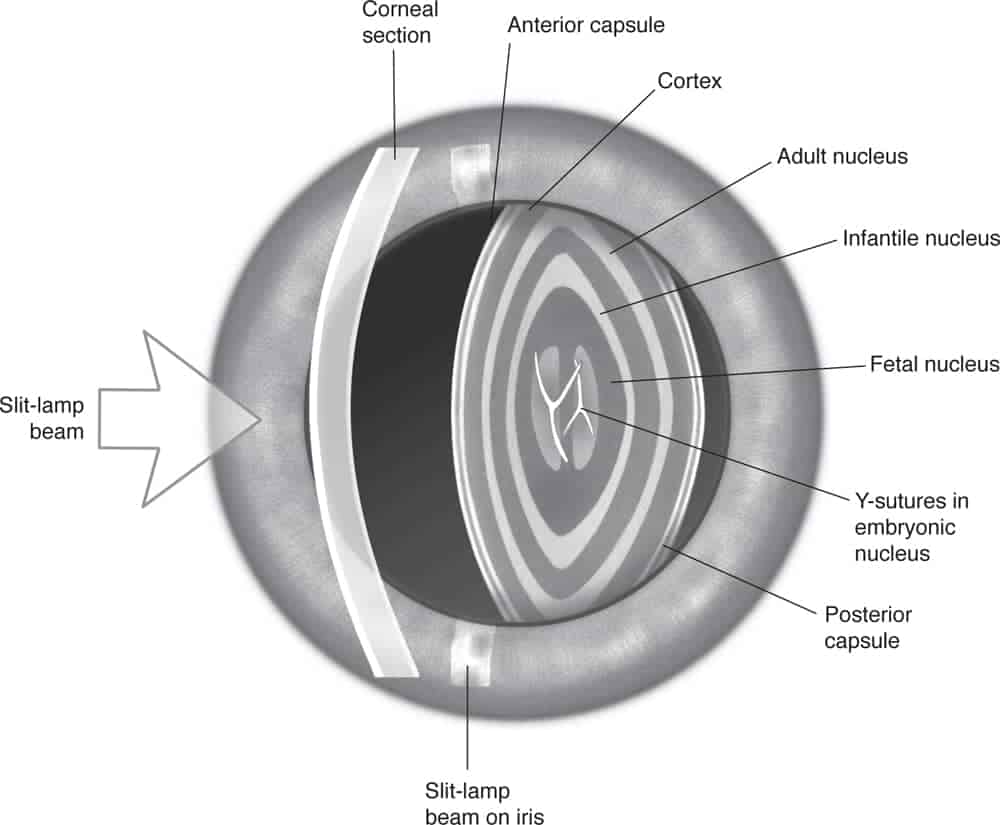
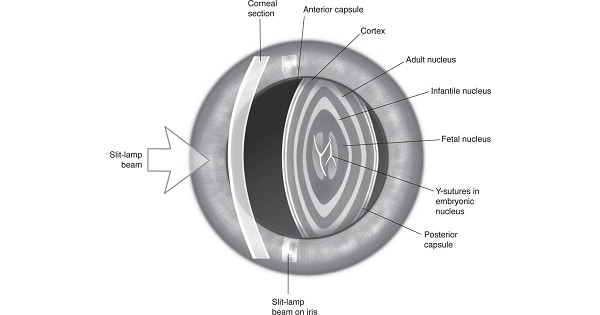
- These are long protein fibers that are closely packed & parallel.
- Lens fibres are formed through out the life, these are arranged compactly as nucleus and cortex of the lens.
a) Nucleus : It is the central part containing the oldest fibres. Consists of different zones:
- Embryonic nucleus: Formed at 1-3 months of gestation, therefore consists the oldest primary fibres.
- Fetal nucleus : Lies around the embryonic nucleus & is formed from 3 months of gestation till birth.
- Infantile nucleus: Corresponding the lens from birth to puberty & surrounds the fetal nucleus.
- Adults: Corresponds to the lens fibres formed after puberty to rest of the life.
b) Cortex: It is the peripheral part contain the youngest fibres.
- The ciliary zonules (Zonules of zinn or suspensory ligaments of ligaments of lens) hold the lens in position & enable the ciliary muscle to act on it.
Fibres of zonules are divided into:
1) Hayloid zonule (orbiculo-posterior capsular fibres)
- These originate from the pars plana of the ciliary body & inser into the capsule just posterior to the equator at the edge of patellar fossa.
2) Anterior zonule (orbiculo-anterior capsular fibres or anterior zonular sheet)
- These originate from the pars plana of the ciliary body & insert into the capsule just anterior to the equator.
- These are the strongest & thickest of the zonular fibres.
3) Posterior zonule (ciliary-posterior capsular fibres or posterior zonular sheet)
- These originate from the pars plicate of the ciliary body & insert into the capsule posterior to equator.
- These are most numerous.
4) Equatorial zonule (Cilio-equatorial fibres)
- These originate from the pars plicata of ciliary body & insert into the lens capsule at the equator.
Metabolic activity of lens
- Lens is an avascular structure but receives its nutrition mostly from aqueous humor.
- Some nutrition derived from vitreous humor too.
- Lens does not need much oxygen, but receives glucose as its main energy source.
- Glucose from the aqueous (mainly) & vitreous diffuses into the lens.
Exam Important
- Crystalline lens develops from Surface ectoderm.
- Water content in lens is 64%.
- Lens has a respiratory quotient of 1.
- Crystalline lens absorbs light rays shorter than 350 nm.
- Diameter of an adult crystalline lens is 9-10 mm.
- Thickness of the adult crystalline lens is about 5 mm.
- The capsule of the crystalline lens is thinnest at posterior pole.
- Epithelium is absent in lens on Posterior surface.
- Oldest lens fibres are found in Nucleus.
- The youngest lens fibres are present in Superficial layer of the cortex.
- The lens fibres meet around the Y-shaped sutures in Embryonic nucleus of the crystalline lens.
- Infantile nucleus of the crystalline lens refers to the nucleus developed from Birth to puberty.
- Hyaloideocapsular ligament of Weiger or retrolental ligament is a strong adhesion b/w the lens & posterior capsule.
- Strongest & thickest attachment of zonule is at just anterior to the equator.
- The crystalline lens derives its nourishment from Aqueous and vitreous humor.
- Vitamin A does not handle free radicals inside lens.
Don’t Forget to Solve all the previous Year Question asked on ANATOMY & PHYSIOLOGY OF LENS

