

Dermatophytes
Introduction
- Filamentous fungi
- Infect only superficial keratinized tissue
- Skin(stratum corneum), hair and nails.
- Cause a variety of clinical conditions, collectively known as dermatophytoses, tinea or ring worm.
Classification:
- Three genera:
- Trichophyton
- Causes black dot ring worm
- Microsporum
- Epidermophyton
- Epidermophyton floccosum
- Worldwide
- Trichophyton mentographytes
- Worldwide
- T. rubrum
- Worldwide
- T. Tonsurans
- Europe america
- M. distortum
- Australia, USA
- M. canis
- Worldwide
- M. nanum
- Worldwide
- T. equinum
- Worldwide
- T. verrucosum
- Worldwide
- T. simii
- India
- In lesions appear as :
- Hyphae
- Arthrospores
- On sabouraud’s agar form :
- Septate hyphae
- Asexual spores (micro and macroconidia)
Differentiation is based mainly on macroconidia.
|
|
Trichophyton |
Microsporum |
Epidermophyton |
|
Site |
|
|
|
|
Microconidia |
|
|
|
|
Macroconidia |
|
|
|
Clinical Manifestations
- Local inflammation is due to irritation by fungal products and hypersensitivity reaction.
- Transmission:
- Occurs from infected to uninfected persons often by brushes, combs, and towels.
|
Dermatophytoses |
Causative agent |
|
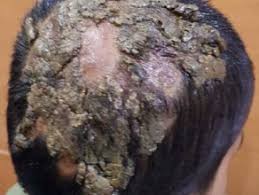
Tinea capitis
|
Microsporum, Trichophyton most species |
|
Favus
|
T. schoenleinii T. violaceum, M. gypseum |
|
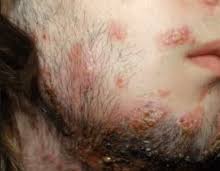
Tinea barbae
|
T. rubrum, T. mentagrophytes, T. verrucosum |
|
Tinea imbricata |
T. concentricum |
|
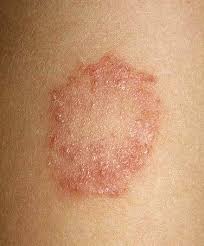
Tinea corporis
|
T. rubrum and any other dermatophyte |
|
T. cruris (Tock itch) |
E. floccosum, T.rubrum |
|
T pedis (Athlete’s foot)
|
E. floccosum, T rubrum |
|
Ectothrix hair infection |
Microsporum species, T. rubrum |
|
Endothrix hair infection
|
T. schoenleinii, T. tonsurans, T. violaceum(INDIA) |


Treatment
- Topical antifungal agents
- Oral griseofulvin is DOC.
- 3 months duration for fingure nail dermatophytosis.
Introduction
- Infect only superficial keratinized tissue
- Skin(stratum corneum), hair and nails.
- Cause a variety of clinical conditions, collectively known as dermatophytoses, tinea or ring worm.
Classification:
- Three genera:
- Trichophyton
- Causes black dot ring worm
- Microsporum
- Epidermophyton
- M. distortum
- Australia, USA
- Not in India
- In lesions appear as :
- Hyphae
- Arthrospores
- On sabouraud’s agar form :
- Septate hyphae
- Asexual spores (micro and macroconidia)
- . Differentiation is based mainly on macroconidia.
|
|
Trichophyton |
Microsporum |
Epidermophyton |
|
Site |
|
|
|
|
Microconidia |
|
|
|
|
Macroconidia |
|
|
|
Clinical Manifestation
|
Dermatophytoses |
Causative agent |
|
Tinea capitis |
Microsporum, Trichophyton most species |
|
Favus |
T. schoenleinii T. violaceum, M. gypseum |
|
Tinea barbae |
T. rubrum, T. mentagrophytes, T. verrucosum |
|
Tinea imbricata |
T. concentricum |
|
Tinea corporis |
T. rubrum and any other dermatophyte |
|
T. cruris (Tock itch) |
E. floccosum, T.rubrum |
|
T pedis (Athlete’s foot) |
E. floccosum, T rubrum |
|
Ectothrix hair infection |
Microsporum species, T. rubrum |
|
Endothrix hair infection |
T. schoenleinii, T. tonsurans, T. violaceum(INDIA) |
Treatment
- Topical antifungal agents
- Oral griseofulvin is DOC.
- 3 months duration for fingure nail dermatophytosis.
