


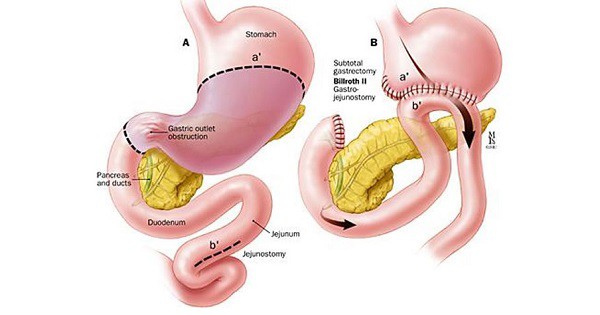
Gastric Outlet Obstruction
Gastric outlet obstruction (GOO, also known as pyloric obstruction)
Anatomy
- The stomach is located mainly in the left upper quadrant beneath the diaphragm and is attached superiorly to the esophagus and distally to the duodenum.
- The stomach is divided into four portions: cardia, body, antrum, and pylorus.
- Inflammation, scarring, or infiltration of the antrum and pylorus are associated with the development of GOO.
Pathophysiology
- Patients present with intermittent symptoms that progress until obstruction is complete.
- Vomiting is the cardinal symptom.
- Initially, patients may demonstrate better tolerance to liquids than solid food.
- In a later stage, patients may develop significant weight loss due to poor caloric intake.
- Malnutrition is a late sign, but it may be very profound in patients with concomitant malignancy.
- In the acute or chronic phase of obstruction, continuous vomiting may lead to dehydration and electrolyte abnormalities.
- In gastric outlet obstruction in a peptic ulcer patient the site of obstruction is most likely to be duodenum.
Etiology
The major benign causes of GOO are
- PUD, gastric polyps, ingestion of caustics, pyloric stenosis, congenital duodenal webs, gallstone obstruction (Bouveret syndrome), pancreatic pseudocysts, and bezoars.
Treatment
- Metabolic alkalosis of GOO responds to the administration of chloride is important; therefore, sodium chloride solution should be the initial intravenous (IV) fluid of choice.
- Place a nasogastric (NG) tube to decompress the stomach.
- Histamine-2 (H2) blockers and proton pump inhibitors are the mainstay of treatment.
- Perform gastric decompression by NG tube and suction.
- Vagotomy and antrectomy with Billroth II reconstruction (gastrojejunostomy) gives best results.
- Vagotomy and pyloroplasty and pyloroplasty.
- A combination of balloon dilatation and highly selective vagotomy.
Exam Important
- Vomiting is the cardinal symptom.
- In gastric outlet obstruction in a peptic ulcer patient the site of obstruction is most likely to be duodenum.
Treatment
Don’t Forget to Solve all the previous Year Question asked on Gastric Outlet Obstruction

