
GLUCOCORTICOIDS – FUNCTIONS & REGULATION
GLUCOCORTICOIDS – FUNCTIONS & REGULATION
Adrenal glands:
- Paired structures situated above kidney.
- Layers – Outer cortex & inner medulla.
- Adrenal cortex is essential for life.
Adrenal cortex:
- Contains 3 layers
Secretions:
- Corticosteroid hormones – Glucocorticoid, mineralocorticoids & androgens
Glucocorticoids:
- 21 carbon steroids
- Secreted by Zona fasciculata – Middle layer
- Referred as “Glucocorticoid” widespread effect on glucose (and protein) metabolism.
- Highly essential hormone for life
Hormones included –
- Cortisol & Corticosterone.
- Chief natural glucocorticoids – Cortisol
Mechanism of action:
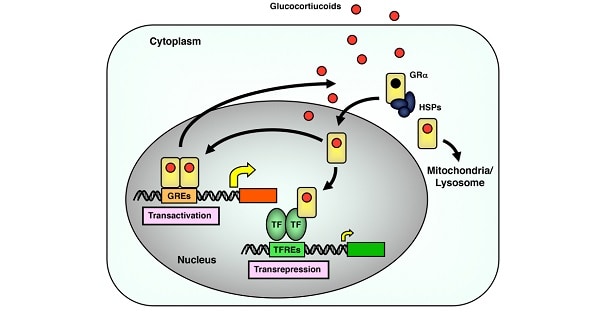
- All act on intracellular cytoplasmic receptors
Functions:
- Important effects on multiple organ systems, mostly are permissive.
- Primary role – Help body cope with acute or chronic stress
- To execute “Fight” / “Flight” response
Cortisol:
- No direct initiation of metabolic & circulatory process;
- Facilitated action of other hormones.
Important actions of glucocorticoid:
1. Carbohydrate metabolism –
- Promote gluconeogenesis & glycogenesis in liver.
- Reduce peripheral utilization of glucose in most tissues except “Brain & Heart”.
Facilitating action:
- Presence of cortisol – Glucagon & adrenaline is more effective in producing muscle glycogenolysis.
- Combined result,
- Increased blood glucose level.
- Improved glucose supply to Brain & Heart in stress.
2. Protein metabolism –
- Both catabolic (in muscles) & anabolic (in liver) effects.
In muscle –
- Inhibits protein synthesis
- Enhances protein breakdown (proteolysis)
In Liver –
- Anabolic effect
- Increases synthesis of enzymes involved in hepatic proteins production.
Overall effect –
- Anti-anabolic (catabolism).
- Hence, excess cortisol (Cushing syndrome) causes negative nitrogen balance
3. Fat metabolism –
- Cortisol promotes lipolysis directly & also indirectly (permissive action).
- By enhancing lipolysis caused by glucagon, GH, adrenaline & thyroxine
- FFA level is increased due to lipolysis.
- Fuel during stress & starvation.
4. Cardiovascular effects –
- Cortisol needs maintainance for normal vascular integrity & responsiveness.
- Enhances vascular responsiveness to norepinephrine
- Hence maintaining normal BP & volume
5. Effect on blood cells –
- Stimulates hemopoiesis & increases no. of circulating erythrocytes, neutrophils & platelets.
- Reduces no. of circulating lymphocytes, eosinophils & basophils.
- By promoting tissue migration.
6. Renal effects –
- Glucocorticoids facilitate rapid excretion of water load (increase free-water clearance)
- Enhance uric acid excretion.
Note:
- Mineralocorticoids does not have these effects.
- So, glucocorticoids maintain normal GFR not aldosterone.
7. Gastric effects –
- Increases gastric acid secretion.
- Decrease gastric mucosal cell proliferation
- Hence, corticosteroids predispose to peptic ulceration.
8. Muscle contraction –
- Optimism level of glucocorticoids is needed for normal muscular activity.
- By increasing contraction force helpful in stress.
9. Stress adaptation –
- Stress increases ACTH secretion→ Increased glucocorticoid secretion.
- Glucocorticoids help to cope up stress
10. Anti-growth effects –
- Large doses of cortisol decrease Ca2+absorption from gut & enhance its renal excretion.
- Inhibits mitosis of fibroblast.
- Increase degradation of collagen.
- Leads to osteoporosis & delayed wound healing.
11. Other effects –
Anti-inflammatory –
- Corticosteroids induce production of lipocortins
- Results phospholipase A2 inhibition.
- An enzyme involved in production of inflammatory mediators (PGs, LTs, PAF)
- Immunosuppressive.
- Anti-allergic.
- Psychological effects.
Exam Important
GLUCOCORTICOIDS – FUNCTIONS & REGULATION
- Adrenal cortex is essential for life.
Glucocorticoids:
- Secreted by Zona fasciculata – Middle layer
- Referred as “Glucocorticoid” widespread effect on glucose (and protein) metabolism.
- Highly essential hormone for life.
- Chief natural glucocorticoids – Cortisol
Mechanism of action:
- All corticosteroid hormones act on intracellular cytoplasmic receptors
Functions:
- Primary role – Help body cope with acute or chronic stress.
- To execute “Fight” / “Flight” response
Effects:
1. Carbohydrate metabolism –
- Corticosteroids promote gluconeogenesis & glycogenesis in liver.
- Reduce peripheral utilization of glucose in most tissues except “Brain & Heart”.
- Facilitating action:Combined result,
- Presence of cortisol – Glucagon & adrenaline is more effective in producing muscle glycogenolysis.
2. Protein metabolism –
- Cortisol has both catabolic (in muscles) & anabolic (in liver) effects.
In muscle –
- Cortisol inhibits protein synthesis
- Enhances protein breakdown (proteolysis)
In Liver –
- Cortisol has an anabolic effect
- Increases synthesis of enzymes involved in hepatic proteins production
Overall effect –
- Anti-anabolic (catabolism).
- Hence, excess cortisol (Cushing syndrome) causes negative nitrogen balance
3. Fat metabolism –
- Cortisol promotes lipolysis
- FFA level is increased due to lipolysis.
4. Effect on blood cells –
- Reduces no. of circulating lymphocytes, eosinophils & basophils.
5. Anti-growth effects –
6. Leads to osteoporosis & delayed wound healing.
3. Actions during inflammatory process –
- Corticosteroids induce production of lipocortins
- Results phospholipase A2 inhibition.

