
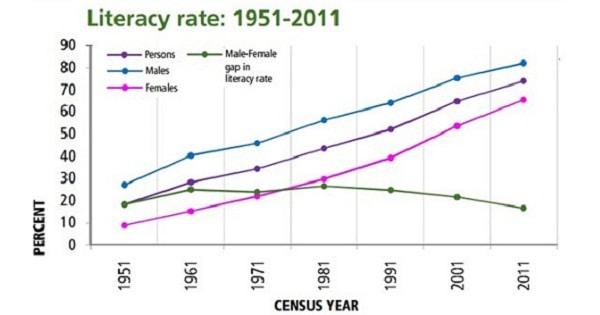
Literacy
LITERACY AND EDUCATION:
- It was decided in 1991 census to use the term literacy rate for the population > 7 years.
- A person is deemed as literate if he or she can read and write with understanding in any language
- Effective literacy rate: > 7 years population in the denominator
LITERACY RATE IN INDIA:
- National effective literacy rate in India (2011) – 74.04
- Literacy rate in males: 82.14%; females: 65.46%
- Kerala has the highest literacy rate – 93.91
- Bihar has the lowest – 63.82
LITERACY RATE IN WORLD:
- 82% acc. to CIA World
- Literacy rate in the World; [UNDP Programme report 2007-8]
- Rank 1;Georgia(100%)
- Rank173: Burkina Faso (23.5%)
INDIAN GOVERMENT SCHEMES:
Model Menu for School Lunch Program:
| Food item | g/day/child |
|---|---|
| Cereals and millets | 75 |
| Pulses | 30 |
| Oils and fats | 8 |
| Leafy vegetables | 30 |
| Non leafy vegetables | 30 |
- The Kasturba Gandhi Balika Vidyalaya or KGBV is a residential girls’ secondary school run by Government of India for the weaker sections in India.
School Education
Samagra Shiksha:
- The Union Budget, 2018-19, has proposed to treat school education holistically without segmentation from pre-nursery to Class 12.
- An overarching programme for the school education sector extending from pre-school to class 12 has been, therefore, prepared with the broader goal of improving school effectiveness measured in terms of equal opportunities for schooling and equitable learning outcomes.
It subsumes the three Schemes of :
- Sarva Shiksha Abhiyan (SSA):The main mission of SSA is to provide “useful and relevant elementary education for all children in the 6 to 14 age group by 201
- Rashtriya Madhyamik Shiksha Abhiyan (RMSA)
- Teacher Education (TE).
Mid Day Meal:
- Was introduced in a large scale in 1960s under the chief ministership of K. Kamraj Nadar in Tamil Nadu.
- Objective _ Attracting more children to schools and retain them
- The meal supply should provide at least one-third of the total energy requirement, and half of the protein need.
- In September 2004 the scheme was revised to provide cooked mid-day meal
- 300 calories and 8-12 grams of protein to all children studying in classes I-V in Government and aided schools and EGS/AIE centers.
- In addition to the free supply of food grains
Schemes for Infrastucture Development of Private Aided/Unaided Minority Institutes (IDMI):
- IDMI has been operationalisedto augment Infrastructure in Private Aided/Unaided Minority Schools/Institutions in order to enhance quality of education to minority children.
Strengthening for providing quality Education in Madrassas ( SPQEM):
- SPQEM seeks to bring about qualitative improvement in Madrasas to enable Muslim children attain standards of the national education system in formal education subjects.
Adult Education
Saakshar Bharat:
- Formulated in 2009 with the objective of achieving 80% literacy level at national level, by focusing on adult women literacy seeking to reduce the gap between male and female literacy to not more than 10 percentage points
It has four broader objectives, namely:
- Imparting functional literacy and numeracy to non-literates
- Acquiring equivalency to formal educational system
- Imparting relevant skill development programme
- Promote a leaning society by providing opportunities for continuing education.
State Resource Center (SRCs):
- Mandated to provide academic and technical resource support to adult and continuing education through development and production of material and training modules.
- In addition SRC would be required to conduct motivational and environmental building, action research and evaluation and monitoring.
Jan Shikshan Sansthans(JSSs):
- Established to provide vocational training to non-literate, neo-literate, as well as school drop outs by identifying skills as would have a market in the region of their establishment.
Assistance to Voluntary Agencies:
- Assistance to Voluntary Agencies will be considered for undertaking projects of basic literacy/under Sakshar Bharat/continuing education and other projects relevant to accomplishment of overall activities of the Scheme and launching of target specific need based and innovative programme such as Equivalency Programmes.
Exam Important
- Female literacy rate in India as per the NFHS 3 is 59%
- Mid day meal programme was first launched in Tamil Nadu
- In census literacy rate is assessed by Ability to read and write
- In 2001 census Population 7 years of age and above was used as denominators for calculating the literacy rate
- Students receive 75 gm cereal /day in mid day meal progamme
- Mid day meal programme comes under Ministry of education
- Mid day meal should provide One-third of the total energy requirement and half of the protein need
Don’t Forget to Solve all the previous Year Question asked on Literacy

