
NITROUS OXIDE
Introduction:
- Colorless, odorless, heavier than air, nonirritating & inflammable gas.
- Also referred as “Laughing gas”.
Color coding:
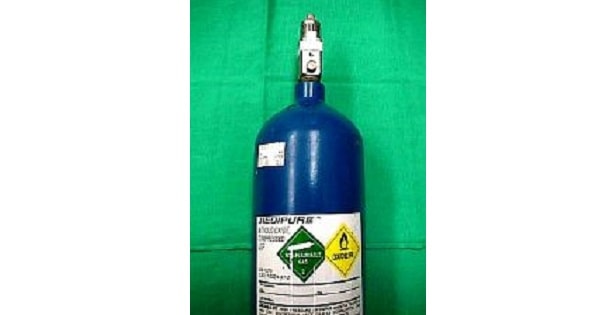
- Supplied under pressure in blue colored steel cylinders with blue shoulder in UK & ISO.
- PIN index: 3-5
Properties:
- Least potent anesthetic agent. (MAC=105%).
- Pure N2O at 1 atmospheric pressure cannot produce adequate anesthesia.
- Very low blood solubility → Quick induction with smooth & rapid recover.
Actions:
- Good analgesic.
- Poor muscle relaxant activity.
Uses:
- As a carrier & adjuvant to other anesthetics.
- Mixture of 66% N2O + 33% O2+ 0.2 – 2% another potent anesthetic is employed for most of surgical procedures.
Entonox:
- Mixture of 50% N2O & 50% O2.
- Little effect on respiration, heart & BP – Safest anesthetic.
Contraindications:
- Pneumothorax
- Pneumoperitoneum
- Emphysema.
- Volvulus.
- Acute intestinal obstruction → Increase in pressure & expansion can occur.
- Pneumocephalus → Increases ICT.
- On developed pneumocephalus N2O not used for 1 week.
Surgeries:
- Microlaryngeal surgeries→ Increased cuff pressure & aggravated laryngeal edema.
- Middle ear surgery, tympanoplasties → Increased pressure & graft displacement.
- Posterior fossa surgery & laparoscopic surgery → Air embolism may occur.
- Vitreoretinal surgery→ Diffuses N2O causing bubble expansion.
- Ear surgery (Tympanic membrane grafting, Cochlear implant).
Adverse effects:
- Second gas effect.
- Diffusion hypoxia.
- Prevented by administering 1000/0 oxygen after N2O discontinuation & endotracheal tube removal.
Bone marrow depression.
- Bone marrow changes prevented by pretreating patients with large doses of folinic acid.
Vit B12 deficiency:
- Manifestations – Megaloblastic anemia, subacute combined cord degeneration.
- Methemoglobinemia & laryngospasm may occur.
Long term administration:
- Produce hematologic toxicity & neurotoxicity.
- Due to interaction of N20 with Vit B12.
- Increases pressure significantly in closed air spaces.
Exam Important
- Use of nitrous oxide is contraindicated in Tympanic membrane grafting, Pneumoencephalography, Vitreoretinal surgery, Cochlear implant, Microlaryngeal surgery & Vitreoretinal surgery
- Nitrous oxide should be avoided in middle ear surgery when tympanic grafts are used
- Gas stored in liquid form is Nitrous oxide
- Nitrous oxide causes bone marrow suppression
- Blue cylinder with blue shoulder is the color coding for Nitrous oxide gas cylinder for UK and ISO.
- Nitrous oxide is a low potency anesthetic agent as Nitrous oxide has a low lipid solubility and its MAC value of 105%.
- PIN index for nitrous oxide is 3-5
- At the end of anaesthesia after discontinuation of nitrous oxide and removal of endotracheal tube, 1000/0 oxygen is administered to the patient to prevent Diffusion Hypoxia
- Nitrous oxide shows Blunts ventilatory response to hypoxia
- Laughing gas is Nitrous oxide
- Nitrous oxide causes megaloblastic anemia
Don’t Forget to Solve all the previous Year Question asked on NITROUS OXIDE

