
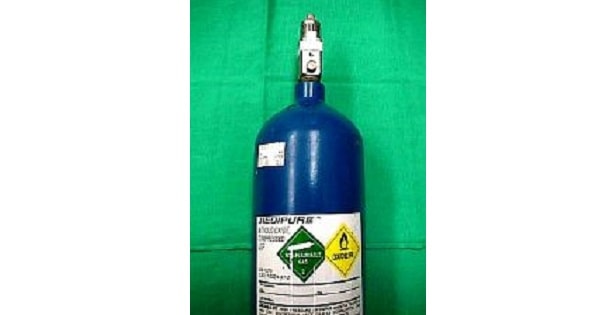
NITROUS OXIDE
Which of the following inhalation anaesthetics should be avoided in middle ear surgery when tympanic grafts are used:
| A | Halothane | |
| B | Nitrous oxide | |
| C | Ether | |
| D | Isoflurane |
Which of the following inhalation anaesthetics should be avoided in middle ear surgery when tympanic grafts are used:
| A | Halothane | |
| B | Nitrous oxide | |
| C | Ether | |
| D | Isoflurane |
Nitrous oxide
| A | Carbon dioxide | |
| B | Nitrous oxide | |
| C | Cyclopropane | |
| D | Oxygen |
| A | Carbon dioxide | |
| B | Nitrous oxide | |
| C | Cyclopropane | |
| D | Oxygen |
Nitrous oxide
Which of the following inhalation anaesthetics should be avoided in middle ear surgery
| A |
Halothane |
|
| B | Nitrous oxide | |
| C | Ether | |
| D | Isoflurane |
Which of the following inhalation anaesthetics should be avoided in middle ear surgery
| A |
Halothane |
|
| B | Nitrous oxide | |
| C | Ether | |
| D | Isoflurane |
Nitrous oxide

Which of the following anaesthetic agent causes bone marrow supression?
| A |
Halothane |
|
| B |
Ketamine |
|
| C |
Nitrous Oxide |
|
| D |
Isoflurane |
Which of the following anaesthetic agent causes bone marrow supression?
| A |
Halothane |
|
| B |
Ketamine |
|
| C |
Nitrous Oxide |
|
| D |
Isoflurane |
Nitrous oxide may cause bone marrow supression by interfering with the production of factors necessary for DNA synthesis.
Nitrous oxide has few adverse effects, it is a mild cardiac depressant
and pulmonary vasoconstrictor and is relatively contraindicated in patients with pulmonary hypertension.
It cause diffusional hypoxia.
It inhibits folate metabolism and is contraindicated in pregnancy.
It promote expansion of internal gas-filled structures, and is avoided in patients with pneumothorax, pneumocephalus, and vascular air embolism.
An anaesthetist orders a new attendant to bring the Nitrous oxide cylinder. He will ask the attendant to identify the correct cylinder by following which colour code?
| A |
Blue cylinders with Blue shoulders |
|
| B |
Black cylinders with grey shoulders |
|
| C |
White cylinders with black shoulders |
|
| D |
Grey cylinder with white shoulders |
An anaesthetist orders a new attendant to bring the Nitrous oxide cylinder. He will ask the attendant to identify the correct cylinder by following which colour code?
| A |
Blue cylinders with Blue shoulders |
|
| B |
Black cylinders with grey shoulders |
|
| C |
White cylinders with black shoulders |
|
| D |
Grey cylinder with white shoulders |
Blue cylinder with blue shoulder is the colour coding for Nitrous oxide gas cylinder for UK and ISO.
Colour coding of Gas cylinders
Colour coding of Gas cylinders (for UK and ISO) :
| Substance | Gas/vapour | Symbol |
Colour coding
Cylinder |
Colour coding
Shoulder
|
| Oxygen | Gas | O2 | Black | White |
| Nitrous oxide | Vapour | N2O | Blue | Blue |
| Entonox | Gas and Vapour | N2O/O2 | Blue | White/Blue |
| Air | Gas | AIR | Black | White/Black |
| Carbon dioxide | Vapour | CO2 | Grey | Grey |
| Helium | Gas | He | Brown | Brown |
A patient undergoing surgical procedure is given nitrous oxide as the anaesthetic agent. There has been a delay in induction and the anesthetist is considering additional interventions.
| A |
Both Assertion and Reason are true, and Reason is the correct explanation for Assertion |
|
| B |
Both Assertion and Reason are true, and Reason is not the correct explanation for Assertion |
|
| C |
Assertion is true, but Reason is false |
|
| D |
Assertion is false, but Reason is true |
A patient undergoing surgical procedure is given nitrous oxide as the anaesthetic agent. There has been a delay in induction and the anesthetist is considering additional interventions.
| A |
Both Assertion and Reason are true, and Reason is the correct explanation for Assertion |
|
| B |
Both Assertion and Reason are true, and Reason is not the correct explanation for Assertion |
|
| C |
Assertion is true, but Reason is false |
|
| D |
Assertion is false, but Reason is true |
Nitrous oxide is a non irritating low potency anaesthetic agent,
unconsciousness cannot be produced in all individuals without concomitant hypoxia.
It has a MAC value of 105%.
MAC value is a measure of potency of the drug,
it is the lowest concentration of anaesthetic in pulmonary alveoli needed to produce immobility in response to a painful stimulus in 50% individuals
Higher the MAC lower the potency and lipid solubility and vice versa.
PIN index is a safety measure for gas cylinders. What is the PIN index for nitrous oxide?
| A |
3-6 |
|
| B |
2-5 |
|
| C |
3-5 |
|
| D |
1-6 |
PIN index is a safety measure for gas cylinders. What is the PIN index for nitrous oxide?
| A |
3-6 |
|
| B |
2-5 |
|
| C |
3-5 |
|
| D |
1-6 |
Pin Index safety system:
-
To discourage incorrect cylinder attachments, a pin index safety system has been adopted by cylinder manufacturers.
-
The relative positioning of the pins and holes is unique for each gas.
Pin Index safety system for medical gas cylinders:
|
Gas |
Index Pins |
|
Air |
1 and 5 |
|
CO2 mix (CO2 <7%) |
2 and 6 |
|
CO2 mix (CO2 >7%) |
1 and 6 |
|
Cyclopropane |
3 and 6 |
|
Ethylene |
1 and 3 |
|
He-O2 (<80%) |
2 and 4 |
|
He-O2 (>80%) |
4 and 6 |
|
Nitrous oxide |
3 and 5 |
|
Nitrogen |
1 and 4 |
|
Oxygen |
2 and 5 |
Ref: Morgan, Jr. G.E., Mikhail M.S., Murray M.J. (2006). Chapter 2. The Operating Room: Medical Gas Systems, Environmental Factors, & Electrical Safety. In G.E. Morgan, Jr., M.S. Mikhail, M.J. Murray (Eds), Clinical Anesthesiology, 4e.
Use of nitrous oxide is contraindicated in all of the following surgeries, EXCEPT:
| A |
Tympanic membrane grafting |
|
| B |
Pneumoencephalography |
|
| C |
Vitreoretinal surgery |
|
| D |
Exenteration operation |
Use of nitrous oxide is contraindicated in all of the following surgeries, EXCEPT:
| A |
Tympanic membrane grafting |
|
| B |
Pneumoencephalography |
|
| C |
Vitreoretinal surgery |
|
| D |
Exenteration operation |
Conditions in which nitrous oxide might be hazardous include,
- Air embolism
- Pneumothorax
- Acute intestinal obstruction
- Intracranial air (tension pneumocephalus following dural closure or pneumoencephalography)
- Pulmonary air cysts
- Intraocular air bubbles
- Tympanic membrane grafting
Ref: Morgan, Jr. G.E., Mikhail M.S., Murray M.J. (2006). Chapter 7. Inhalation Anesthetics. In G.E. Morgan, Jr., M.S. Mikhail, M.J. Murray (Eds), Clinical Anesthesiology, 4e.
At the end of anaesthesia after discontinuation of nitrous oxide and removal of endotracheal tube, 1000/0 oxygen is administered to the patient to prevent:
| A |
Diffusion Hypoxia |
|
| B |
Second gas effect |
|
| C |
Hyperoxia |
|
| D |
Bronchospasm |
At the end of anaesthesia after discontinuation of nitrous oxide and removal of endotracheal tube, 1000/0 oxygen is administered to the patient to prevent:
| A |
Diffusion Hypoxia |
|
| B |
Second gas effect |
|
| C |
Hyperoxia |
|
| D |
Bronchospasm |
A i.e. Diffusion Hypoxia
Pin code index of nitrous oxide is:
March 2013 (c)
| A |
1, 6 |
|
| B |
2, 5 |
|
| C |
2, 6 |
|
| D |
3, 5 |
Pin code index of nitrous oxide is:
March 2013 (c)
| A |
1, 6 |
|
| B |
2, 5 |
|
| C |
2, 6 |
|
| D |
3, 5 |
Ans. D i.e. 3, 5
True regarding Nitrous oxide is:
March 2013 (d)
| A |
Stored at room temperature |
|
| B |
Blunts ventilatory response to hypoxia |
|
| C |
Highly inflammable |
|
| D |
Complete anaesthetic agent |
True regarding Nitrous oxide is:
March 2013 (d)
| A |
Stored at room temperature |
|
| B |
Blunts ventilatory response to hypoxia |
|
| C |
Highly inflammable |
|
| D |
Complete anaesthetic agent |
Ans. B i.e. Blunts ventilator response to hypoxia
Nitrous oxide
- Discovered by: Priestly
- Cylinder colour: Blue
- PIN index (code): 3,5
- Also known as: Laughing gas,
- Adverse effects:
– Megaloblastic anemia,
– Bone marrow suppression,
- Second gas effect/ diffusion hypoxia
- C/I in:
– Pneumothorax,
– Air embolism etc.
Laughing gas is:
March 2005
| A |
Ketamine |
|
| B |
Nitric oxide |
|
| C |
Nitrous oxide |
|
| D |
Methane |
Laughing gas is:
March 2005
| A |
Ketamine |
|
| B |
Nitric oxide |
|
| C |
Nitrous oxide |
|
| D |
Methane |
Ans. C: Nitrous oxide
Nitrous oxide is known as “laughing gas” due to the euphoric effects of inhaling it, a property that has led to its recreational use as a dissociative hallucinogen
Which of the following is not true regarding cryosurgery:
March 2011
| A |
Done without anaesthesia |
|
| B |
Temperature is below freezing point [-60 degree Celsius] |
|
| C |
Done in CIN |
|
| D |
Nitrous oxide is widely used |
Which of the following is not true regarding cryosurgery:
March 2011
| A |
Done without anaesthesia |
|
| B |
Temperature is below freezing point [-60 degree Celsius] |
|
| C |
Done in CIN |
|
| D |
Nitrous oxide is widely used |
Ans. D: Nitrous oxide is widely used
Cryosurgery is suited for small lesions (dysplasia and CIN)
It is done as an OPD procedure without analgesia
CO2 (-60 degree C), Freon (-60 degree C) and nitrous oxide (-80 degree C) are the freezing agents
Most potent analgesic agent among following
| A |
Nitrous oxide |
|
| B |
Nitric oxide |
|
| C |
CO2 |
|
| D |
Oxygen |
Most potent analgesic agent among following
| A |
Nitrous oxide |
|
| B |
Nitric oxide |
|
| C |
CO2 |
|
| D |
Oxygen |
Ans. a. Nitrous oxide
- above options, most potent analgesic agent is Nitrous oxide.
- “Nitrous oxide- 50:50 nitrous oxide and oxygen has revolutionized it as analgesic agent; it has been used as an analgesic agent in obstetric surgeries; dental procedures; in acute trauma; burn dressings and cardiac pain as well.”- Wiley and Churchill-Davidson A Practice of Anesthesia 7/e p536
- Miller says “Nitrous oxide produce analgesia that is in part because of release of proenkephalin derived family of endogenous opioids
Physical properties of N20
- It is colourless, non-irritating and sweet smelling
- Boiling point is -89°C.
- Critical temperature is 36.5°C° which is a.bove room temperature, therefore it can be kept in liquefied state.
- Stored as liquid in blue color cylindersQ
- 35 times more soluble than nitrogen
Remember: Anesthesia with
| No analgesia | HalothaneQ |
| Only analgesia | N20Q |
| Profound analgesia | KetamineQ |
| Best/maximum analgesia | TrileneQ |
All are true about nitrous oxide except ‑
| A |
Laughing gas |
|
| B |
Causes megaloblastic anemia |
|
| C |
Causes diffusion hypoxia |
|
| D |
Good muscle relaxant |
All are true about nitrous oxide except ‑
| A |
Laughing gas |
|
| B |
Causes megaloblastic anemia |
|
| C |
Causes diffusion hypoxia |
|
| D |
Good muscle relaxant |
Ans. is ‘d’ i.e., Good muscle relaxant
Nitrous oxide N,O
- It is colourless, odourless, heavier than air, nonirritating and noninflammable gas.
- It is also called laughing gas.
- MAC is 105% (least potent) – even pure N,O at I atmospheric pressure can not produce adequate anaesthesia.
- It has good analgesic but poor muscle relaxant activity.
- It is supplied under pressure in blue coloured steel cyclinders.
- It has very low blood solubility → induction is quick and smooth with rapid recovery.
- Second gas effect and diffusion hypoxia occur with N20 only.
- N,0 is generally used as a carrier and adjuvant to other anaesthetics → A mixture of 70% N20 + 25 – 30% 0, + 0.2 – 2% another potent anaesthetic is employed for most of the surgical procedures.
- Entonox is a mixture of 50% N20 and 50% 02.
- It has little effect on respiration, heart and BP.
- It can cause bone marrow depression and vit Budeficiency.
- N20 is the only anaesthetic reported to produce hematologic toxicity and neurotoxicity with long term administration.
- Both toxicities are the result of the interaction of N20 with vit B12.
- Complete bone marrow failure can be expected after several days of continuous exposure.
- Bone marrow changes are preventable by pretreating patients with large doses offolinic acid.
- Other manifestations of vit B 12 deficiency eg. megaloblastic anemia, subacute combined degeneration of cord may also occur.
- Methemoglobinemia and laryngospasm may occur.
- It is contraindicated in patients with air cavities like pneumothorax, pneumoperitoneum and volvulus → expansion and increase in pressure occur.

