

SYMPATHETIC RECEPTORS
INTRODUCTION:
- Adrenergic receptors/adrenoceptors/Sympathetic receptors – Class of G protein-coupled receptors.
- Targets catecholamines, mainly norepinephrine (noradrenaline) & epinephrine (adrenaline).
- Cells binds to catecholamine receptors & stimulates sympathetic nervous system.
Sympathetic nervous system –
- Responsible for fight-or-flight response, including pupil diltation, increasing heart rate, mobilizing energy, & blood-flow divertion from non-essential organs to skeletal muscle.
RECEPTOR TYPES:
α receptors:
Subtypes
- α1 (a Gq coupled receptor)
- α2 (a Gi coupled receptor)
- Phenylephrine – Selective α-receptor agonist.
β receptors:
Subtypes:
- β1, β2 and β3.
- All three linked to Gs proteins (although β2 also couples to Gi & to adenylate cyclase.
- Agonist binding causes raised intracellular second messenger cAMP concentration.
- Downstream effectors of cAMP include cAMP-dependent protein kinase (PKA), which mediates intracellular events following hormone binding.
- Isoprenaline – non-selective agonist.
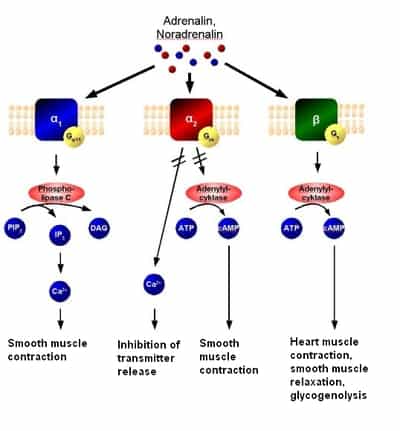
| Receptor | Location | Selected action | Mechanism | Agonist | Antagonist |
|---|---|---|---|---|---|
| α1 | Vascular , GU smooth muscle Liver Intestinal Smooth muscle Heart |
Smooth muscle contraction, Mydriasis, Vasoconstriction in the skin, mucosa & abdominal viscera Sphincter contraction of the GI tract and urinary bladder |
Gq: phospholipase C(PLC) activated, IP3,and DAG, ↑ calcium |
Noradrenaline Phenylephrine Methoxamine Cirazoline Xylometazoline Midodrine Metaraminol Chloroethylclonidine |
Acepromazine Alfuzosin Doxazosin Phenoxybenzamine Phentolamine Prazosin Tamsulosin Terazosin Trazodone (TCAs) Amitriptyline Clomipramine Doxepin Trimipramine Typical and atypical antipsychotics Antihistamines (H1 antagonists) Hydroxyzine |
| α 2 |
β-cell of pancreas Platelet Nerve Terminal Vascular smooth muscle |
Smooth muscle mixed effects, Norepinephrine (noradrenaline) inhibition, Platelet activation |
Gi: adenylate cyclase inactivated, cAMP↓ |
Agmatine Dexmedetomidine Medetomidine Romifidine Clonidine Chloroethylclonidine Brimonidine Detomidine Lofexidine Xylazine Tizanidine Guanfacine Amitraz |
Phentolamine Yohimbine Idazoxan Atipamezole Trazodone Typical and atypical antipsychotics |
| β1 | Juxtraglomular cell Heart |
Positive Chronotropic, Dromotropic and inotropic effects Increased amylase secretion |
Gs: adenylate cyclase activated, cAMP↑ |
Dobutamine Isoprenaline Noradrenaline |
Metoprolol Atenolol Bisoprolol Propranolol Timolol Nebivolol Vortioxetine |
| β2 | Smooth muscle (GI,GU,Vascular,Braonchial) Skeletal Muscle |
Smooth muscle relaxation (Ex. Bronchodilation) |
Gs: adenylate cyclase activated, cAMP |
Salbutamol Bitolterol mesylate Formoterol Isoprenaline Levalbuterol Metaproterenol Salmeterol Terbutaline Ritodrine |
Butoxamine Timolol Propranolol ICI-118,551 |
| β3 | Adipose Tissue | Enhance lipolysis, Promotes relaxation of detrusor muscle in the bladder |
Gs: adenylate cyclase activated, cAMP↑ |
L-796568 Amibegron Solabegron Mirabegron |
SR 59230A |
Exam Important
- Adreneric β receptors having lipolysis property in fat cells is Beta -3.
- Alpha 2 agonist cause analgesia & not hyperalgesia.
- Salmeterol is long acting beta-2-agonist.
- Beta-2-agonist causes a brief spell of hyperkalemia followed by hypokalemia.
- Beta-2-agonist doesn’t cause hypoglycemia.
- Alpha-2-agonist causes Sedation, Glaucoma & Hypertension.
- Beta-1 receptors in heart stimulates its contractions.
- Beta-2 receptors are present in smooth muscles.
- Beta-1 receptors stimulation releases renin.
- Beta blockers are used to treat hyperthyroidism (Not hypothyroidism).
Don’t Forget to Solve all the previous Year Question asked on SYMPATHETIC RECEPTORS

