


VERNEAL KERATOCONJUNCTIVITIS (SPRING CATTARRH)
VERNEAL KERATOCONJUNCTIVITIS (SPRING CATTARRH)
- Spring catarrh is an allergic inflammation of conjunctiva.
- Characterized by recurrent, bilateral, interstitial, selflimiting conjunctivitis.
- Aggravated during spring & summer period.
- It is considered to be Type I hypersensitivity reaction (immediate type) to exogenous allergens such as grass pollens.
- More common in boys & affects age group 4-20 years.
- More common in summer, hence the name spring cattarrh looks a misnomer.
- Recently it is being labeled as “Warm weather conjunctivitis”.
CLINICAL FEATURES
- Spring cattarrh is characterized by marked itching & burning.
- Stringy (ropy) discharge, lacrimation, photophobia & heaviness of lids.
Clinically spring cattarrh is divided into three types:
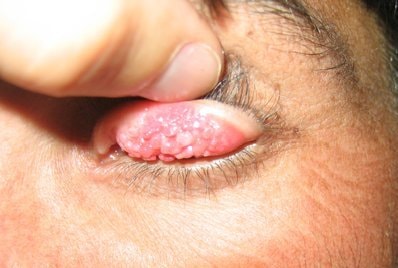
1. Palpebral form:
- Most common type.
- The upper palpebral conjunctiva shows papillae (papillary hypertrophy) with their characterstic appearance:
- large & flat toped
- cobble stone appearance (Pavement stone appearance)
- these papilla heal without scarring

2. Bulbar form:
Characterized by:
- Dusky red triangular congestion of bulbar conjunctiva in palpebral area
- Gelatinous thickened accumulation of tissue around the limbus
- Presence of discrete whitish raised dots along the limbus (Tranta’s spot)


3. Mixed form : both bulbar & palpebral manifestations occur together.
Corneal signs (Vernal keratopathy)
- Punctuate epithelial keratitis
- Ulcerative vernal keratitis: shallow transverse ulcer (Shield ulcer)
- Vernal corneal plaques
- Subepithelial scarring
- Pseudogerontoxon: characterized by a classical “cupid’s bow” outline.


TREATMENT
- Steroids
- Mast cell stabilizers as di-sodium-chromoglycate & olapatadine & idoxamide tromethamine.
- Topical antihistaminics, cyclosporine & vasoconstrictor like nephazoline
- Olaptadine is a new mast cell stabilizer used in spring catarrh.
Exam Important
- Vernal keratoconjunctivitis is associated with Corneal opacity.
- Epidemic keratoconjunctivitis is caused by Adenovirus.
- Keratoconjunctivitis sicca refers to Aqueous tear deficiency dry eye.
- Features of vernal keratoconjunctivitis are Papillary hypertrophy, Shield’s ulcer, Trantra’s spot.
- Treatment of vernal keratoconjunctivitis includes Steroids, Chromoglycate, Olopatadine.
Don’t Forget to Solve all the previous Year Question asked on VERNEAL KERATOCONJUNCTIVITIS (SPRING CATTARRH)

