

Yersinia pestis
Morphology
- Gram-negative
- Saftey pin appreance
- Pleomorphic
- Bipolar-staining coccobacillus member of the Enterobacteriaceae family
- Obligate intracellular pathogen
- Most are motile under 30 degrees C. and non-motile at 37 degrees C
MACROSCOPIC APPEARANCE
- Colonies grown on Nutrient Agar appear translucent to opaque.
- Stalactite growth in ghee broth
 KEY BIOCHEMICAL REACTIONS
- Catalase-positive.
- Oxidase-negative.
- Phenotypic characteristics are often temperature dependent.
- Voges-Proskauer-negative at 37 degrees C.
- Methyl-Red-positive.
- Lactose-negative.
- Urease-variable.
- H 2 S not produced.
METABOLIC PROPERTIES
- Facultatively anaerobic. Chemoorganotrophic, having both a fermentative and respiratory type metabolism. Acid without gas is produced from glucose.
Transmission
- Cause disease in rodents, insects and humans.
- Wild rat main reservoir
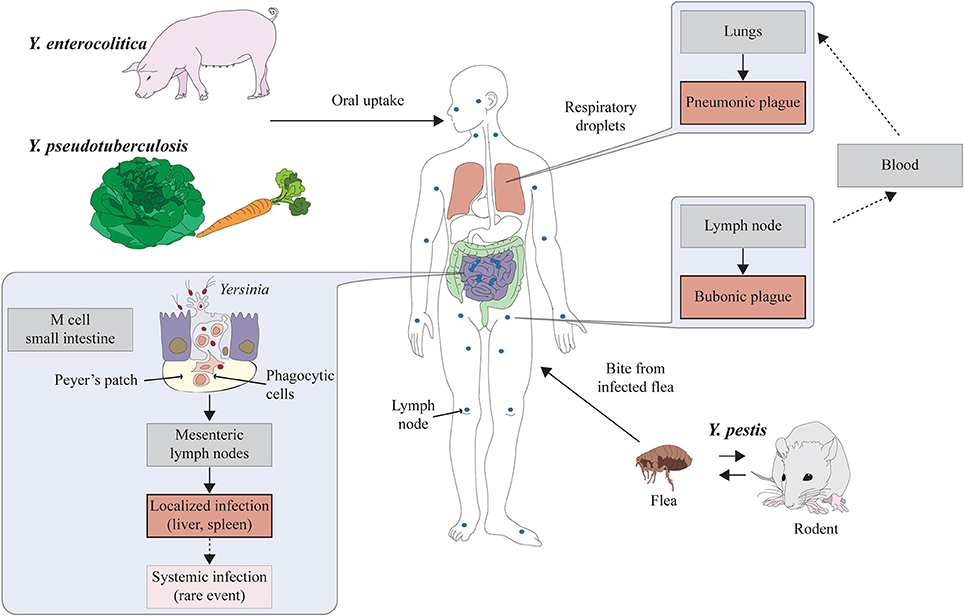
- The primary carriers of the pathogen are the Oriental rat flea, Xenopsylla cheopis, and infected rodents.
Disease
Three forms of the plague
- Bubonic
- Septicemic
- Pneumonic
Bubonic plague
- Most common
- Human acts as dead end host
- Easily diagnosed by the presence of extremely swollen and tender lymph glands called “buboes” that can grow to the size of an egg, and typically arise in the groin, neck and armpits.
- Absence of visible cellulitis
- Disease becomes evident 2-6 days after infection
- High fevers, chills, headache, and extreme exhaustion.
- Development of gangrene in the extremities, lending it the name “Black Death”.

- Bacteremia and death from Gram-negative induced shock occurs in 40-60% of untreated cases, while only 1-10% of treated cases are lethal.
Septicemic plague
 Necrosis
- Develops secondarily to bubonic plague, and is a result of direct invasion of the bloodstream without involvement of the lymph nodes.
- Due to the lack of buboes, symptoms generally resemble the flu and make diagnosis difficult.
- In severe cases, seizure and shock can take place.
- Death rates for this form are 40% for treated cases and 100% for untreated cases.
Pneumonic plague
- The most serious form of infection is the which is 100% lethal if not treated within the first 24 hours.
- This mode of infection is the result of inhaled droplets of infectious material that proceed to directly colonize the lung tissue.
- Man to man transmission.
- Symptoms, on top of those found in the other two forms, include a severe cough, bloody sputum, chest pains, confusion, cyanosis, shock and eventual death.
Diagnosis
- Laboratory confirmation of plague depends on the isolation of Y. pestis from cultures of body fluid or tissues.
- Cultures of three blood samples taken over a period of 45 minutes, before the treatment, will usually result in isolation of bacteria.
- Yersinia pestis expresses an envelope glycoprotein called Fraction 1 (F1) antigen only at temperatures >33°C.
- Serum antibodies to F1 are measured using passive hemagglutination assays (PHA).
- High titers of antibody along with correlating symptoms, such as buboes, generally indicate a positive diagnosis.
- Further testing may include X-rays of the lung to check for presence of pneumonic plague, examination of sputum, and lymph node biopsies.
Treatment
- Yersinia pestis is very susceptible to streptomycin and chloramphenicol
- DOC chemoprophylaxis-Tetracycline
- Concomitant therapy is highly recommended to avoid shock resulting from the lysis of high numbers of Gram-negative cells and the induction of a severe inflammatory response.
Misc.
- Bioterrorism Agent Category A agent
- Notifiable diseases
- Survival in cold environment also favours Yersinia pestis.
Exam Important
Morphology
- Gram-negative
- Saftey pin appreance
- Pleomorphic
- Most are motile under 30 degrees C. and non-motile at 37 degrees C
MACROSCOPIC APPEARANCE
- Stalactite growth in ghee broth
Transmission
- Wild rat main reservoir
- The primary carriers of the pathogen are the Oriental rat flea, Xenopsylla cheopis, and infected rodents.
Disease
- Three forms of the plague
Bubonic plague
- Most common
- Human acts as dead end host
- Easily diagnosed by the presence of extremely swollen and tender lymph glands called “buboes” that can grow to the size of an egg, and typically arise in the groin, neck and armpits.
- Absence of visible cellulitis
- Disease becomes evident 2-6 days after infection
- High fevers, chills, headache, and extreme exhaustion.
- Development of gangrene in the extremities, lending it the name “Black Death”.
Septicemic plague
- Necrosis
- Develops secondarily to bubonic plague, and is a result of direct invasion of the bloodstream without involvement of the lymph nodes.
- Due to the lack of buboes, symptoms generally resemble the flu and make diagnosis difficult.
- In severe cases, seizure and shock can take place.
- Death rates for this form are 40% for treated cases and 100% for untreated cases.
Pneumonic plague
- The most serious form of infection is the which is 100% lethal if not treated within the first 24 hours.
- Man to man transmission.
Treatment
- Yersinia pestis is very susceptible to streptomycin and chloramphenicol
- DOC chemoprophylaxis-Tetracycline
Misc.
- Bioterrorism Agent Category A agent
- Notifiable diseases
- Survival in cold environment also favours Yersinia pestis.
Don’t Forget to Solve all the previous Year Question asked on Yersinia pestis

