BREAST ANATOMY
Development of breast is related with:
March 2013
| A |
GC scale |
|
| B |
Tanner scale |
|
| C |
Ranson criteria |
|
| D |
MESS score |
Development of breast is related with:
March 2013
| A |
GC scale |
|
| B |
Tanner scale |
|
| C |
Ranson criteria |
|
| D |
MESS score |
Ans. B i.e. Tanner scale
Breast is a ‑
| A |
Endocrine gland |
|
| B |
Modified sweat gland |
|
| C |
Modified sehaceous gland |
|
| D |
Holocrine gland |
Breast is a ‑
| A |
Endocrine gland |
|
| B |
Modified sweat gland |
|
| C |
Modified sehaceous gland |
|
| D |
Holocrine gland |
Breast is a modified sweat gland. It is apocrine type of sweat gland.
Structure 5 in the photograph of breast represents ? 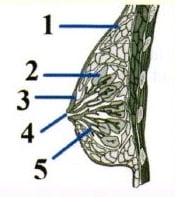
| A |
Coopers’ ligament. |
|
| B |
Lobule with alveoli. |
|
| C |
Lactiferous duct. |
|
| D |
Areolar tissue. |
Structure 5 in the photograph of breast represents ?
| A |
Coopers’ ligament. |
|
| B |
Lobule with alveoli. |
|
| C |
Lactiferous duct. |
|
| D |
Areolar tissue. |
In the picture of breast above-
1-Cooper’s ligament.
2- Lobule with alveoli.
3- Areola.
4 -Nipple.
5- Lactiferous duct.
Lactiferous ducts form a tree branched system connecting the lobules of the mammary gland to the tip of the nipple. They are also referred to as galactophores,galactophorous ducts, mammary ducts, mamillary ducts and milk ducts. They are the structures which carry milk toward the nipple in a lactating female.
Lymphatic drainage of upper outer quadrant of breast ‑
| A |
Anterior axillary |
|
| B |
Posterior axillary |
|
| C |
Paratracheal |
|
| D |
None of the above |
Lymphatic drainage of upper outer quadrant of breast ‑
| A |
Anterior axillary |
|
| B |
Posterior axillary |
|
| C |
Paratracheal |
|
| D |
None of the above |
Ans. is ‘a‘ i.e., Anterior axillary
- Most lymph, especially that from the superior lateral quadrant and center of breast, drains into the axillary lymph nodes, which, in turn, are drained by the subclavian lymphatic trunk.
- Among the axillary nodes, the lymphatics end mostly in the anterior groups and partly the posterior and apical groups. Lymph from the anterior and posterior groups passes to the central and lateral groups, and through them to the apical (terminal) groups. Finally it reaches the supraclavicular nodes.
- The lymph vessels of the breast are arranged into two groups :‑
- Superficial lymphatics : Drain skin of the breast.
- Deep lymphatics : Drain parenchyma of breast along with nipple and areola :‑
- 75% is drained into axillary nodes (mostly into anterior axillary).
- 20% is drained into internal mammary lymph nodes.
- 5% is drained into posterior intercostal lymph nodes.