

Breast Anatomy
DEVELOPMENT:
- Tanner I:No glandular tissue: areola follows the skin contours of the chest (prepubertal) (typically age 10 and younger)
- Tanner II: Breast bud forms, with small area of surrounding glandular tissue; areola begins to widen (10–11.5)
- Tanner III: Breast begins to become more elevated, and extends beyond the borders of the areola, which continues to widen but remains in contour with surrounding breast (11.5–13)
- Tanner IV :Increased breast size and elevation; areola and papilla form a secondary mound projecting from the contour of the surrounding breast (13–15)
- Tanner V: Breast reaches final adult size; areola returns to contour of the surrounding breast, with a projecting central papilla. (15+)
ANATOMY:
The breast can be considered to be composed of two regions:
- Circular body – largest and most prominent part of the breast.
- Axillary tail – smaller part, runs along the inferior lateral edge of the pectoralis major towards the axillary fossa.
MICROANATOMY:
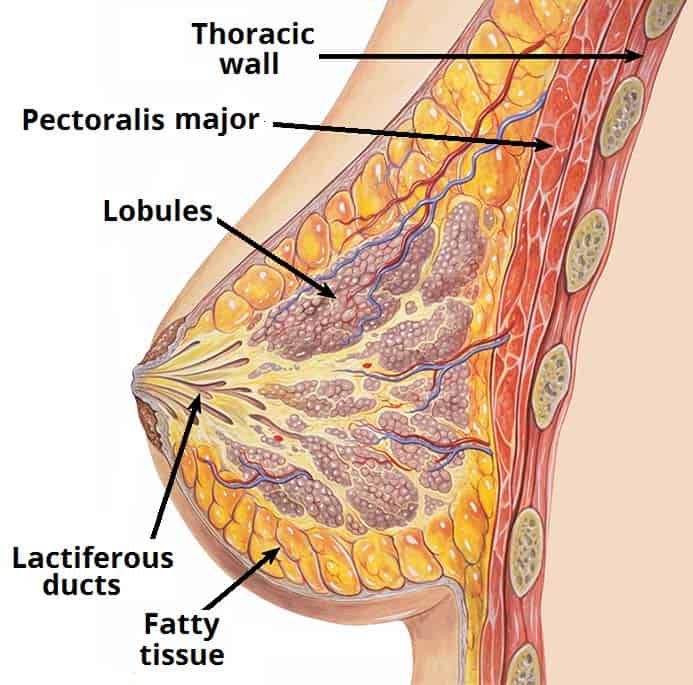
- The breast is composed of mammary glands surrounded by a connective tissue stroma.
Mammary Glands
- Modified sweat glands. They consist of a series of ducts and secretory lobules (15-20).
- Each lobule consists of many alveoli drained by a single lactiferous duct.
- These ducts converge at the nipple like spokes of a wheel.
Connective Tissue Stroma
- Fibrous and a fatty component.
- The fibrous stroma condenses to form suspensory ligaments (of Cooper). These ligaments have two main functions:
- Attach and secure the breast to the dermis and underlying pectoral fascia.
- Separate the secretory lobules of the breast.
Pectoral Fascia
- The base of the breast lies on the pectoral fascia – a flat sheet of connective tissue associated with the pectoralis major muscle.
- It acts as an attachment point for the suspensory ligaments.
- There is a layer of loose connective tissue between the breast and pectoral fascia – known as the retromammary space.
- This is a potential space, often used in reconstructive plastic surgery.
BLOOD AND NERVE SUPPLY:
- Each breast receives blood supply from lateral thoracic branches of axillary artery and intercostal arteries.
- The veins accompany the arteries.
- The lymphatics drain into axillary, transpectoral and internal mammary nodes, hence the need to remove them in breast cancer.
- The nerves come from fourth, fifth and sixth intercostal nerves
Exam Question
- Development of breast is related with Tanner scale
- Breast is a Modified sweat gland
- Lymphatic drainage of upper outer quadrant of breast is Anterior axillary
Don’t Forget to Solve all the previous Year Question asked on Breast Anatomy
