
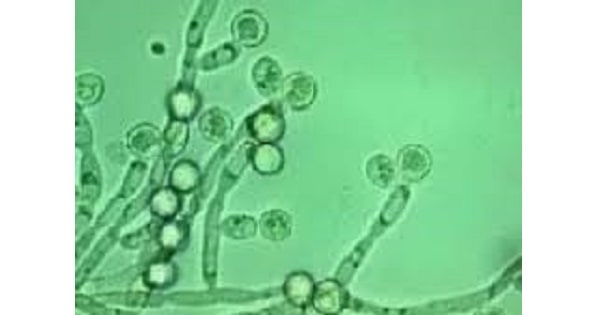
Candida
True about Candida albicans is –
| A |
Candida is pathogenic to mice |
|
| B |
It’s growth is inhibited by Griseofulvin |
|
| C |
Candida shows mycelia and chlamydospores on corn meal agar |
|
| D |
All |
True about Candida albicans is –
| A |
Candida is pathogenic to mice |
|
| B |
It’s growth is inhibited by Griseofulvin |
|
| C |
Candida shows mycelia and chlamydospores on corn meal agar |
|
| D |
All |
Ans. is ‘c’ i.e., Candida shows mycelia and chlamy dospores on corn meal agar
Candida
. Candida albicans is the most common cause of mucosal candidiasis.
. All candida species pathogenic for humans are also encountered as commensals of humans, particularly in the mouth, stool and vagina.
. They grow rapidly on simple media as oval budding cells at 25° to 37°C.
. In tissue, both yeasts and pseudohyphae are present.
. Candida albicans is differentiated by other candida :
– It forms true hyphae (mycelia) or germ tubes when grown in serum.
– It forms thick walled large spores called chlamydospores when grown in corn meal agar.
– It is dimorphic.
Remember -4 Candida albicans can produce yeast, true hyphae and pseudohyphae.
The following is not true of candida albicans ‑
| A |
Yeast like fungus |
|
| B |
Forms chlamydospores |
|
| C |
Blastomeres seen in isolates |
|
| D |
Causes meningitis in immunocompromised |
The following is not true of candida albicans ‑
| A |
Yeast like fungus |
|
| B |
Forms chlamydospores |
|
| C |
Blastomeres seen in isolates |
|
| D |
Causes meningitis in immunocompromised |
Ans. is ‘c’ i.e., Blastomeres seen in isolates
- Candida is a yeast like fungus.
- Forms thick walled chlamydospores when grown on cornmeal agar.
- Systemic infections such as septicemia, endocarditis and meningitis may occur as terminal complications in persons on prolonged immunosuppression.
Candidiasis is associated with all except-
| A |
OCP user |
|
| B |
IUCD user |
|
| C |
Diabetes |
|
| D |
Pregnancy |
Candidiasis is associated with all except-
| A |
OCP user |
|
| B |
IUCD user |
|
| C |
Diabetes |
|
| D |
Pregnancy |
Ans. is ‘b’ i.e., IUCD user
Normal commensal of skin are
| A |
Staphylococcus aureus |
|
| B |
Candida |
|
| C |
Propioni bacterium acnes |
|
| D |
b and c both |
Normal commensal of skin are
| A |
Staphylococcus aureus |
|
| B |
Candida |
|
| C |
Propioni bacterium acnes |
|
| D |
b and c both |
B, C i.e. Candida; Propioni bacterium acnes
Resident flora (normal commensal) of skin consists of permanently present mixture of several non pathogenic microorganisms. It includes :
Coagulase negative Staphylococcus epidermidis (not coagulase positive staphylococcus aureus)Q and peptococcus.
Diptheroid bacilli which may be aerobic (eg Corynebacterium minutissimum) or anerobic (eg propionibacterium acnes)Q.
Brevibacterium, a hemolytic streptococcus (S.viridians), enterococci (S. fecalis), gram –ye Coliform bacilli & acme tobacter’ (Harellea) and acid fast non pathogenic mycobacterium (in areas rich in sebaceous secretion eg external ear & genitalia).
Fungus such as candida and yeast eg Malassezia.
Which is a yeast like fungi:
September 2007
| A |
Cryptococcus |
|
| B |
Candida |
|
| C |
Blastomyces |
|
| D |
Histoplasma |
Which is a yeast like fungi:
September 2007
| A |
Cryptococcus |
|
| B |
Candida |
|
| C |
Blastomyces |
|
| D |
Histoplasma |
Ans. B: Candida
Yeast like fungi grow partly as yeast and partly as elongated cells resembling hyphae.The latter form a pseudomycelium. Candida albicans is a pathogenic yeast-like fungus.
All are true about candida except ‑
| A |
Pseudohyphae seen |
|
| B |
Produce chlamydospore |
|
| C |
It is a mould |
|
| D |
It is a dimorphic fungus |
All are true about candida except ‑
| A |
Pseudohyphae seen |
|
| B |
Produce chlamydospore |
|
| C |
It is a mould |
|
| D |
It is a dimorphic fungus |
Ans. is ‘c’ i.e., It is a mould
Candida
- Candida is a yeast like fungus (not mould).
- Candida albicans is the most common cause of mucosal candidiasis.
- All candida species pathogenic for humans are also encountered as commensals of humans, particularly in the mouth, stool and vagina.
- They grow rapidly on simple media as oval budding cells at 25° to 37°C.
- In tissue, both yeasts and pseudohyphae are present.
- Candida albicans is differentiated by other candida :
- It forms true hyphae (mycelia) or germ tubes when grown in serum.
- It forms thick walled large spores called chlamydospores when grown in corn meal agar.
- It is dimorphic.
Remember → Candida albicans can produce yeast, true hyphae and pseudohyphae.
- A rapid method of identifying C. albicans is based on its ability to form germ tubes within two hours when incubated in human serum at 37°C Reynolds – Braude phenomenon ( Also known as germ tube test)
The image is shown of a dimorphic fungus, inhabiting 80% of intestinal tract, colon, and mouth and which is the most common cause of fungal infections worldwide.One of its species shows positive Germ Tube test.Identify this fungus .
| A |
Coccidiomycosis. |
|
| B |
Penicillium. |
|
| C |
Candida. |
|
| D |
Aspergillus. |
The image is shown of a dimorphic fungus, inhabiting 80% of intestinal tract, colon, and mouth and which is the most common cause of fungal infections worldwide.One of its species shows positive Germ Tube test.Identify this fungus .
| A |
Coccidiomycosis. |
|
| B |
Penicillium. |
|
| C |
Candida. |
|
| D |
Aspergillus. |
Ans:C.)Candida
The fungus shown in the photograph above represents candida.
Candida
- It is a genus of yeasts and is the most common cause of fungal infections worldwide.
- Candida albicans is the most commonly isolated species.
- C. albicans is a diploid fungus populating the human body worldwide, inhabiting 80% of everyone’s intestinal tract, colon, and mouth with no problems.
- It is normally commensal of humans but can be pathogenic if a person’s immunity is lowered or there is a change in natural flora or physiology.
- Morphology:
- It is dimorphic.
- C. albicans can take on either a unicellular (yeast) or multicellular (hyphae, pseudohyphae) form.
- In Gram stained smears, Candida appears as gram positive budding yeast cells (blastoconidia) and/or pseudohyphae showing regular points of constriction.Spores form on the pseudohyphae called chlamydospores
- Culture:
- Candida appears as large, round, white or cream colonies, which emit a yeasty odor on agar plates at room temperature.
- Germ tube positive:A rapid method of identifying C. albicans is based on its ability to form germ tubes within two hours when incubated in human serum at 37°C Reynolds – Braude phenomenon ( Also known as germ tube test)
Most common oral infection in diabetes mellitus
| A |
Candida |
|
| B |
Aspergillus |
|
| C |
Streptococcus |
|
| D |
Stphylococcus |
Most common oral infection in diabetes mellitus
| A |
Candida |
|
| B |
Aspergillus |
|
| C |
Streptococcus |
|
| D |
Stphylococcus |
Ans. is ‘a’ i.e., Candida
- Individuals with DM have a greater frequency and severity of infection. The reasons for this include incompletely defined abnormalities in cell-mediated immunity and phagocyte function associated with hyperglycemia, as well as diminished vascularization. Hyperglycemia aids the colonization and growth of a variety of organisms (candida and other fungal species).

