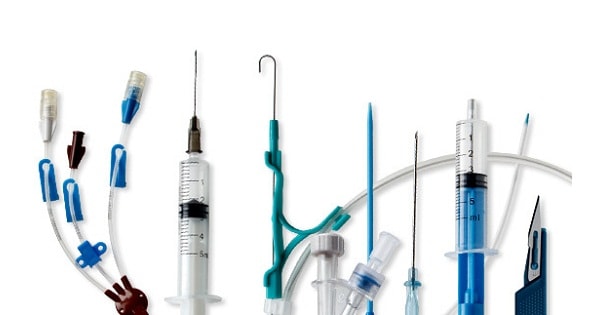
Central Venous Catheterization
A 33-year-old woman who underwent multiple enterotomies for penetrating abdominal trauma has a subclavian central line placed and subsequently develops “air hunger”.
Assertion: This patient has most likely developed pneumothorax.
Reason: Following central venous catheterization, pneumothorax can occur even as late as 48hours.
| A |
Both Assertion and Reason are true, and Reason is the correct explanation for Assertion |
|
| B |
Both Assertion and Reason are true, and Reason is not the correct explanation for Assertion |
|
| C |
Assertion is true, but Reason is false |
|
| D |
Assertion is false, but Reason is true |
A 33-year-old woman who underwent multiple enterotomies for penetrating abdominal trauma has a subclavian central line placed and subsequently develops “air hunger”.
Assertion: This patient has most likely developed pneumothorax.
Reason: Following central venous catheterization, pneumothorax can occur even as late as 48hours.
| A |
Both Assertion and Reason are true, and Reason is the correct explanation for Assertion |
|
| B |
Both Assertion and Reason are true, and Reason is not the correct explanation for Assertion |
|
| C |
Assertion is true, but Reason is false |
|
| D |
Assertion is false, but Reason is true |
Pneumothorax is a fairly common complication of placement of central venous catheter.
Occurrence rate of pneumothorax following subclavian or internal jugular vein catheterisation is 1-6%.
Following central vein catheterization pneumothorax can occur as late as 48 – 72 hours.
Ref: Schwartz’s Principles of Surgery, 9e, Chapter 12
While inserting a central venous catheter, a patient develops respiratory distress. Which of the following is the most likely cause?
| A |
Hemothorax |
|
| B |
Hypovolemia |
|
| C |
Pneumothorax |
|
| D |
Pleural effusion |
While inserting a central venous catheter, a patient develops respiratory distress. Which of the following is the most likely cause?
| A |
Hemothorax |
|
| B |
Hypovolemia |
|
| C |
Pneumothorax |
|
| D |
Pleural effusion |
Since this patient in the question has developed respiratory distress while inserting a central venous catheter, the most likely cause is pneumothorax. Pneumothorax is the most frequently reported acute complication of subclavian vein catheterization.
Complications of subclavian vein catheterization can be acute or chronic.
Acute complications occur within 30 days of procedure, it includes: failure of placement of catheter, pneumothorax, hemothorax, hemopneumothorax, hemorrhage, misplacement of catheters, arterial injury, air embolism, injury to veins, cardiac chambers and neural structures.
Ref: Venous Catheters: A Practical Manual By Philip C. Pieters, Page 250 ; Critical Care Study Guide: Text and Review By Gerard J. Criner, Pages 55-6
Most common complication of central venous catheter
| A |
Local bleeding |
|
| B |
Thrombosis |
|
| C |
Catheter related infection |
|
| D |
Pneumotherax |
Most common complication of central venous catheter
| A |
Local bleeding |
|
| B |
Thrombosis |
|
| C |
Catheter related infection |
|
| D |
Pneumotherax |
C i.e. Catheter related infection
A pt. developed resp. distress and hypoxemia after central venous catheterization through int. jugular vein, reason for this is –
| A |
Pneumothorax |
|
| B |
Hypovolemia |
|
| C |
Septicemia |
|
| D |
Cardiac tamponade |
A pt. developed resp. distress and hypoxemia after central venous catheterization through int. jugular vein, reason for this is –
| A |
Pneumothorax |
|
| B |
Hypovolemia |
|
| C |
Septicemia |
|
| D |
Cardiac tamponade |
Ans is ‘a’ ie. Pneumothorax
Sabiston writes ‑
“Central venous cannulation is indicated for monitoring of central venous pressure, chronic intravenous therapy such as hyperalimentation, insertion of transvenous electrodes, and obtaining venous access in pts. with difficult peripheral venous access. The internal jugular and subclavian veins are most commonly cannulated. Potential complications include haematoma, neurological injury, pneumothorax or haemothorax, arrythmias, cardiac rupture and thrombosis.”
MC late complication of central venous line:
March 2013 (f)
| A |
Air embolism |
|
| B |
Thromboembolism |
|
| C |
Cardiac arrhythmias |
|
| D |
Sepsis |
MC late complication of central venous line:
March 2013 (f)
| A |
Air embolism |
|
| B |
Thromboembolism |
|
| C |
Cardiac arrhythmias |
|
| D |
Sepsis |
Ans. D i.e. Sepsis
Central venous lines (CVLs)
- They are routinely used for monitoring and the administration of total parenteral nutrition (TPN) and medications in almost all critical / intensive care units (CCUs).
- Central venous access is normally obtained by cannulation of the internal jugular, the subclavian, or the femoral veins.
- Central venous access may also be obtained from more distal sites, typically the basilic and brachial veins, using a peripherally inserted central catheter (PICC).
- However, intravascular catheters are often associated with serious complications, such as catheter-related bloodstream infection.